



Traveling through Turkey’s Black Sea region means accepting that nature sets the schedule. Here, it’s often the fog and rain—not you—that decide the day’s plans. A sunny mountain plateau can disappear into the clouds by afternoon, while a valley hidden by mist one day may reveal its full beauty the next morning.
In this guide, I’ll take you through the 9-day road trip we completed with our children, Şifa and Vefa. From the dramatic coastline of Ordu and the peaceful highlands of Giresun to the valleys and mountain plateaus of Rize, the breathtaking scenery of Artvin, and the historic landmarks of Trabzon, I’ll share every stop exactly as we experienced it.
If you’re planning to explore the Black Sea region by car, this itinerary will help you map out your journey and decide which places deserve more of your time along the way.
📖 9-Day Itinerary Overview
- Day 1: Ordu (Yason Cape & Yoroz Summit)
- Day 2: Giresun (Kümbet Plateau & Blue Lake)
- Day 3: Rize (Zilkale, Boxwood Forests & Elevit Plateau)
- Day 4: Artvin (Borçka Karagöl & Çağlayan Village)
- Day 5: Rize (Pokut & Sal Plateaus)
- Day 6: Trabzon (Sümela Monastery & Hamsiköy)
- Day 7: Trabzon (Uzungöl & Karester Plateau)
- Day 8: Rize (Bulut Waterfall & The Reality of Ayder)
- Day 9: Trabzon (Atatürk Mansion & Journey Home)
- 🎁 Bonus: Practical Tips for Your Black Sea Road Trip
Day 1 — Ordu
After spending the night in Ünye, we set off early the next morning. Although Ordu city center is only about an hour away, we decided to take the longer coastal route through Fatsa and the district of Perşembe. We had two reasons for the detour: to visit Yason Cape and to enjoy one of the most scenic stretches of the Black Sea coastline.
🌊 Yason Cape
Located on a small peninsula between Fatsa and Perşembe, Yason Cape is one of the most beautiful viewpoints along Turkey’s Black Sea coast. You’ll need to leave your car near the entrance and take a short walk of just a few minutes to reach the historic lighthouse.
Once you arrive, you’re greeted by the endless horizon the Black Sea is famous for. Beyond the sea stretching toward the skyline and the open sky above, there’s almost nothing else in sight. If the weather is clear, take your time here—you’ll appreciate the peaceful atmosphere just as much as the view itself.

After leaving Yason Cape, we continued toward Ordu city center. We made a quick stop in Perşembe to pick up a few snacks from a local market before getting back on the road.
🚠 Boztepe
About 40 minutes after leaving Yason Cape, we reached the center of Ordu and parked the car. Our first stop was the Upside Down House, which we thought the kids would enjoy. It’s a fun place for a short visit, with every room designed completely upside down.
From there, we took the cable car up to Boztepe. The ride lasts around five to seven minutes, and as you climb higher, the city slowly unfolds beneath you. On one side, the deep blue waters of the Black Sea; on the other, rolling green hills stretching into the distance.

Boztepe is easily the best place to enjoy panoramic views over Ordu. At the top, you’ll find several viewing terraces, cafés, and souvenir shops. We stopped for a coffee, enjoyed the scenery for a while, and then continued our journey.
🌲 Yoroz Summit
After taking the cable car back down to the city center, you can also spend some time exploring Ordu’s historic bazaar if your schedule allows. We chose to continue toward Yoroz Summit, turning inland from the Turnasuyu area along the Ordu–Giresun highway.
We left the car at the trailhead and started hiking. This turned out to be one of our favorite walks of the entire Black Sea trip.
The first section follows a forest path before giving way to a long staircase that disappears beneath a dense canopy of trees. The hike takes about an hour, and for most of that time you barely catch a glimpse of the sky. Instead, you’re surrounded by lush green forest in every direction. Our children completed the hike without any difficulty, although younger kids may find the descent tiring. A stroller isn’t an option here.
When you finally reach the summit, the reward is spectacular. We were lucky enough to visit on a perfectly clear day, with uninterrupted views of the Black Sea, green mountain ridges, and villages scattered across the landscape. Locals told us the summit is often covered in clouds, so if you have the flexibility, it’s worth checking the forecast and choosing a clear day.
No photograph really captures what it’s like to stand here. The quiet, the sound of the wind, and the feeling of being completely surrounded by nature are something you have to experience in person. From the summit, you can even spot Ordu in the distance.
After hiking back down from Yoroz Summit, we drove for about an hour to Giresun. Following a short break along the waterfront, we continued toward Kümbet Plateau, where we would spend the night.
🌿 Kümbet Plateau
From Giresun city center, it’s about a 90-minute drive to Kümbet Plateau via the town of Dereli. The entire route is paved and easy to drive, following a scenic valley through the mountains. If you have the time, Dereli also makes a pleasant stop along the way.
We arrived at the plateau before sunset, giving us enough time to leave the car and take a short walk around the village center. Kümbet is peaceful and relatively small, making it an ideal place to slow down after a day on the road. We spent the night at a friend’s mountain house, although there are also several hotels and guesthouses available.
Even though we visited in August, the temperature dropped surprisingly low after dark. We ended up sleeping under thick blankets. If you’re looking to escape the summer heat, Kümbet is an excellent choice. You’ll also find small grocery stores, bakeries, and other essentials, so there’s no need to stock up before leaving Giresun.
If the sky is clear, don’t forget to look up before going to bed. With almost no light pollution, the stars here are far more impressive than anything you’ll see in the city.
Day 2 — Giresun

We woke early to the peaceful silence of the plateau and followed the road through Kümbet toward the wide open area at the top of the mountain. If you’re using Google Maps, simply search for Aymaç Nature Park. Since we arrived so early, we had the entire place almost to ourselves—it felt as though nature had opened its doors just for us.
We set up our portable grill and enjoyed breakfast with an incredible panoramic view stretching across the surrounding mountains.
All around us were endless shades of green, herds of cows grazing in the distance, and complete silence. It genuinely felt like we had stepped into a postcard. Every morning, local farmers bring their cattle to graze on the hillsides surrounding this area, where they roam freely throughout the day. Rather than disturbing the peaceful atmosphere, this daily rhythm feels like a natural part of the landscape.


The area is also popular with campers and makes an excellent place to spend a night under the stars. Whether you bring your own tent or stay in a local guesthouse, there’s plenty of space to enjoy the outdoors.
💦 Kuzalan Waterfall
Around midday, we left Kümbet Plateau and drove for about an hour to Kuzalan Nature Park. The park is home to a wide waterfall that cascades down the mountainside in dozens of thin streams, spreading across nearly 100 meters. After parking for free, it’s only a short walk to the viewing area.

One thing to keep in mind: the area has a surprisingly large number of hornets. I found that out the painful way after being stung. If you’re visiting with very young children or anyone sensitive to insect bites, it’s worth being a little cautious.
To be honest, if you’re short on time, this is one stop I’d consider skipping. Later in the trip, especially around Artvin and the higher plateaus, you’ll come across waterfalls that are even more impressive.
💎 Blue Lake (Mavi Göl)
Just a few kilometers beyond Kuzalan Waterfall, you’ll reach Blue Lake. The lake gets its name from its striking turquoise water, and at first glance it certainly lives up to the photos.
The downside is the crowds.
When we visited, it was so busy that even taking a photo meant waiting for your turn. It’s undoubtedly beautiful, but whether it’s worth dealing with the crowds is something only you can decide. If you’re hoping for a quiet, immersive nature experience, you’ll probably enjoy some of the less-visited places on this itinerary even more.

After leaving Blue Lake, we turned east toward Rize. The drive takes around four hours along the Black Sea coastal highway, with green mountains on one side and the sea on the other. We arrived in Rize late in the evening.
For the next seven days, Rize became our base. Every morning we took day trips to Artvin, Trabzon, the surrounding valleys, and the mountain plateaus before returning each evening. The biggest reason we chose this approach was flexibility. Every day’s route depended entirely on the weather forecast. If rain was expected in Trabzon, we headed to Artvin instead. If Artvin looked cloudy, we simply reversed the plan. By staying flexible, we managed to enjoy almost every destination under the best possible conditions—a strategy I’d highly recommend for anyone planning a road trip through the Eastern Black Sea region.
Day 3 — Rize Highlands
On our first full day in Rize, the weather forecast looked perfect: clear skies over the highlands. That made the day’s decision easy because there’s one golden rule in the Eastern Black Sea region—never waste a sunny day.
One thing is worth mentioning right away. Exploring Rize’s mountain plateaus with your own car isn’t the best idea. The roads are steep, narrow, and often rough, with loose gravel and rocky sections. Even the locals will tell you not to put unnecessary strain on your vehicle.
Fortunately, there’s an easy alternative: daily shared minibus tours. That’s the option we chose, and it turned out to be both affordable and stress-free. We met our minibus at Fırtına Valley. From Rize city center, it takes about an hour to reach the meeting point near the town of Pazar, and we set off around 9:30 in the morning.
When we visited, there were no direct tours departing from Rize itself—you first had to make your own way to Fırtına Valley. Today, however, you can find tours that depart directly from Rize city center and return there at the end of the day.
🏰 Zilkale
After leaving Fırtına Valley, we followed a narrow mountain road through Çamlıhemşin for about half an hour before reaching our first stop: Zilkale.
Built in the 15th century and remarkably well preserved, the fortress stands dramatically on a steep rocky cliff overlooking Fırtına Valley, almost as if it has been guarding the valley for centuries.

You can buy a ticket and explore the inside of the castle. Walking along its ancient stone walls, you’ll not only discover traces of its long history but also enjoy breathtaking views of the valley from almost every window. If you’re visiting the Rize highlands, this is one stop you definitely shouldn’t miss.
🌊 Palovit Waterfall
A short drive beyond Zilkale brought us to Palovit Waterfall, the second stop of the day.
It’s widely considered one of Turkey’s most powerful waterfalls. If there were an official ranking based on water volume, I’d be surprised if it wasn’t among the country’s top three.
The water crashes down the cliffs with incredible force. You don’t just see it—you hear it and feel its cool mist long before you reach the bottom. Getting close requires a bit of effort, but the view is absolutely worth it.
We spent a while simply standing there, listening to the roar of the water and taking in the deep green surroundings. Moments like this remind you why the Black Sea region feels so different from anywhere else.

🌳 Boxwood Forests
From Palovit, the minibus continued to the Boxwood Forests, home to what is considered Turkey’s last remaining natural boxwood forest.
Sadly, these rare trees have had a difficult history. Many were cut down over the years, and those that remain are now threatened by disease. Even so, walking through the forest feels unlike anywhere else. Twisted branches, weathered trunks, and unusual tree shapes create an almost surreal atmosphere. In the past, local people carved these dense hardwood trees into spoons, bowls, walking sticks, and everyday household items.

The whole place reminded us of the enchanted forests from The Lord of the Rings. Sunlight filtering through the leaves, the gnarled trunks, and the silence between the trees make every step feel as though you’ve wandered into a fantasy world.
🏔️ Elevit Plateau
Leaving the forest behind, the minibus began climbing higher into the mountains. We stopped several times along the way to admire the scenery, but no photograph could fully capture the endless green valleys below us.
After roughly an hour and a half of climbing, we reached Elevit Plateau, sitting at an elevation of around 1,850 meters (6,070 feet).

Compared to some of the other plateaus in the region, the roads here are relatively well maintained.
A crystal-clear stream flows through the middle of the village, and together with the sound of the wind, it completely erases the noise of everyday life. The scenery reminded us of the Swiss Alps. Surrounded by towering mountains, quiet wooden houses, and wide open landscapes, Elevit quickly became one of our favorite places on the trip.
Before leaving, we looked at each other and said the same thing:
“We’ll definitely come back one day.”
🌉 Sevdaluk Village
On the way back from Elevit, we made several stops along Fırtına Valley, but our favorite was Sevdaluk Village.
True to its name, the village has a charm that’s difficult to describe. Traditional stone houses, tea gardens, a historic stone bridge crossing the stream, and quiet country roads all come together to create a place that feels untouched by time.

Unlike many of the region’s better-known attractions, Sevdaluk doesn’t feel overly touristy. Instead, it offers an authentic glimpse into everyday life in the Black Sea countryside, where life seems to move at its own unhurried pace.
After visiting Sevdaluk Village, our busy but unforgettable day came to an end. We returned to Fırtına Valley, got back into our own car, and drove back to Rize for the evening.
Day 4 — Artvin
Early that morning, we checked the weather forecast and saw clear skies over Artvin. That was all the motivation we needed to head east. Our destination for the day was Borçka Karagöl. From Rize, the drive takes around two and a half hours, passing through Hopa before climbing into the mountains. The final 30 minutes wind along narrow, twisting roads, but every bend rewards you with another beautiful view.
Overall, the drive isn’t particularly difficult.
If there’s one piece of advice I’d give, it’s this: arrive early. We reached the lake in the morning, and by the time we were leaving around midday, we saw busloads of visitors arriving. Experiencing the lake in the quiet of the morning made all the difference.
🍃 Borçka Karagöl
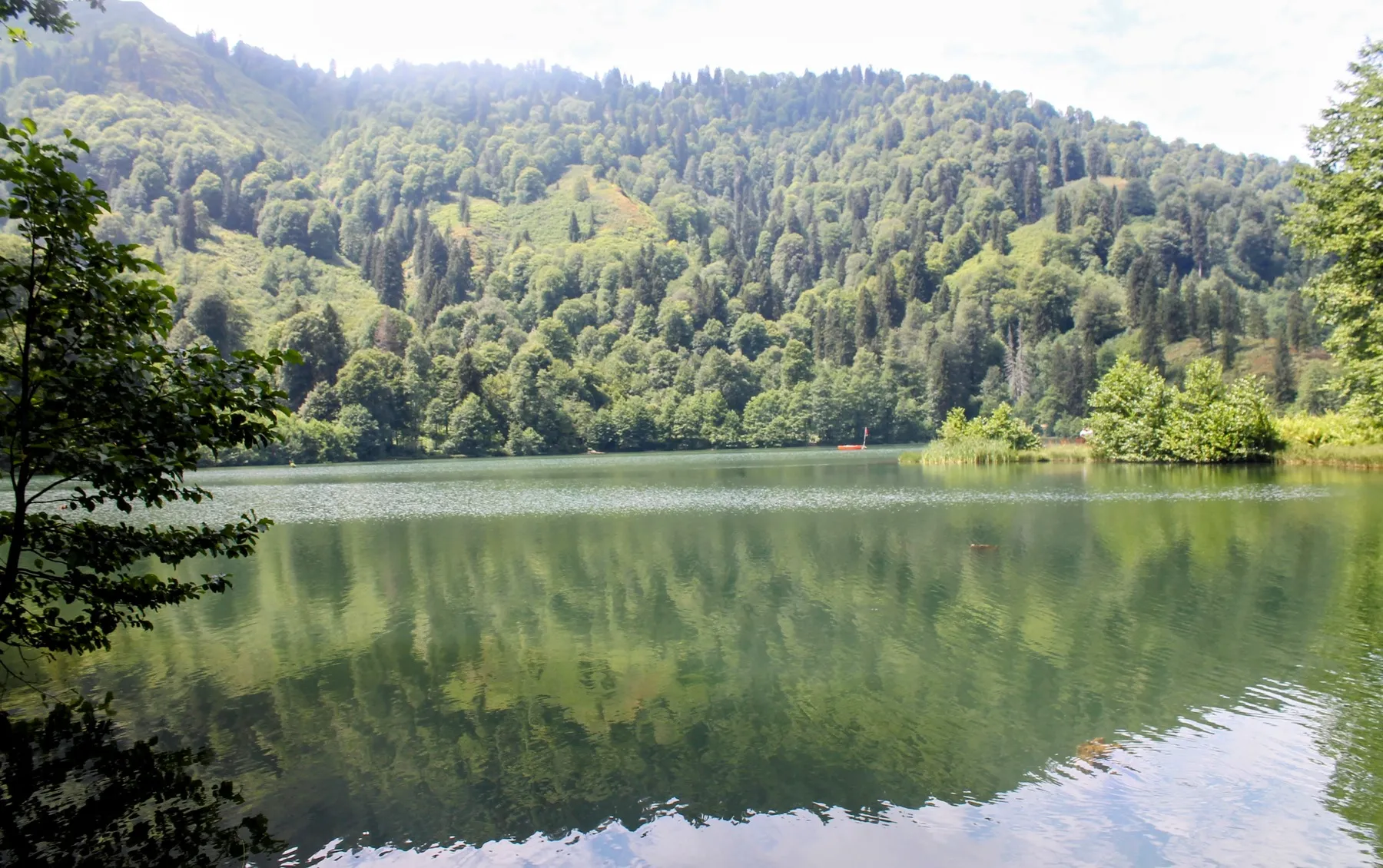
The moment we stepped into the national park, Borçka Karagöl appeared before us, and we couldn’t take our eyes off it.
The still water reflected the surrounding forest so perfectly that it almost looked unreal, as though someone had painted the landscape by hand.

Hidden among the mountains, the lake has an incredible sense of calm. The variety of green surrounding it was unlike anything we’d seen before. The reflections of the forest on the mirror-like surface created one of the most beautiful landscapes of our entire Black Sea trip.
A walking trail circles the entire lake, making it easy to explore from every angle. The path is well maintained and takes around one to one and a half hours at a relaxed pace.
On one side, the crystal-clear lake; on the other, dense forests rising up the mountainsides.
There’s no need to rush here. Just walk, stop whenever you feel like it, take in the scenery, and enjoy the silence. It was one of the most peaceful walks of our journey.
🏡 Çağlayan Village (Fındıklı)
On the drive back from Karagöl, we made a completely unplanned stop that turned out to be one of the biggest surprises of the trip.
Following a narrow road from the town of Fındıklı alongside Büyük Creek, we eventually reached the small village of Çağlayan.

Don’t just stop for lunch.
Take some time to wander through the village itself.

Within just a short walk, you’ll encounter almost everything that defines rural life in the Eastern Black Sea. Kiwi vines climb over the walls of traditional houses, tea-processing buildings are still in operation, a lively stream runs through the middle of the village, and a centuries-old stone bridge quietly connects both sides. Wooden Black Sea houses stand among endless tea plantations, while small tea gardens invite you to slow down and enjoy the surroundings.
More than just another sightseeing stop, this walk offered us a chance to experience the region’s living culture.
If you’re driving through this part of the Black Sea coast, make sure Çağlayan Village is part of your itinerary.
After this memorable detour, we continued our journey and returned to Rize in the early evening.
Day 5 — Rize Highlands
Today’s destination was another part of Rize’s highlands, but this time the adventure would be even greater: Pokut Plateau and Sal Plateau.
Reaching these mountain villages without a tour minibus or a proper 4WD vehicle is almost impossible. The roads are narrow, rough, and in many places feel more like mountain tracks than actual roads.
Once again, we met our minibus in Fırtına Valley.
The drive itself was an adventure.
The minibus bounced constantly over rocks and deep potholes, making it feel as though we were crossing rough seas rather than climbing a mountain. Yet every uncomfortable stretch was rewarded with breathtaking scenery—deep green valleys, dramatic cliffs, mist-covered peaks, and landscapes that looked like paintings.
After roughly an hour and a half of climbing, we finally arrived at Pokut Plateau.
☁️ Pokut Plateau
Perched at around 2,000 meters (6,560 feet) above sea level, Pokut is one of the highest plateaus in the region. Reaching it already feels like an achievement—but whether you get to enjoy the famous views depends a little on luck.
When we arrived, the plateau was wrapped in mist. The valleys, mountain ridges, and distant peaks were all hidden behind a soft white curtain. Fortunately, the fog wasn’t so dense that we couldn’t see anything at all. Checking the weather forecast before coming is always a good idea, but this is the Black Sea after all—sometimes even the mist becomes part of the experience.

There’s a small café-restaurant on the plateau where the sound of the traditional tulum (Black Sea bagpipe) drifts through the wooden building. Sitting there with a cup of tea while the clouds slowly move across the mountains creates an atmosphere that’s memorable even without perfect visibility.
Pokut isn’t just a place to admire from afar—it’s a place to simply slow down and enjoy.
🥣 Sal Plateau
A pleasant 15 to 20-minute walk from Pokut brought us to Sal Plateau. Although it’s slightly lower in elevation, it felt much warmer and more welcoming.


A small family-run restaurant sits at the heart of the plateau, serving simple local dishes. Two specialties stand out: beef sauté made from cattle raised on the plateau and homemade rice pudding.

The beef was delicious, rich, and full of flavor.
But the rice pudding…
I’m not exaggerating when I say it was the best I’ve ever tasted.
It had an incredibly smooth, creamy texture with a subtle smoky flavor and was served fresh from the pot. If you make it to Sal Plateau, don’t leave without trying it.
While we were eating, the mist slowly began to lift. For the first time that day, the valleys opened up beneath us.
Rolling green hills, deep valleys, and mountain ridges stretching toward the horizon—it almost felt as if nature had decided we’d earned the view.
We spent a little more time wandering around Sal Plateau before returning with our minibus to Fırtına Valley and driving back to Rize.
Day 6 — Trabzon
Early the next morning, we headed toward Trabzon. The drive from Rize takes about an hour and a half, with the Black Sea accompanying you on one side and lush green hills on the other. Our plan for the day was to explore Trabzon itself along with a few of its best-known attractions.
🏙️ Trabzon City Center
As soon as we arrived, our first stop was Ertuğrul Pide, one of the city’s most famous and highly recommended pide restaurants.
We ordered several varieties—cheese, minced meat, and egg—and every one of them was delicious.
That said, I have to admit something as someone from Konya.
The crust was much thicker than what I’m used to.

Back home, pide usually has a thin, crispy edge, whereas Trabzon’s version feels much more bread-like. Of course, that’s simply the local style, and for many people, that’s exactly how it should be.

After lunch, we spent some time wandering through Trabzon’s compact city center.
It’s not particularly large, so you can easily leave your car in one of the underground parking garages and explore the main streets on foot without needing much time.
⛪ Sümela Monastery
About half an hour later, we reached the parking area below Sümela Monastery.
From there, shuttle minibuses take visitors to the entrance. Walking the entire way is possible, but it’s both time-consuming and quite demanding. As the shuttle climbed the winding mountain road, the monastery slowly came into view, clinging dramatically to the cliffside.
The monastery itself is remarkable.
But what truly makes it unforgettable is its setting.
Built into a sheer rock face high above a lush green valley, it’s difficult to imagine how such a structure could have been constructed—even with today’s technology. Dating back to the 4th century, Sümela is not only a place of faith but also an extraordinary feat of engineering and determination.

Inside, you’ll find beautiful Christian frescoes decorating the walls. Sadly, many have been damaged over the centuries. Faces have been scratched away, scenes defaced, and countless details lost to time. Even so, it’s impossible not to imagine how magnificent they must once have been.
From the monastery’s terrace overlooking the valley, you’re rewarded with sweeping views of dense forests, drifting clouds, and complete silence. Standing there feels like stepping into another century altogether.
🥛 Hamsiköy
After leaving Sümela Monastery, we continued through Maçka and reached Hamsiköy about an hour later. The road is winding, but with every turn the scenery becomes even greener.

Hamsiköy is famous throughout Turkey for its rice pudding, so naturally we had to try it. It was fresh, creamy, and undeniably good.
But to be completely honest, the unforgettable rice pudding we had at Sal Plateau was still fresh in our minds. As good as Hamsiköy’s version was, it simply couldn’t compete with that one.
The scenery, however, is a different story.
Hamsiköy is absolutely stunning.
Cows graze freely across the hillsides, colorful wooden houses dot the green slopes, and rolling mountains stretch toward the horizon. On a sunny day, it’s easy to understand why so many people compare this landscape to the Swiss Alps.
Come for the rice pudding if you like—but stay for the views.
🇹🇷 The Grave of Eren Bülbül
On our way back toward Maçka, we noticed a roadside sign pointing to the grave of Eren Bülbül. We immediately turned around and followed the narrow mountain road for another 10 to 15 minutes until we reached a small hilltop cemetery.

When we arrived, Eren’s mother was sitting quietly beside his grave.
She greeted us with a warm smile, and we spent some time talking with her.
She told us about the years they had spent living there—high in the mountains, in a tiny house without electricity, carrying water by hand, and enduring harsh winters filled with snow and fog. Listening to stories about Eren and his siblings growing up in such difficult conditions was deeply moving.
She also told us that the government later built the family a proper home, and thankfully they now live in much better conditions. Even so, standing there, you can still sense the hardship and isolation that once shaped daily life on that mountain.
I’d also like to remember Petty Officer Ferhat Gedik, who was killed while trying to protect Eren. Their sacrifice reflects a quiet courage that deserves to be remembered.
May they both rest in peace.
🐟 Cazılar Deresi Restaurant
After leaving Eren Bülbül’s memorial, we returned to Trabzon and made one more short stop at the Little Hagia Sophia Mosque, which looked beautifully restored and very well maintained.
From there, we drove about half an hour toward the district of Yomra for dinner at Cazılar Deresi Restaurant.

Although it’s built around a trout farm, it’s much more than just a seafood restaurant.
Fresh trout is served in a traditional steamed style, and the food is excellent. What really makes the place memorable, though, is the setting. The restaurant is built above a flowing stream inside a large wooden structure that resembles an old Black Sea mansion.
Inside, the atmosphere is unexpectedly playful, with Halloween-inspired decorations, mysterious lighting, and plenty of little details for children to explore. There are even small ponds where you can catch the trout that will later be cooked for your meal.
If you’re traveling as a family, it’s a wonderful place to spend an evening.
One small warning, though.
The road between Cazılar Deresi and Yomra becomes very dark after sunset. With frequent bends and limited road signs, it’s worth driving carefully once night falls.
After dinner, we headed back to Rize and called it a day.
Day 7 — Trabzon
Today, we headed for one of the Black Sea region’s most iconic—and perhaps most debated—destinations: Uzungöl.
From our base in Rize, the drive takes about an hour. It’s an easy and comfortable route with wide roads, smooth asphalt, and clear signage, making it one of the simplest drives of the entire trip. We were lucky with the weather too. Clear skies, sunshine, and the refreshing mountain air made for a perfect morning.
🌅 Uzungöl
The moment you arrive, it’s impossible not to notice what people often talk about: the heavy development and the crowds.
Even so, despite all the hotels, cafés, and visitors, Uzungöl somehow manages to hold on to its natural beauty.
You can enjoy a pleasant walk around the lake or climb up to one of the viewpoints on the hillside for a panoramic view of the valley.

That said, I have to make an honest comparison.
If you’ve already visited Borçka Karagöl, Uzungöl may feel a little too developed. Throughout this journey, we noticed a simple pattern: the easier a place is to reach, the more its landscape has changed.
Places like Pokut, Sal, and Elevit, reached only by rough mountain roads, have preserved their original character far better.
Interestingly, while talking with local residents, we learned that some highland roads are intentionally left unpaved. The goal is to prevent mass tourism from changing both the landscape and the traditional way of life.
After seeing these places ourselves, we completely understand—and support—that decision.
🚙 Karester Plateau
Wanting to leave the crowds behind, we decided to climb to Karester Plateau, high above Uzungöl.
The road begins just beside the mosque near the lake. Simply follow the signs for Karester. The first few kilometers are paved, but after that the road quickly turns into a rough, rocky mountain track.
Although the distance is only about 10 kilometers, the poor road conditions meant it took us roughly 45 minutes to reach the top.

When we arrived, thick fog covered everything.
At first, we thought the climb had been pointless.
But the real surprise came on the way back down.
About halfway along the descent, the clouds began to clear, revealing several incredible viewpoints overlooking Uzungöl from high above.
If you’re planning to drive up to Karester, here’s our advice:
The best views aren’t actually at the summit—they’re on the way there.
We unfolded our camping chairs, poured ourselves tea from our thermos, and spent nearly an hour watching the clouds drift across the lake below.
Interestingly, many locals do exactly the same thing.
If the rough road feels too demanding, you don’t necessarily need to continue all the way to the top. The viewpoints halfway up are reason enough to make the trip.
One more interesting detail: the upper part of this road is also a popular takeoff point for tandem paragliding. Watching colorful paragliders silently glide across the valley added something special to an already unforgettable landscape.
After the descent, we returned to the lakeshore and parked the car once again.
This time, instead of staying near the busy main promenade, we walked toward the quieter far end of the lake.
If you have extra time in Uzungöl, don’t stop at the main viewing area.
Follow the trail beyond the crowds, where you’ll find several smaller ponds hidden among the trees. The atmosphere becomes much quieter, making it easier to appreciate the natural beauty that made Uzungöl famous in the first place.
After spending some peaceful time there, we drove back to Rize.
That evening, we took a relaxed walk through the city center before calling it a day.
Day 8 — Rize Highlands
Our original plan for our final full day in Rize was to visit Huser Plateau, famous for its spectacular sea of clouds.
But in the Black Sea region, nature usually has the final say.
Heavy rain throughout the night had turned the mountain roads into deep mud, and the tour operators warned us that the route would be too risky to attempt that day. Rather than take unnecessary chances, we changed our plans once again and headed back toward Fırtına Valley.
We figured, “We can’t leave the region without seeing Ayder at least once.”
💧 Bulut Waterfall (Tar Creek)
About fifteen minutes before reaching Ayder, we spotted a small roadside sign for Bulut Waterfall—and we’re so glad we followed it.
A wooden boardwalk leads through the forest for about 1.5 kilometers, making it an easy walk even with children.
The waterfall gets its name from the way the water drifts gently down the rocks in countless tiny streams, almost as if it were falling from the clouds themselves.
Before you even see it, you hear it.
And somehow, before you hear it, you feel it.
The cool air, the fine mist, and the quiet atmosphere create a sense of calm that’s difficult to describe. Sitting beside the waterfall with nothing but the sound of rushing water was one of the most peaceful moments of our trip.
There’s a free parking area at the entrance, and the surrounding forest is home to several endemic plant species, making it even more rewarding for nature lovers.
Even if Ayder is on your itinerary, we’d suggest making Bulut Waterfall your real destination.
🌿 Ayder Plateau
A few minutes later, we arrived at Ayder Plateau.
For years, Ayder has been one of the most famous destinations in the Black Sea region, and naturally we were excited to finally see it ourselves.
To be honest…
It turned out to be our biggest disappointment of the entire trip.
The magical atmosphere people often describe has largely been replaced by tourism infrastructure.
A wide road cuts through the middle of the plateau, lined with hotels, cafés, souvenir shops, and crowds of visitors. Music pours from loudspeakers while people queue for photos.
The peaceful silence we had fallen in love with throughout the Black Sea region was largely missing here.
If you’re looking for the untouched spirit of the mountains, we’d recommend spending your time instead in places like Pokut, Sal, Elevit, Huser, or Kümbet.
For us, that’s where the true character of the Black Sea still survives.
🚣 Ziplining & Rafting on the Fırtına River
Later that afternoon, we explored the adventure activities scattered along Fırtına River.
Between Çamlıhemşin and Ayder, you’ll find numerous companies offering ziplining across the river. If you’re looking for a bit of adrenaline while enjoying the scenery from above, it’s a fun experience.
One tip, though:
Always negotiate the price.
The first price you’re given is often much higher than what you’ll actually end up paying. With a little bargaining, you can usually get a substantial discount.

The same applies to rafting.
The rafting route along the Fırtına River is one of the longest and most exciting in the Black Sea region. All equipment is provided, although children under eight aren’t allowed to participate.
We negotiated there as well and ended up paying almost half the original asking price, making it one of the best-value activities of the entire trip.
After another full day of exploring, we returned to our base in Rize one last time.
As we packed for the next morning, we realized we were taking home far more than photographs—we were leaving with memories of misty mountains, rushing rivers, and the unique rhythm of life that makes the Black Sea region unlike anywhere else.
Day 9 — Trabzon & The Journey Home
We woke early on our final morning in Rize, loaded our luggage into the car, and began the drive home.
But leaving the Black Sea wasn’t as easy as simply getting on the highway.
Before saying goodbye, we decided to make a few final stops in Trabzon.
🏛️ Atatürk Mansion
Our first stop after arriving in Trabzon was Atatürk Mansion, one of the city’s most elegant historic buildings.
Originally gifted to Mustafa Kemal Atatürk by the people of Trabzon, the mansion has since been turned into a museum. Inside, you’ll find original furniture, books, and personal belongings that quietly tell the story of one of Turkey’s most important historical figures.

As beautiful as the house is, what impressed us most was its garden.
The hydrangeas were in full bloom, creating one of the most beautiful displays we’ve ever seen anywhere in Turkey. Every corner of the garden felt picture-perfect, and every bench seemed to invite you to slow down and simply enjoy the peaceful surroundings.
More than just a historic house, Atatürk Mansion captures the refined and tranquil character of Trabzon itself.
🍚 Kalkanoğlu Pilavcısı
Before beginning the long drive home, we made one final food stop at Kalkanoğlu Pilavcısı, one of Trabzon’s most famous local restaurants.
We ordered a classic Black Sea meal: rice, stewed white beans, and roasted beef.

The beans were perfectly cooked and gently seasoned, while the beef was tender and full of flavor.
But if I’m being completely honest, the real star of the meal was the rice.
Each grain was perfectly separate, lightly buttery, and cooked to perfection. It was one of those simple dishes that reminds you how extraordinary good ingredients and careful cooking can be.
If you visit Kalkanoğlu, don’t overlook the rice—it deserves just as much attention as everything served alongside it.
🌿 Leaving the Black Sea Behind
Over the course of nine days, we drove thousands of kilometers through the Black Sea region, exploring rugged coastlines, quiet valleys, mountain villages, and some of the most beautiful highlands we’ve ever visited.
Sometimes the fog forced us to change our plans.
Other times, the clouds parted at exactly the right moment, revealing landscapes we’ll never forget.
Every destination had something unique to offer, but when we look back, what stays with us most isn’t a single viewpoint or attraction.
It’s the feeling of the Black Sea itself.
The silence of the forests.
The endless shades of green.
The sound of rushing rivers.
The mornings spent above the clouds.
If you have any questions about this itinerary or are planning a similar trip, feel free to leave a comment.
I hope this 9-day route helps you plan your own Eastern Black Sea adventure—and that it inspires you to discover one of Turkey’s most remarkable regions for yourself.
Safe travels, and enjoy every mile of the journey. 🌿
🎁 Bonus: Practical Tips from Our Trip
After nine days on the road, we came home with more than just photos. We also picked up a few lessons that might make your own Black Sea road trip a little easier.
🍵 Spend an Evening at ÇAYKUR Tea Garden
Almost every evening in Rize followed the same routine—we walked to the ÇAYKUR Tea Garden.
It quickly became one of our favorite places in the city.
The atmosphere is calm, family-friendly, and refreshingly free from loud music or large tourist crowds. Instead, you simply sit back with a glass of freshly brewed tea while enjoying the cool evening air.

And the tea?
It’s exactly what you’d hope to drink in Rize.
Fresh, flavorful, and unmistakably local.
If you’re visiting the city, don’t be surprised if you find yourself coming back every evening, just as we did.
🚗 A Driving Tip for Mountain Roads
One lesson we learned the hard way:
If you stop on a steep mountain road, don’t switch your engine off immediately.
After long uphill climbs, the engine needs a little time to cool down. Leaving it running for a short while before shutting it off can help prevent overheating.
Trust us…
We ended up testing our insurance company’s roadside assistance because we didn’t know this.

🥨 About the Local Simit…
I hope no one from the Black Sea region takes this personally…
But the local simit just wasn’t for us.
Especially around Rize, many are shiny, extremely firm, and much harder than the simit we’re used to elsewhere in Turkey.
Of course, tastes differ—but if you’re expecting the softer, crispier style found in other parts of the country, you may be in for a surprise.

🧀 Get Ready for Muhlama
The Black Sea cuisine may not have an endless variety of dishes, but what it does well, it does exceptionally well.
And nothing represents the region better than muhlama (also known as kuymak).
Made with cornmeal, butter, and plenty of local cheese, it’s rich, comforting, and almost impossible to stop eating.

You’ll find it everywhere—mountain plateaus, village cafés, roadside restaurants, and family-run guesthouses.
At first you might think,
“Muhlama again?”
A week later, you’ll probably be wondering how soon you can eat it again.
📍 Route Map
I’ve marked our complete route—including every major stop and a few worthwhile detours—on the map below.
If you’d like to follow the same itinerary, you can simply open the map and retrace our journey, one stop at a time.

Yorumlar
Comments