

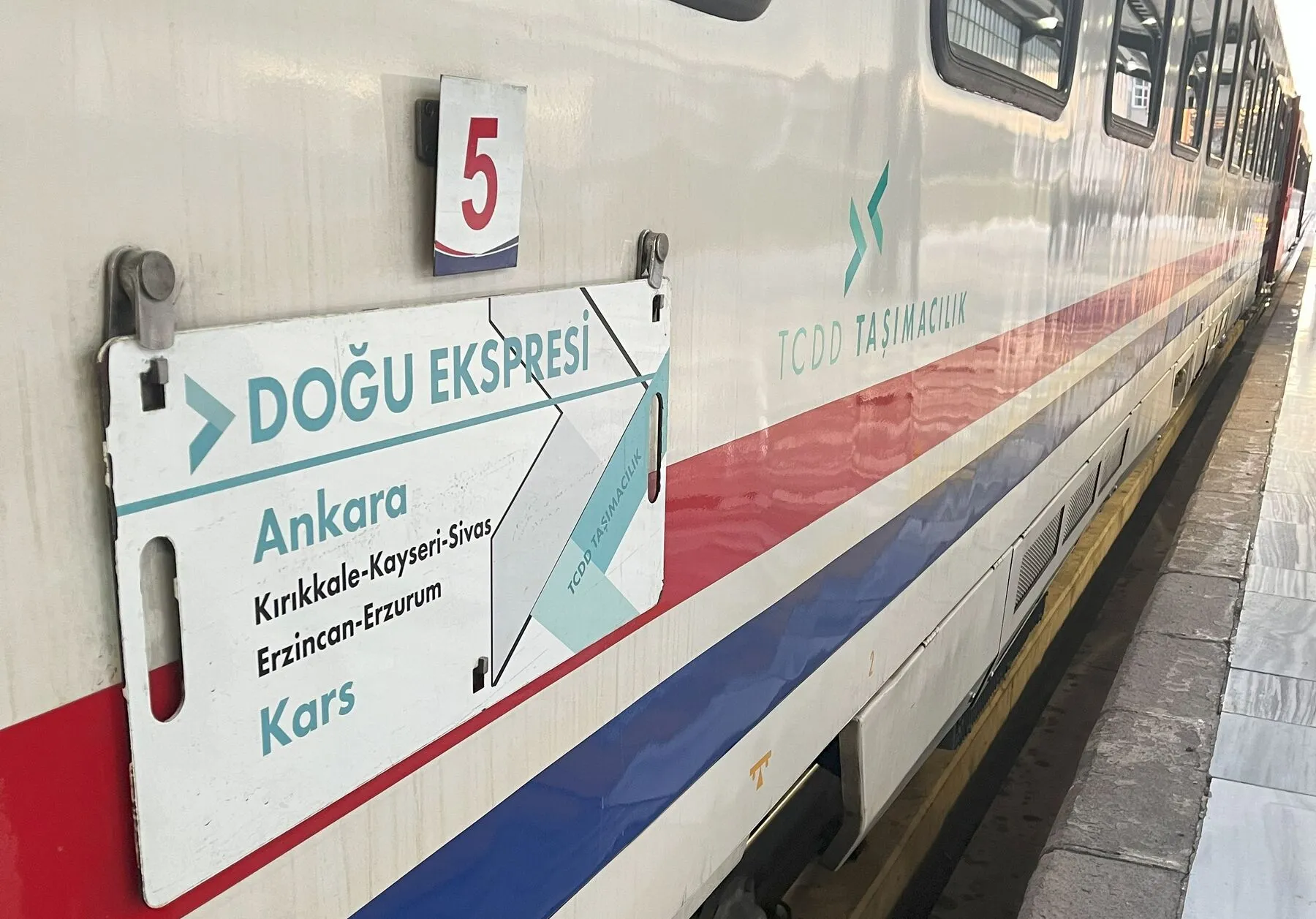


The Eastern Express is one of Turkey’s most famous train journeys. Running from Ankara, the country’s capital, to the eastern city of Kars near the borders of Armenia and Georgia, the route covers almost 1,400 kilometers (870 miles) across the heart of Anatolia.
What makes this journey special is not the destination itself, but the constantly changing landscapes outside the window. Snow-covered mountains, remote villages, frozen rivers, and vast open plains slowly unfold over the course of 27 hours.
What makes this journey special is not the destination itself, but the constantly changing landscapes outside the window. Snow-covered mountains, remote villages, frozen rivers, and vast open plains slowly unfold over the course of 27 hours.
We traveled with our two children, Şifa (9) and Vefa (6), and the experience reminded us of something simple: sometimes the best entertainment is not on a screen, but outside the window.
In this guide, we share everything we learned along the way—from the surprisingly competitive ticket-buying process to life inside a sleeper compartment and practical tips for making the most of the journey.
What’s Inside This Guide?
🎟️ Buying Tickets: The Hardest Part of the Journey
If you think the most challenging part of the Eastern Express is spending 27 hours on a train, think again. The real challenge is getting a ticket.
We traveled during Turkey’s mid-year school holiday, one of the busiest periods of the year. At peak times, sleeper cabins can sell out within seconds. That is not an exaggeration.
Fortunately, with some preparation and a bit of luck, securing tickets is possible. Here is the strategy that worked for us.
Know When Tickets Go on Sale
Tickets are usually released about 30 days before departure, although this can change. If you already know your travel dates, start checking the official TCDD website and mobile app at least a month in advance.
Figure Out the Release Time
One of the biggest challenges is that TCDD does not publicly announce the exact time new tickets become available.
We spent several nights checking the system around midnight until we noticed a pattern. During our trip, new tickets were typically released between 2:10 and 2:15 a.m. local time.
The timing may vary, so it is worth monitoring the system for a few days before your intended booking date.
Use Multiple Devices
When tickets are highly competitive, every second matters.
We recommend having at least two people trying at the same time, ideally using different internet connections. One person can use Wi-Fi while the other uses mobile data. In our experience, the TCDD mobile app was sometimes faster than the website, so keep both options open.
Prepare Everything in Advance
Before tickets are released, make sure you are already logged in and have all passenger details ready.
Decide in advance whether you want a standard seat, a couchette, or a sleeper compartment. When tickets disappear in seconds, there is no time to make decisions.
Do a Practice Run
A few days before booking, familiarize yourself with the booking process. Learn where the departure dates appear, how passenger information is entered, and how payment works.
It may sound excessive, but when competition is intense, preparation helps.
Book Your Return Trip Immediately
The moment you successfully secure your outbound ticket, start thinking about the return journey.
Many travelers focus so much on getting to Kars that they forget they will need a ticket back. Return tickets can be just as difficult to obtain, especially during winter.
For us, the trip did not feel real until both directions were booked.
🚂 From Ankara to Kars: 27 Hours Across Turkey
During winter, the Eastern Express usually departs from Ankara in the late afternoon, around 5:00 p.m., and arrives in Kars the following evening after roughly 27 hours on board.
Our outbound journey was almost perfectly on time. On the way back, however, we arrived about two hours late. Delays are not uncommon, especially during winter, so if you plan to catch a flight after arriving in Kars, it is wise to leave plenty of buffer time.
One important note: the train departs on schedule and does not wait for late passengers. We recommend arriving at Ankara Railway Station at least 30 minutes before departure.
The route crosses much of central and eastern Turkey, passing through cities such as Kırıkkale, Kayseri, Sivas, Erzincan, and Erzurum before finally reaching Kars. Along the way, the train stops at more than 40 stations, passes through dozens of tunnels, and travels across some of the country’s most remote landscapes.

As the train leaves Ankara behind, the urban landscape gradually gives way to the wide-open plains of Anatolia. Villages become smaller, mountains grow taller, and the pace of life outside the window seems to slow down.
Some of our most memorable moments came in eastern Turkey. Early in the morning near Erzincan, we watched fields slowly emerge through the fog as the sun began to rise. Closer to Erzurum, the snow-covered slopes of Mount Palandöken appeared in the distance, glowing in the winter light.
Another unforgettable moment came near Sarıkamış, a town known for one of the most tragic chapters of Ottoman military history. As the train passed through the snowy forests surrounding the area, the atmosphere inside the carriage seemed to become noticeably quieter.
There were also smaller moments that stayed with us: watching the locomotive curve into a tunnel far ahead of our carriage, spotting isolated farmhouses in the middle of nowhere, and seeing distant lights appear briefly in the darkness before disappearing again.
This is not a high-speed train journey. It is slow, sometimes surprisingly slow. But that is exactly the point. The Eastern Express gives you time to sit back, look out the window, and experience a side of Turkey that most visitors never see.
🎒 What to Pack for the Eastern Express
Do not rely on station stops for food or supplies.
Most stops along the route are very short, and while larger stations such as Sivas, Erzincan, and Erzurum offer a few more options, smaller stations may have little or nothing available. Bringing your own food and drinks will make the journey much more comfortable.
Here is what we packed for our trip.
Food & Drinks
- Plenty of water
- Nuts, chocolate, and biscuits
- Sandwiches and fresh fruit
- A thermos flask for tea or coffee
The train has a dining car, but having your own snacks and drinks is convenient, especially during the evening and early morning hours.
Comfort & Hygiene
- Hand soap and paper towels
- Comfortable slippers with non-slip soles
- Lip balm and moisturizer (the air inside the compartment can become quite dry in winter)
There is no need to bring bedding. TCDD provides clean sheets, a pillowcase, and a blanket for each passenger traveling in a sleeper compartment.
Entertainment
One of the nicest things about the Eastern Express is that you do not need much entertainment.
Still, we brought a few simple things:
- Books for both adults and children
- Small travel games
- Coloring books and pencils
- A travel journal
Our children, Şifa and Vefa, spent part of the journey writing down their thoughts and sketching the landscapes they saw outside the window. Looking back, those pages became some of our favorite souvenirs from the trip.
A Small Detail That Made a Big Difference
We packed a set of small LED string lights and decorated our compartment window.
It may sound unnecessary, but it completely changed the atmosphere in the evening. After dark, we switched off the main lights and sat quietly with only the soft glow of the LEDs. Outside, there was almost complete darkness, interrupted only by distant village lights and occasional stations.
Watching the snowy landscape disappear into the night while the train rolled eastward became one of our favorite memories of the journey.

What About a Kettle?
Officially, electric kettles are not allowed on board.
That said, we noticed that many passengers brought them anyway. We followed the rules and left ours at home. Fortunately, our neighbors in the next compartment were kind enough to share hot water when we needed it.
People often share tea, food, and stories with their neighbors. By the time we arrived in Kars, many passengers felt less like strangers than when the journey began.
🌡️ Giyim: İki Farklı Dünyaya Hazırlanın
The sleeper compartments are surprisingly warm in winter. In fact, they can sometimes feel too warm.
Kars, on the other hand, is one of the coldest cities in Turkey. Winter temperatures can drop well below freezing, and temperatures around -15°C (5°F) are not unusual.
Layering is the best strategy. We spent most of the journey in light indoor clothes, then added winter jackets, scarves, gloves, and hats when stepping off the train in Kars.
Packing for both environments will make the transition much easier.
🏠 🏠 Life in a Sleeper Compartment: Traveling with Children on the Eastern Express
When we first stepped into our sleeper compartment, it felt small.
Four people, limited space, and nearly 27 hours on a train sounded like a challenge on paper. But something interesting happened after the first few hours: the compartment started to feel less like a train cabin and more like a tiny home on wheels.
Our children, Şifa and Vefa, claimed the space almost immediately.
“This is our room!” they announced, as if they had just moved into a new house.
Even simple things became part of the adventure. Walking up and down the carriage, watching the scenery change outside the window, or waiting for the next station stop was enough to keep them entertained.

As evening arrived, they put on their pajamas and helped prepare their own beds. Before falling asleep, they sat by the window watching the darkness outside.
“Where will we be when we wake up tomorrow?” one of them whispered.
The next morning, Vefa woke up, looked outside, and realized the train was still moving through the snowy countryside.
“We slept all night, and we’re still going!”
The look of surprise on his face was priceless.

One of the things we appreciated most about this journey was how naturally it encouraged curiosity. Without planning it, we spent more time talking, observing, reading, and simply watching the world go by.
For our children, the landscape outside the window became the main attraction. They counted tunnels, watched villages appear and disappear, and tried to guess where the train would go next.
In a world filled with screens, notifications, and constant distractions, that felt surprisingly refreshing.
Would we recommend the Eastern Express to families with children?
Absolutely.
As long as your children are comfortable spending time on a train and do not need constant activity, the journey itself becomes part of the adventure. In many ways, the train is not just transportation to Kars—it is one of the highlights of the trip.
❄️ Is the Eastern Express Better in Winter or Summer?
This is one of the most common questions people ask when planning an Eastern Express trip.
The honest answer is that there is no single best season. It depends on what kind of experience you are looking for.
We chose to travel in winter, and if it were our first trip again, we would probably make the same choice.
Much of the Eastern Express’s international reputation comes from its winter scenery. Snow-covered mountains, frozen rivers, white forests, and endless fields blanketed in snow create a landscape that feels almost cinematic.
Some of our favorite views came in eastern Turkey, where the countryside around Erzincan, Erzurum, and Sarıkamış was covered in snow. Waking up to an entirely white landscape outside the window was one of the highlights of the journey.
That said, summer has its own appeal.
Travelers who visit during the warmer months are rewarded with green valleys, flowing rivers, colorful wildflowers, and longer daylight hours. You also get more time to enjoy the scenery before sunset.
If you are taking the Eastern Express for the first time, we would personally recommend winter. The snowy landscapes create a unique atmosphere that has made the route famous both within Turkey and internationally.
But regardless of the season, the real magic of the Eastern Express remains the same: sitting by the window and watching the landscapes of Anatolia slowly change hour by hour as the train makes its way across the country.
🚉 Station Stops and Food Options Along the Route
One of the first things to know about the Eastern Express is that station stops are usually shorter than many first-time travelers expect.
While the train makes dozens of stops along the route, most of them last only a few minutes—just enough time for passengers to stretch their legs, step onto the platform, or take a quick photo before boarding again.

At larger stations such as Sivas, Erzincan, and Erzurum, you may find small kiosks selling drinks, snacks, sandwiches, and other basic supplies. However, options can be limited, especially during busy travel periods or late in the evening.
Smaller stations often have little or no food available at all.
For that reason, we strongly recommend bringing your own food and drinks rather than relying on station stops.
🍖 Should You Try Cağ Kebab in Erzurum?
Before arriving in Erzurum, train staff usually collect orders for Cağ Kebab, one of the region’s most famous dishes.
Cağ Kebab is a traditional lamb kebab from eastern Turkey, often considered one of the country’s best meat dishes. The food is prepared in advance and delivered to passengers when the train stops in Erzurum.
We decided to skip it.
Not because we dislike Cağ Kebab—in fact, quite the opposite. We simply knew that Kars was only a few hours away, and we wanted to save our appetite for the local food waiting there.
Looking back, we are glad we did.
Kars is known for its rich culinary traditions, and some of our favorite meals of the entire trip were enjoyed after we arrived. From local cheeses and regional meat dishes to traditional bakeries and family-run restaurants, the city offers plenty of reasons to arrive hungry.
Our advice?
If you are curious, try the Cağ Kebab in Erzurum. But if you can wait a little longer, Kars has plenty of excellent food waiting for you as well.

❄️ Arrival in Kars
After 27 hours on the train, we finally arrived in Kars.
Stepping off the Eastern Express, the first thing we noticed was the cold. Not the kind of cold that makes you reach for a jacket, but the kind that immediately reminds you that you are in one of the coldest regions of Turkey.
Located in Turkey’s far northeast, Kars feels very different from many other Turkish cities. Its historic stone buildings, wide streets, and long winters give it a unique character.

Over the following days, we explored the city, tasted local specialties, and discovered why so many travelers consider Kars one of Turkey’s most underrated destinations.
What surprised us most was how different Kars felt from western Turkey. The architecture, food, climate, and even the pace of daily life gave the city a character of its own.
We’ll share more about our favorite places, accommodations, and food experiences in a separate guide dedicated to Kars.
Final Thoughts
Looking back, the Eastern Express was far more than a train ride from Ankara to Kars.
It was 27 hours of slowing down, watching the landscape change, sharing meals with strangers, and spending uninterrupted time together as a family.
On the return journey, the same mountains, villages, and snowy plains somehow felt different. The excitement of going somewhere new had been replaced by the quiet satisfaction of having experienced it.
By the end of the trip, we realized something simple:
The best part of the Eastern Express is not arriving in Kars.
It is everything that happens along the way.
Twenty-seven hours might sound long before the trip. By the end of it, we wished it had lasted a little longer.
The best part of the Eastern Express is not arriving in Kars.
It is everything that happens along the way.


Yorumlar
Comments