



Datça is one of those places in the Aegean that has managed to preserve its natural beauty and peaceful atmosphere. In this guide, you’ll find our own experiences along with practical tips on where to stay, the cleanest bays, how to get around, and the best time to visit.
Instead of staying in Datça town, we chose Palamutbükü, a quieter part of the peninsula known for its natural beauty. Rather than large resort hotels, you’ll mostly find boutique guesthouses, family-run apartments, and small hotels here, which help preserve the area’s relaxed atmosphere. If you’re planning to experience Datça the way we did, we’ve gathered all our notes and recommendations in this guide.
📖 What’s in This Guide?
- 🕌 Day 1: Datça Town, Old Datça & Kargı Bay
- 🌊 Day 2: Kurubük — Peace, Quiet, and Nature
- 🏛️ Day 3: Knidos — Sunset at the Tip of the Peninsula
- 🏖️ Day 4: Ovabükü — Shallow Waters for Families
- 🐢 Day 5: Kızılbük — Swimming with Loggerhead Sea Turtles
- ✨ Day 6: Aquarium Bay & a Sky Full of Stars
- 🧭 Practical Information for Visiting Datça
🕌 Day 1 — Datça Town
We started the day by exploring the center of Datça. While the town has a lively atmosphere with its narrow streets and local shops, traffic can get quite busy during the summer months. We found it much easier to park the car nearby and explore the area on foot.
Old Datça
One of the first places worth visiting in Datça is Old Datça. With its stone houses dating back to the Ottoman period and streets lined with colorful bougainvillea, it’s one of the most charming parts of the town.


Traveler’s Tip: Leave your car in the parking area at the entrance and simply wander through the downhill streets. Visiting early in the morning means fewer people around and a much more comfortable walk before the heat sets in.
As you stroll through the streets, you’ll come across local restaurants serving regional dishes, along with small boutiques selling handmade products.
Local Market
After exploring Old Datça, we headed to the local market. If you’re visiting in August, it’s a lively place filled with fresh local produce. Don’t miss Datça’s famous sweet tomatoes, known for their firm texture and rich flavor. From artichokes in olive oil to walnut sausage with honey, almost everything sold here comes directly from local producers. The vendors are friendly and enjoy chatting with visitors, and many of the stalls are run by local women.

Good to Know: The market isn’t open every day. It usually takes place on Wednesdays and Sundays, so it’s worth checking the schedule before planning your visit.
Kargı Bay
For a relaxing swim, we headed to Kargı Bay, just a 10-minute drive from Datça town. It’s easy to reach by car, and there are also regular minibuses from the town center.

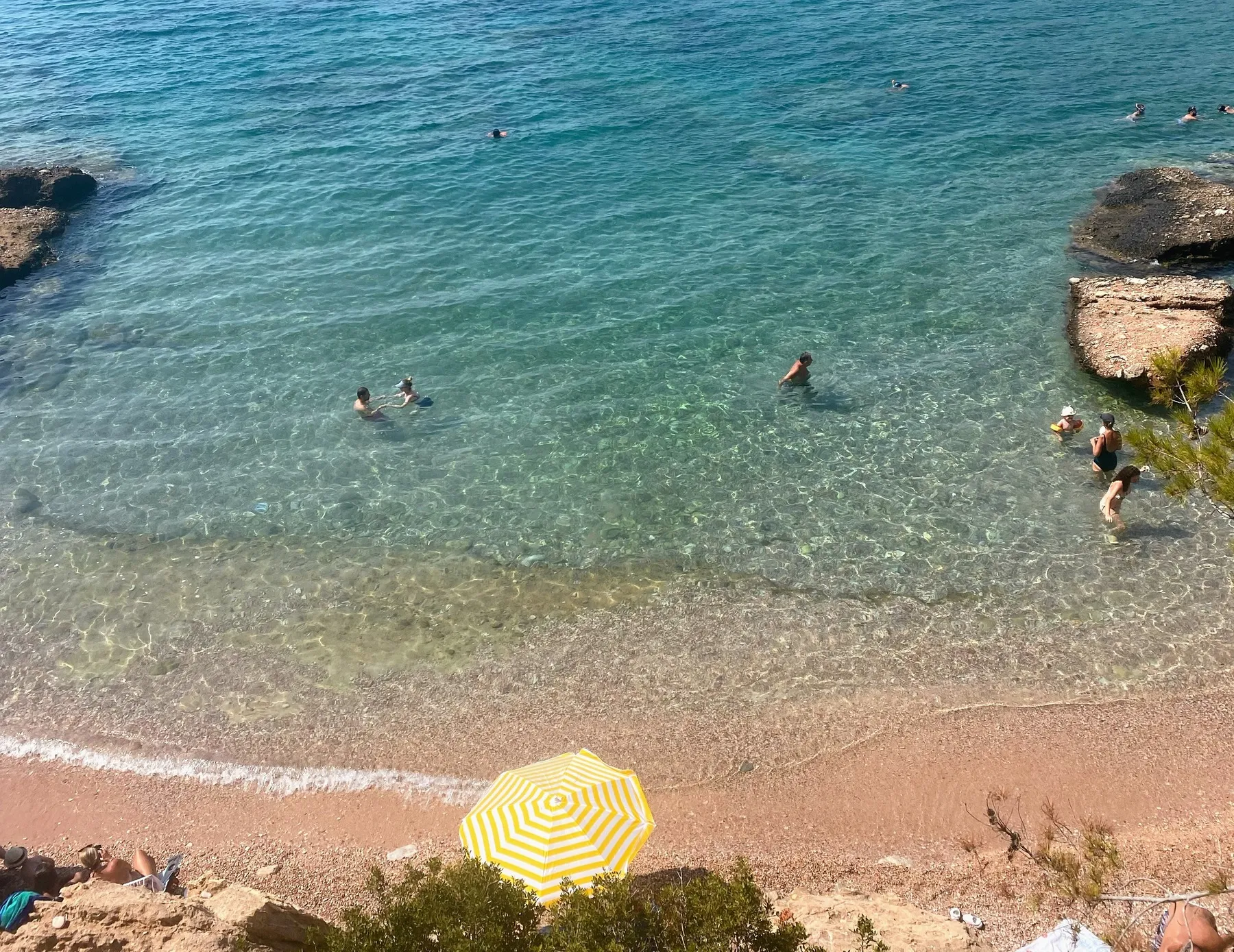
The bay has parking, showers, and changing cabins. Although most of the beach is occupied by seaside businesses, there’s still a small public section at the southern end. The beach is pebbly, but the water is so clear and turquoise that you quickly forget about the stones.
At the end of the day, we drove to Palamutbükü, where we would be staying for the next few days. The journey takes about an hour, with almond trees and beautiful coastal views accompanying you along the way.
🌊 Day 2 — Kurubük
We woke up to another peaceful morning in Palamutbükü. For breakfast, we tried Datça’s traditional round bread, fresh from the bakery. Crispy on the outside with a slightly tangy flavor inside, it was a great way to start the day. After breakfast, we headed to Kurubük, about a 15-minute drive away.
Kurubük
Kurubük is one of the best places to experience Datça’s quiet and unspoiled side. Popular with campers and nature lovers, the bay has remarkably clear water and a completely natural shoreline.
⚠️ Good to Know: There are no facilities at Kurubük. You won’t find changing cabins, restrooms, or even a small kiosk to buy food or drinks, so be sure to bring everything you’ll need, including water, towels, and a beach umbrella.

Maybe that’s exactly what makes Kurubük so special. With no businesses or facilities around, the bay has managed to keep its natural, peaceful character. It’s the kind of place where time seems to slow down.
After spending the day by the sea, we returned to Palamutbükü in the late afternoon. Before sunset, we took one last swim at the beach near our accommodation and ended our second day in Datça watching the sky change colors as the sun disappeared beyond the horizon.
🏛️ Day 3 — Sunset at Knidos
We started the day with a quiet breakfast by the beach in Palamutbükü before anyone else had arrived.

We picked up some freshly baked Datça bread from a local bakery, added a few breakfast essentials, and set up our own little picnic right by the water. After breakfast, we spent the rest of the morning swimming in the crystal-clear sea before heading back to the hotel to get ready for our afternoon trip to Knidos.
Knidos Ancient City
The drive from Palamutbükü to Knidos takes about 30 minutes, and it’s enjoyable from start to finish. The road is in good condition, and almost every bend opens up to views of the Aegean Sea and olive groves.

📻 An Interesting Detail: As you drive toward Knidos, the radio stations constantly switch back and forth. Around one bend, you might hear a Turkish song playing on a Greek radio station, and around the next, you’re listening to broadcasts entirely in Greek. It’s a small detail that constantly reminds you just how close you are to the Greek islands.
Located at the very tip of the Datça Peninsula, Knidos was once an important center of science and art in the ancient world. It’s also known for the famous Statue of Aphrodite that once stood here. Walking among the remains of the theater, agora, and ancient harbors, it’s easy to imagine what life might have looked like centuries ago.
The Lighthouse & Golden Hour
About an hour and a half before sunset, we made our way up to the lighthouse overlooking the ancient city. Don’t let the climb discourage you. It’s a short walk, and once you reach the top, you’ll be rewarded with sweeping views of both the ancient harbor and the open Aegean Sea.

After reaching the lighthouse, we quietly watched the ships passing on the horizon while waiting for the sun to set. What stood out most wasn’t the view itself, but the respectful silence shared by everyone there despite the number of visitors.


As the sun slowly disappeared below the horizon, the sky turned shades of gold, orange, and pink. It was one of those moments we’ll always remember from our time in Datça.
💡 Traveler’s Tip: There are no street lights inside the ancient city on the way back. It’s best to start walking down before it gets completely dark, or bring a flashlight if you plan to stay for sunset.
🏖️ Day 4 — Ovabükü
We started the day with another breakfast featuring the fresh Datça bread we had quickly grown to love. Today’s destination was Ovabükü, a neighboring bay just a short drive from Palamutbükü.
Ovabükü
About 20 minutes from Palamutbükü, Ovabükü is one of the lesser-known spots on the Datça Peninsula that has managed to keep its natural character. Compared to Palamutbükü, it’s much quieter and seems to be a favorite among locals.
The beach is a mix of fine pebbles and sand, and the sea stays shallow for quite a long distance. That makes it a comfortable choice, especially if you’re traveling with children.

🧭 Traveler’s Note: Ovabükü has the basic facilities you’ll need, including restrooms, changing cabins, a small café, and sunbeds with umbrellas for rent. As the afternoon goes on and the waves become calmer, the bay feels completely different in the soft evening light.
An Honest Recommendation: Ovabükü is a pleasant place to spend a few hours during your Datça trip, but for us, it didn’t stand out as much as Palamutbükü or Knidos. If your time in Datça is limited, we’d recommend giving priority to those places instead.
🐢 Day 5 — Kızılbük
Today’s destination was Kızılbük, home to what we thought was the most beautiful water in Datça. It’s about a 30–35 minute drive from Palamutbükü. The road is generally in good condition, although the final section is a bit narrow and downhill.

Kızılbük
There’s a paid parking area at the entrance to the bay. During the summer, it fills up quickly, so it’s worth arriving early. We were lucky enough to find a spot and decided to spend the whole day here.

🧭 Traveler’s Note: Just across from Kızılbük is Hayıtbükü. We stopped by, but it didn’t quite meet our expectations because it’s right next to the road and tends to get very crowded. We personally found Kızılbük much quieter and more enjoyable.
The facilities here are more than enough for a comfortable day at the beach. There are changing cabins, restrooms, a small café, and sunbeds available. We had lunch at the beach restaurant and didn’t have to pay anything extra apart from the sunbeds.
The Sea & Underwater Life
Out of all the places we swam in Datça, this was our favorite. The water is exceptionally clear, with beautiful shades of turquoise. There’s also a wooden pier that’s perfect for jumping into the sea or taking a few photos.
The highlight of the day came when several loggerhead sea turtles (Caretta caretta) quietly swam past us. Following them underwater for a few moments was an experience we’ll never forget.
💡 Don’t Forget: If you want to spot the turtles and enjoy the underwater scenery, be sure to bring a snorkel and a pair of swimming goggles.
The pine forest just behind the bay is also a pleasant place for a short walk or a break in the shade. If you prefer a quieter stay, there are accommodation options in Kızılbük as well, making it a nice place to spend your entire holiday.
✨ Day 6 — Aquarium Bay
Aquarium Bay gets its name from its crystal-clear water. Just a 10–15 minute walk from Palamutbükü, this small and unspoiled bay is one of the quietest places in the area. As soon as you put your head underwater, you’ll likely spot colorful fish, sea stars, sea urchins, and even small octopuses.

🧭 Traveler’s Note: Since the bay is quite small, we recommend arriving early in the morning, especially during the summer. There are no facilities here—no restrooms, changing cabins, or cafés—so make sure to bring everything you’ll need, from water and snacks to a beach umbrella.
We only spent a few hours here, but it was one of the quietest and most peaceful moments of our time in Datça.
A Farewell Under the Milky Way
Later that afternoon, we returned to Palamutbükü and got ready for our final evening. After dark, we walked to the rocky end of the beach and simply lay back, looking up at the sky. With very little light pollution, the Milky Way was clearly visible to the naked eye.
Watching its soft, hazy band stretch across the night sky was the perfect way to say goodbye to Datça.

🧭 Practical Information for Visiting Datça
If you’re planning a trip to Datça, here are a few things that might make your visit easier:
- Where to Stay: Palamutbükü is known for its small guesthouses, family-run apartments, and peaceful atmosphere. The absence of large resort hotels is one of the reasons the area has managed to preserve its natural character.
- Getting Around: There are minibuses connecting the bays, but they don’t run very frequently. If you’d like to explore Datça’s quieter corners at your own pace, having a car is by far the most convenient option.
- What to Pack: Many of the bays have little or no facilities, so it’s a good idea to bring your own beach essentials, such as an umbrella, beach mat, and towels. A snorkel and a pair of swimming goggles are also well worth packing if you don’t want to miss the underwater life or the chance to spot loggerhead sea turtles.
- Food: Palamutbükü has supermarkets such as ŞOK and A101 for everyday essentials. Many guesthouses also offer breakfast and dinner. While the seafood restaurants along the beach tend to be a little more expensive, you’ll find dining options to suit most budgets throughout Datça.
✨ Final Thoughts: Slow Down and Simply Be
For us, Datça was much more than a summer holiday. It was a place that reminded us to slow down, reconnect with nature, and enjoy the moment. Over six days, we swam in crystal-clear bays, explored ancient ruins, and ended our trip beneath the Milky Way.
But what stayed with us most was how little we rushed. We simply enjoyed being there. We hope this guide helps you create your own Datça memories.
📍 Interactive Map
We’ve marked every stop from our six-day itinerary on the interactive map below to help you plan your own trip.


Yorumlar
Comments