



Ayvalık has long been one of the most popular holiday destinations on Turkey’s Aegean coast. From the narrow streets and old Greek houses of Cunda to the lively centre of Ayvalık, the island views from Şeytan Sofrası and the long stretch of sand at Sarımsaklı Beach, there is quite a lot to see within a relatively small area.
We arrived in Ayvalık on the sixth day of our seven-day road trip from Bursa to Bergama. After spending the night in Burhaniye, we set off early in the morning and started the day on Cunda Island. From there, we continued to central Ayvalık, drove up to Şeytan Sofrası and finished the day at Sarımsaklı Beach.
We only had one day in Ayvalık, but with such short distances between the main stops, we managed to see quite a lot without having to rush. We liked some places more than we expected, while others, to be fair, didn’t quite live up to the hype. In this post, we’ll share the route we followed, what we saw along the way and what we actually thought of each stop.
🏘️ Cunda Island
We started our day in Ayvalık early in the morning on Cunda Island. Arriving early meant the streets were still quiet and the restaurants were only just getting ready for the day. We left the car in a parking area near the entrance to Cunda and set off to explore on foot.
Also known as Alibey Island, Cunda is the only inhabited island among the Ayvalık Islands. With its old Greek houses, stone buildings and narrow streets, it has become one of the most visited places in the area. Don’t imagine a huge island when you hear the name, though. The part you’ll actually want to explore is fairly compact, and you can easily see the centre on foot.

We started by wandering through the narrow streets between the old stone buildings. For us, this was the best part of Cunda: old houses, stone walls, pink flowers spilling from windows and cobbled lanes winding between them. Some walls and little corners have clearly been arranged with photos in mind, and after walking around for a while, it’s easy to see why people end up taking so many pictures here.

Eventually, we made our way down to the waterfront and walked along the coast for a while. Restaurants and meyhanes are a big part of Cunda, with one after another lining the waterfront. Since we were there early in the morning, though, we caught the island at a much quieter time of day.
After exploring the streets and waterfront, there was one more place we wanted to visit before leaving Cunda: the Rahmi M. Koç Museum.
🏛️ Rahmi M. Koç Museum, Cunda
After exploring Cunda’s streets, our next stop on the island was the Rahmi M. Koç Museum. We had already visited the Rahmi M. Koç Museum in Istanbul and really enjoyed it, so we were curious to see the Cunda branch as well.

The museum is housed in the restored Taksiyarhis Church, one of Cunda’s historic landmarks. Built in the 19th century, the building served various purposes over the years before being restored and opened as a museum in 2014. The stone architecture and high-ceilinged interior are just as interesting as the collection itself.
Compared with the Rahmi M. Koç Museum in Istanbul, this one is much smaller. The collection includes everything from old car parts, engines and machinery models to maritime objects, technical equipment from different periods and even toys. If you’re interested in old machines and mechanical objects, there is plenty here to keep you interested.

The museum isn’t very large, so around 35–40 minutes should be enough for a visit. There is also a small café where you can stop for a coffee afterwards. Once we had finished exploring the museum, we wrapped up our time in Cunda and drove across the bridge towards central Ayvalık.
🏘️ Central Ayvalık
After leaving Cunda, we crossed the bridge and headed into central Ayvalık. If you’re arriving by car, the first challenge isn’t what to see but where to park. Parking in the centre can be a real problem, especially in summer. Finding a space along the main streets is almost impossible, and you may end up circling the side streets several times looking for one.
One useful tip: during the summer, some school grounds in the centre are used as car parks. We came across a few around the streets behind Barbaros Avenue. Leaving the car a little outside the busiest part of the centre and continuing on foot makes much more sense than trying to find a parking space in the middle of the crowds.
To understand the character of Ayvalık today, it helps to know a little about its past. For many years, Greek and Turkish communities lived side by side here, and during the 19th century the town became an important economic centre thanks to olive oil production and trade. The stone houses, former churches and narrow streets you see around the centre today still reflect this multicultural past.
For us, the best place to start exploring is Barbaros Avenue. The street is lined with souvenir shops, small local businesses, bakeries and historic buildings, and you can simply follow it towards the waterfront. But don’t stick to the main street the whole way. Take some of the side streets as you go, because this is where you’ll find many of Ayvalık’s beautiful old stone houses and quieter corners.

Macaron Muhallebicisi on Barbaros Avenue is a nice place to stop for a break, and we’d also recommend popping into the historic bakery just across the street. Another building worth seeing along the way is Hayrettin Paşa Mosque. It was originally built as a church in the 19th century and later converted into a mosque, which is why it looks quite different from a typical mosque from the outside. It’s worth stepping inside, even briefly, to see how the different cultures in Ayvalık’s past have left their mark on its architecture.
Continue along Barbaros Avenue and you’ll eventually reach the harbour. In summer, the waterfront and main streets can become so crowded that even walking around can be difficult at times. Fish restaurants line much of the harbour as well, and in some places you almost have to look between them just to catch a glimpse of the sea.
Central Ayvalık didn’t quite live up to our expectations. Considering how much we had heard about it and how popular it gets during the summer, we found it a little overhyped. For us, the best part was Barbaros Avenue, the old side streets branching off from it and the historic buildings scattered around the area. The crowds around the harbour and main streets, on the other hand, took away some of the enjoyment of exploring the town.

On your way back, you’ll come across plenty of places selling Ayvalık toast along the main street. And if you’ve come all the way to Ayvalık, you might as well try its most famous local snack. Rather than recommending one particular place, we’d suggest having a look around and choosing somewhere that looks good and is busy with locals when you visit.
After having our Ayvalık toast, we wrapped up our time in the centre. Our next stop was Şeytan Sofrası, where we could see the town and the surrounding islands from above.
🌅 Şeytan Sofrası: Ayvalık’s Famous Viewpoint
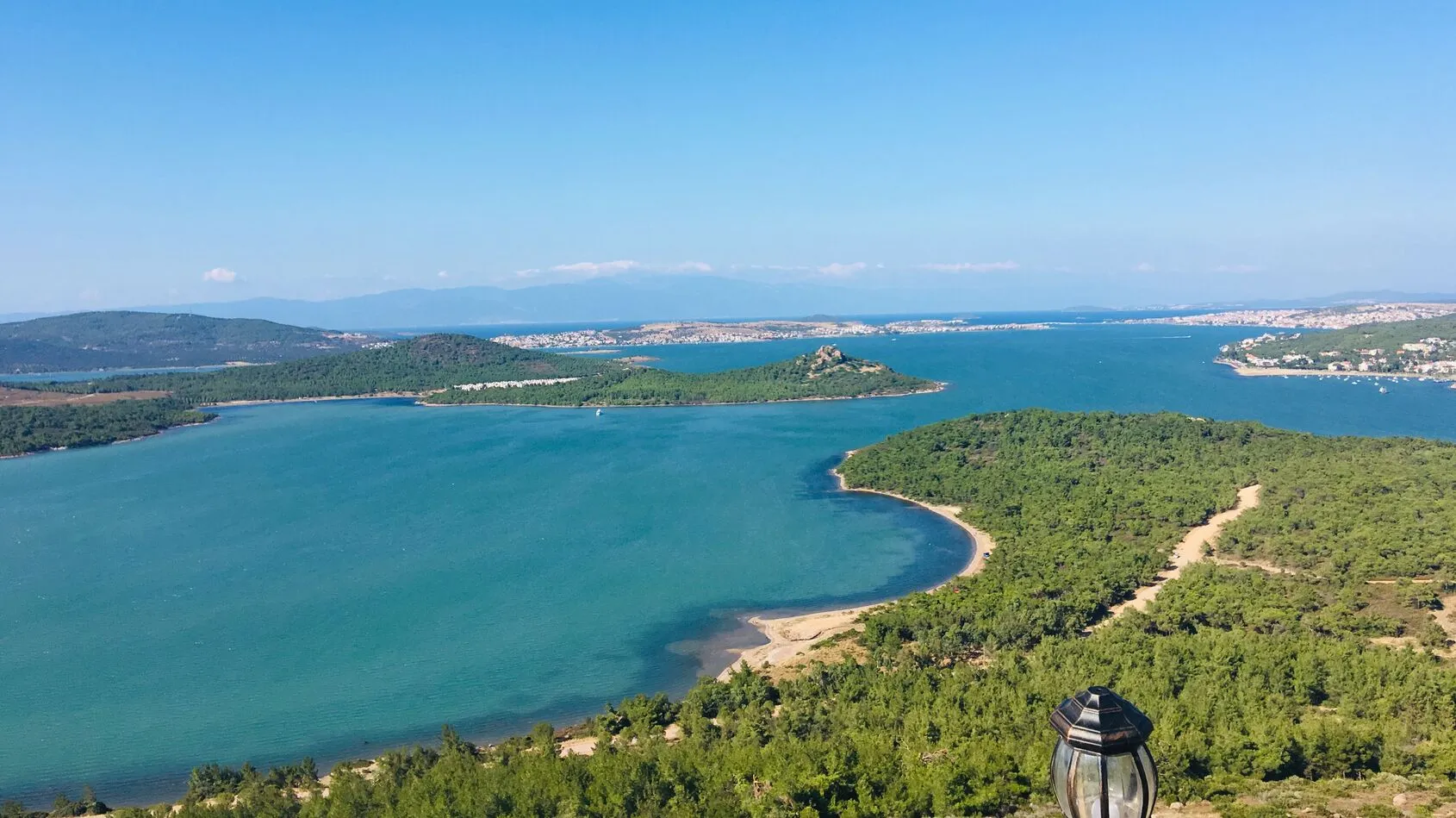
After finishing our walk around central Ayvalık, we got back in the car and drove around 15 minutes up to Şeytan Sofrası. Set on a hill south of Ayvalık, it is one of the best-known viewpoints in the area.
What makes Şeytan Sofrası so popular is the panoramic view over Ayvalık. Walk towards the edge of the hill and you can look out across the Ayvalık Islands and the Aegean Sea. There is also a café at the top where you can sit and enjoy the view. Sunset is the most popular time to visit, although naturally, it’s also when the place gets busiest.

The name comes from a hollow in the rock at the top of the hill that resembles a footprint. According to local legend, it is believed to be the Devil’s footprint. The spot is surrounded by an iron railing, and visitors throw coins inside while making a wish. Whether you believe the story or not is up to you, but it’s certainly one of the most popular spots at Şeytan Sofrası.
When we visited, the wind at the top was incredibly strong. We have no idea whether it’s always that windy up there or we just happened to visit on the wrong day, but it definitely wasn’t the kind of weather that made us want to sit around and enjoy the view for long.

If you’re already in the Ayvalık area, Şeytan Sofrası is worth a stop. On a clear day, the view over the islands is beautiful, but you don’t need to set aside too much time for it. Take in the view, have a quick walk around and continue on your way.
That’s exactly what we did. We headed back down the hill without staying too long and drove towards Sarımsaklı Beach, our final stop of the day.
🏖️ Sarımsaklı Plajı
After leaving Şeytan Sofrası, we drove for around 15 minutes to Sarımsaklı Beach, our final stop of the day.
The first thing that struck us was the sheer size of the beach. It’s a wide, sandy stretch that runs for kilometres along the coast. There are paid beach clubs along the waterfront, but large sections of the beach are open to the public. Even with all that space, though, it can get very crowded during the summer.
What surprised us most when we went into the sea was how cold the water felt. Maybe we’re just too used to the warmer coves of the Mediterranean and Aegean, but we didn’t feel like staying in for very long. Compared with some of the other beaches and coves we’ve visited, the sea here didn’t quite live up to our expectations either.
If you’re arriving by car, there’s one thing you should be careful about: don’t drive onto the sandy areas just to park closer to the beach. We saw several cars stuck in the sand while we were there. There were even tractors waiting nearby to pull them out. From what we could tell, it had practically turned into a little business of its own. 🙂
For us, Sarımsaklı Beach wasn’t particularly impressive, especially if you’re used to the coves and beaches further south along Turkey’s Aegean and Mediterranean coasts. We spent some time there, went for a swim and then decided to move on.
It was only afterwards that we realised we hadn’t taken a single photo at Sarımsaklı.
That probably sums up our Sarımsaklı experience better than anything else.
🚗 Leaving Ayvalık
By the end of our day in Ayvalık, we had managed to see most of the area’s best-known stops, from Cunda to Sarımsaklı. With such short distances between them, it’s easy to fit this route into a single day. Start early enough and you’ll still have plenty of time to explore without rushing.
Cunda was easily our favourite stop of the day. Wandering through the streets between the old stone houses in the quiet of the morning and walking along the waterfront were some of our favourite moments in Ayvalık. In the town centre, we particularly liked Barbaros Avenue and the historic streets around it. Şeytan Sofrası made for a nice scenic stop, while Sarımsaklı Beach fell a little short of our expectations.
Overall, Ayvalık works well as a day trip, although we have to admit that our expectations were a little higher after everything we had heard about it before visiting. Still, between the streets of Cunda, Ayvalık’s old stone buildings and the distinctive atmosphere of the area, we think it’s well worth stopping here if it’s on your route.
After leaving Sarımsaklı, we got back in the car and headed towards Bergama, about an hour away. And with that, we wrapped up the sixth day of our road trip from Bursa through the southern Marmara region and along the northern Aegean coast.
🧭 Keep Exploring
→ Seven Days from Bursa to Bergama — Follow our complete seven-day road trip through Bursa, Bandırma, Çanakkale, Altınoluk, Ayvalık and Bergama, with our route and experiences day by day.


Yorumlar
Comments