



Montmartre was one of the places we were most curious about before visiting Paris.
We weren’t entirely sure what to expect, but we hoped Montmartre would feel different from the rest of Paris. Between its artistic history, hilltop views, and reputation as the city’s bohemian quarter, it quickly became one of the places we were most excited to visit.
If you’re visiting Paris for the first time, or you’re still deciding what to include in your itinerary, Montmartre deserves a spot on your list.
Located on a hill in the northern part of the city, Montmartre feels noticeably different from much of Paris. Its name comes from the Latin Mons Martyrum, meaning “Hill of the Martyrs.” Before becoming part of Paris in the nineteenth century, it was an independent village, and much of that identity has survived. Narrow streets, low-rise buildings, and sweeping views give the area a character that stands apart from the city’s grand boulevards and uniform architecture.
Its place in art history is equally significant. During the late nineteenth and early twentieth centuries, affordable rents and a free-spirited atmosphere attracted artists from across Europe. Picasso, Van Gogh, Monet, and Toulouse-Lautrec all spent time here. Their influence can still be felt in the cafés, galleries, and streets that define Montmartre today.
In this guide, I’ll walk you through the route we followed and share the places that stood out most during our visit.
Let’s begin.
🚶♂️ Anvers Metro Station → Montmartre’a İlk Adım
ike many visitors, we began our exploration at Anvers Metro Station.
Montmartre has always had a slightly different character from the rest of Paris—more bohemian, more diverse, and a little less polished.
From there, we followed Rue de Steinkerque uphill. The street is lined with souvenir shops, small boutiques, and cafés catering mostly to tourists. It isn’t the most authentic part of Montmartre, but it serves as a natural gateway to the neighborhood.
Along the way, we stopped at Philippe Conticini Café. Philippe Conticini is one of the better-known names in French pastry, so we couldn’t resist trying a croissant. It was enormous, flaky on the outside, soft inside, and exactly what we needed before the climb ahead.

⛰️ Funicular or Stairs?
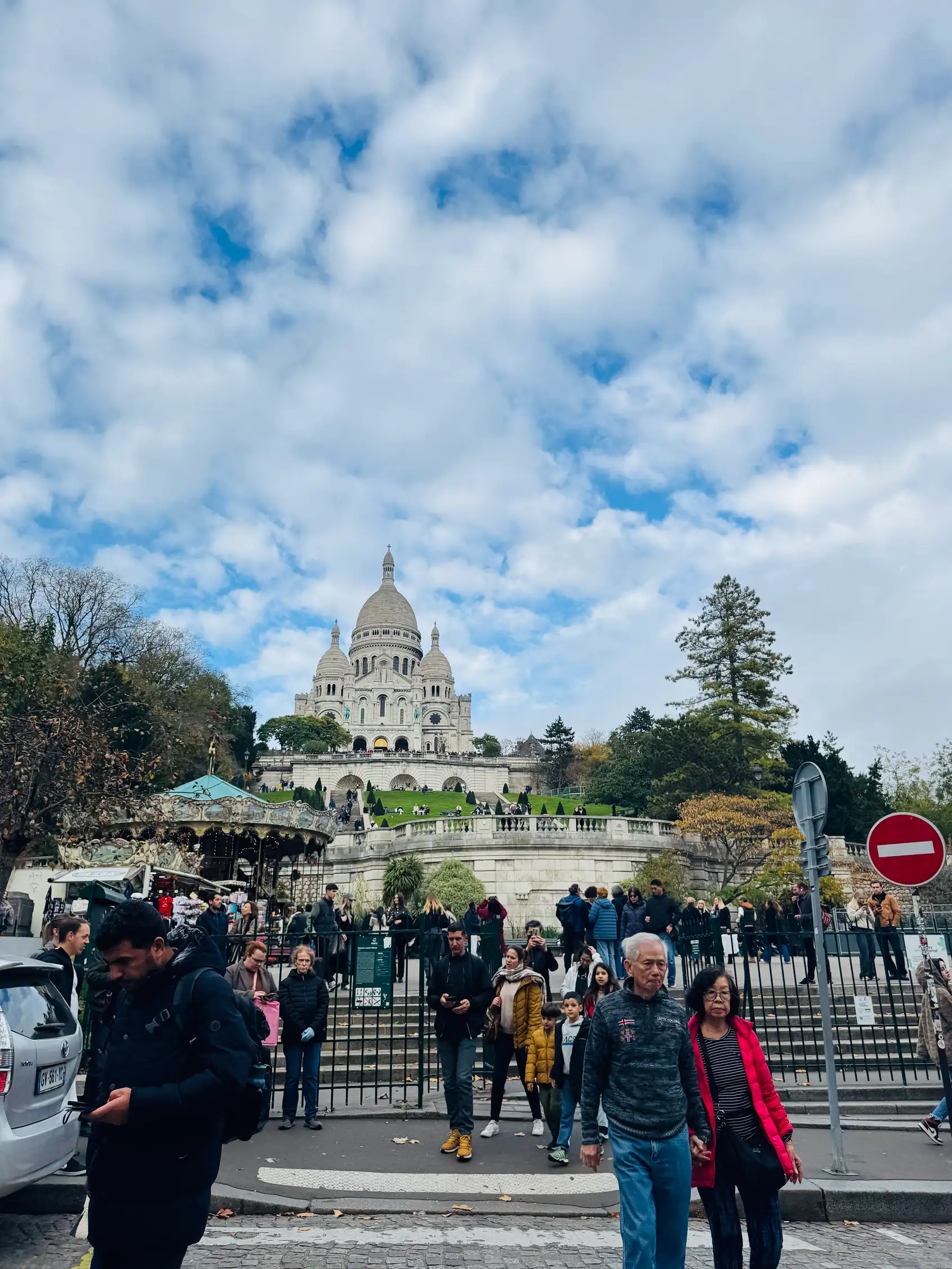
At the end of Rue de Steinkerque, the silhouette of Sacré-Cœur finally comes into view.
From here, you have two options: climb the stairs or take the Montmartre Funicular. The funicular is part of the Paris public transport network, so a standard metro ticket is all you need. We chose it on the way up to save some energy.
The stairs are certainly an option, but there are more than 200 steps and they can feel surprisingly demanding, especially later in the day. We took the funicular up and walked down the stairs on our way back.
⛪ Sacré-Cœur Basilica
At the top of the hill stands Montmartre’s most recognizable landmark: Sacré-Cœur Basilica.
Construction began in the late nineteenth century and was completed in 1914. The bright white exterior comes from the travertine stone used in its construction, giving the basilica a distinctive appearance unlike anything else in Paris.

Architecturally, it combines Romanesque and Byzantine influences, making it quite different from the Gothic churches found elsewhere in the city.
We considered going inside but ultimately decided not to. The exterior and the surrounding views interested us more than the interior itself.

The broad staircase in front of the basilica is one of the best free viewpoints in Paris.
Tourists sit on the steps, musicians perform for passing crowds, and countless people simply stop to admire the view. From here, you can truly appreciate how vast and surprisingly flat Paris is. The rooftops stretch toward the horizon in every direction.
🎨 Wandering Through Montmartre
After spending some time around Sacré-Cœur, we headed into the surrounding streets.

The architecture is charming without feeling overly polished. Stone façades, narrow lanes, and walls covered with climbing plants create a very different atmosphere from central Paris.
We visited in autumn, which made the neighborhood even more photogenic. Golden leaves and soft afternoon light gave many of the streets the appearance of a postcard.


One place that caught our attention was the statue known as the Buste de Dalida.
The area around it was surprisingly busy, which made us curious. Dalida was a hugely successful singer and actress who lived in Montmartre for many years and eventually became one of the neighborhood’s most beloved figures. The more we read about her, the more we understood why she remains such an important figure in Montmartre.

As we continued walking, we came across small parks filled with local life. Children were playing, while groups of older residents gathered to play pétanque, a traditional French game involving metal balls and a small target ball.
Moments like these made Montmartre feel less like a tourist attraction and more like a real neighborhood.

🧑🎨 Place du Tertre: The Artists’ Square
As we climbed higher, the crowds gradually became thicker. A few minutes later, we arrived at Place du Tertre.
Artists fill the square from one side to the other. Some sketch portraits, others create caricatures, while many display their own paintings and artwork.
What we enjoyed most wasn’t necessarily the finished pieces—it was watching the process itself.
Seeing someone sit down as a blank canvas and leave with a completed portrait only a short time later is surprisingly entertaining. Many of the artists are clearly very talented, and there is always something happening somewhere in the square.
Part of what makes Place du Tertre special is its history.
Montmartre was once considered the artistic heart of Paris. Artists such as Pablo Picasso, Vincent van Gogh, and Henri de Toulouse-Lautrec all lived and worked in this area. Affordable rents and a creative atmosphere helped turn the neighborhood into one of Europe’s most important artistic communities.
Sure, it’s touristy these days, but that doesn’t really take away from the experience. We still found it easy to imagine why artists were drawn here in the first place. Rather than diminishing the experience, the popularity of the square arguably makes it easier for visitors to connect with that history.
We spent some time wandering around, watching artists work, and simply soaking up the atmosphere.
The cafés surrounding the square were busy serving crêpes and mulled wine, adding to the lively atmosphere. In the end, Place du Tertre turned out to be much more enjoyable than we expected.
🌇 Returning to the Summit
After exploring the side streets, we gradually made our way back toward Sacré-Cœur.

By the time we returned, the sun was lower in the sky.
The harsh midday light had softened into warm golden tones, and the entire city seemed to glow.
Street musicians were performing nearby. Conversations blended into the background. Paris stretched out in front of us.
We spent almost an hour doing very little:
- Listening to music
- Watching people come and go
- Looking out over Paris
Sometimes those simple moments become the ones you remember most.
The city is beautiful from above at any time of day, but seeing it in the late afternoon felt particularly special. As the light changed, Paris somehow became even more beautiful.
Eventually, we made our way down the staircase and back into the streets below.
✍️ Final Thoughts
Looking back, Montmartre was easily one of our favorite stops in Paris. Somehow, Montmartre manages to be both busy and relaxed at the same time. Within a relatively short walking route, we experienced street life, art, history, viewpoints, and quiet residential corners.
The hour we spent sitting on the steps of Sacré-Cœur overlooking Paris remains one of our strongest memories from the trip.
But just as memorable were the smaller moments: wandering through side streets, discovering local parks, and watching artists work in Place du Tertre.

If you’re planning a trip to Paris, Montmartre is absolutely worth adding to your itinerary.
Continue Exploring
→ 4 Days in Paris — See how Montmartre fits into our complete Paris itinerary, including the museums, neighborhoods, landmarks, and experiences we explored throughout the city.
Yorumlar
Comments