




When putting together a list of things to do in Paris, Palais Garnier is often treated as a place that’s nice to admire from the outside and then move on. In my opinion, that’s a huge mistake.
This is far more than just an opera house. You realize that the moment you step inside. The entire building feels like a performance in itself. The show begins long before the curtain rises—starting with the grand staircases, lavish halls, and remarkable details that surround you at every turn.
In this guide, I’ll share our experience visiting Palais Garnier, explain how to plan your visit, navigate the ticket options, and show you how to turn a simple sightseeing stop into something much more memorable.
Let’s get started.
🎟️ Practical Information
📍 Location & Getting There
Palais Garnier is located right in the heart of Paris, making it one of the easiest landmarks to include in your itinerary. The area is served by several metro lines and bus routes, with Opéra Station being the closest stop. From there, it’s only a short walk before the opera house comes into view.
The building sits between the Louvre and Galeries Lafayette, making it a convenient stop while exploring central Paris. In fact, even if you don’t plan to visit, there’s a good chance you’ll find yourself passing by it several times during your trip.
Its central location is one of the reasons why Palais Garnier fits so naturally into almost any Paris sightseeing route.

⏱️ How Much Time Should You Allow?
To be honest, this isn’t a place where you’ll need to spend several hours. For most visitors, 1 to 1.5 hours is more than enough to explore the building and appreciate its remarkable architecture and interiors at a comfortable pace.
That said, the experience changes completely if you visit during a performance or special event. In that case, your visit naturally becomes much longer—and far more memorable.
🎟️ Tickets, Entry & a Smarter Way to Visit
Under normal circumstances, you’ll need to purchase a ticket to visit Palais Garnier, and the Paris Museum Pass is not accepted here. Standard admission is around €25 per person, which can feel quite expensive if you’re only planning a quick self-guided visit.
The good news is that there’s a much better option.
Tickets for concerts, ballet performances, and other stage events at Palais Garnier are usually released several months in advance. If you keep an eye on the schedule before your trip, you can often find performance tickets for a price similar to—or sometimes even lower than—the standard admission fee.
The advantage is obvious: instead of simply touring the building, you also get the chance to experience a live performance inside one of the world’s most famous opera houses. In addition, you’ll still be able to admire the magnificent auditorium and many of the building’s most impressive spaces.
This is exactly what we did, and honestly, the experience isn’t even comparable. Seeing the venue filled with music, lights, and an audience is completely different from walking through an empty building. The architecture is impressive on its own, but it feels truly alive during a performance.
The only catch is that these tickets can sell out quickly. If you’re interested, it’s worth checking the program a few months before your trip and booking as early as possible.
🎭 The Story and Historical Significance of Palais Garnier
Palais Garnier was one of the most ambitious projects of the reign of Napoleon III. In 1861, a young architect named Charles Garnier won the competition to design the new opera house. Although he was relatively unknown at the time, his proposal stood out for its boldness, grandeur, and theatrical flair.
The construction process was far from straightforward. During the excavation work, builders encountered significant groundwater issues, forcing them to create a massive underground reservoir beneath the building. After nearly fourteen years of construction, Palais Garnier was finally completed in 1875 and quickly became one of the finest examples of Beaux-Arts architecture in Paris.

From the very beginning, the building was much more than an opera house. It soon became one of the city’s most important social venues—a place where Parisian high society gathered to see and be seen. For many visitors, the experience wasn’t limited to the performances on stage. The grand staircases, foyers, and reception halls became social stages of their own, where status and elegance were displayed just as prominently as the operas themselves.
Over time, the building’s dramatic architecture and mysterious atmosphere captured the public imagination. It eventually inspired Gaston Leroux’s famous novel The Phantom of the Opera, securing Palais Garnier’s place not only in architectural history but also in literature and popular culture.
🏛️ Grand Staircase: Where the Performance Begins Before the Curtain Rises
The moment you step inside Palais Garnier, you’re greeted by the Grand Staircase.
Calling it simply a staircase, however, doesn’t do it justice. This is the heart of the building. White, green, and red marble, gilded details, massive columns, and light pouring in from above create a space so visually overwhelming that your first instinct is simply to stop and look around. There are so many remarkable details competing for your attention that it’s difficult to know where to focus first.


The Grand Staircase was never intended to be just a passageway. In the 19th century, it served as a stage in its own right for Parisian high society. Before and after performances, guests would stroll up and down the staircase, observing one another and making sure they themselves were seen. The opera was only part of the evening—the social spectacle was equally important. The balconies and alcoves surrounding the staircase were designed with this culture in mind, offering perfect vantage points for both watching and being watched.
As you climb the staircase today, it’s easy to understand why the space has become so iconic. It feels like stepping into a scene from a period film, the kind of place where royalty and aristocrats would make a grand entrance. No matter how carefully you look, it’s almost impossible to take in every detail.

That atmosphere still lingers today. As you make your way upward, each level reveals new perspectives and architectural details that you may have missed from below.
It’s also one of the best places in the building for photographs. That said, I’ll be honest: no photo truly captures the scale and grandeur of the space. The Grand Staircase is one of those places that has to be experienced in person. Its impact comes not from seeing it in a picture, but from standing in the middle of it and looking up.
✨ Grand Foyer: A Hall Fit for a Palace
Located opposite the main auditorium, the Grand Foyer is easily the most palace-like space inside Palais Garnier.
Stretching out like an opulent gallery, the room is filled from end to end with gilded decorations, enormous mirrors, painted ceilings, and sparkling crystal chandeliers. The comparison that immediately comes to mind is a royal palace—and that’s no coincidence. The room was designed to impress visitors, and perhaps even intimidate them a little with its sheer scale and extravagance. In many ways, it feels capable of rivaling the famous Hall of Mirrors at Versailles.

Historically, this was where guests spent their time during intermissions. People gathered here to socialize, admire the surroundings, and, of course, continue the tradition of seeing and being seen. While performances took place on stage, a different kind of performance unfolded here in the foyer.
The mirrors make the space feel even larger than it already is. Light reflects in every direction, causing the gold details to glow even more intensely. As you walk through the hall, you’ll constantly find yourself stopping to look around. Every few steps seem to reveal another detail that you hadn’t noticed before.

Its impact hasn’t faded with time. Even today, the Grand Foyer feels like much more than a waiting area—it’s a destination in its own right and one of the highlights of the entire building.


In fact, this was one of the places where we spent the most time during our visit. The Grand Staircase is spectacular, the Grand Foyer is spectacular, and choosing between them is nearly impossible. We found ourselves going back and forth between the two again and again, unable to decide which one impressed us more.
You’ll probably understand exactly what I mean once you’re standing there yourself.
🎭 The Auditorium and Opera Boxes: Red Velvet, Gold, and Privacy
The moment you step into the main auditorium of Palais Garnier, it becomes immediately clear why it is considered one of the world’s most iconic opera houses.
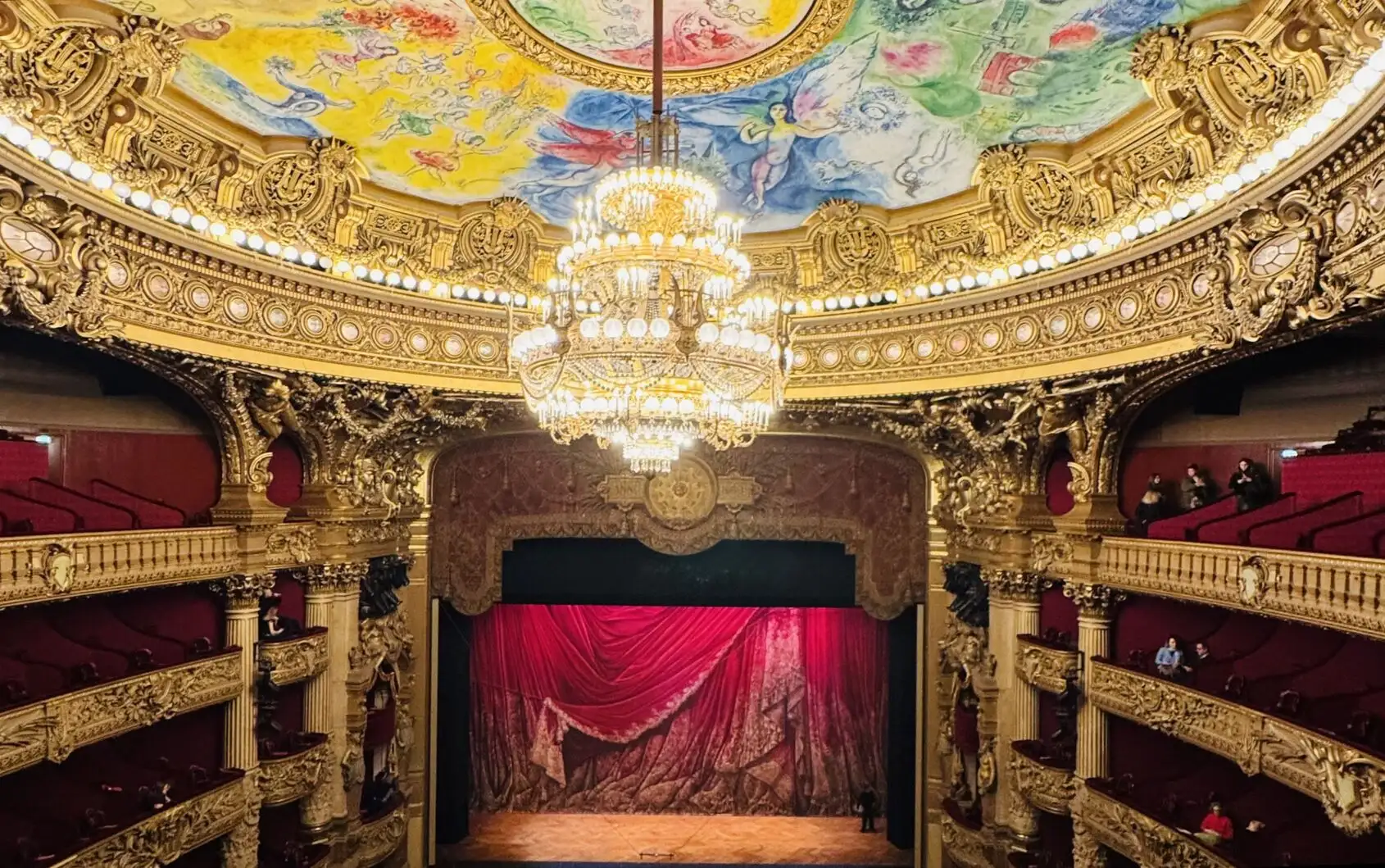
Red velvet seats, gilded decorations, and a magnificent chandelier hanging at the center create the classic image of a grand opera hall—but taken to the highest possible level. Looking upward, you’ll also notice the colorful ceiling painted by Marc Chagall, whose modern artwork provides a striking contrast to the building’s traditional architecture.

One of the auditorium’s most distinctive features is the series of opera boxes that surround the hall. Rising in multiple tiers, these private boxes were designed as much for social life as for watching performances. Each one feels like a small private room, often complete with its own entrance and a degree of separation from the rest of the audience.
The arrangement reflects the social structure of the era remarkably well. Each box functioned as a semi-private space where guests could observe the stage while remaining visible to everyone else in the auditorium.
In a way, there were always two performances taking place at once. On one side were the artists on stage. On the other were the elegantly dressed spectators occupying the boxes above.
That’s what makes Palais Garnier so fascinating. The spectacle was never confined to the stage—it unfolded throughout the entire hall.
🎶 The Performance Experience: Watching the Show or Watching the Venue?
Attending a performance at Palais Garnier is a little different from a typical concert experience.
To be honest, the seats in some of the upper balcony sections are not particularly comfortable. After sitting for a while, you definitely start to notice it. Fortunately, the view makes up for much of that inconvenience.

Unlike many modern theaters and concert halls, the auditorium wasn’t designed with gently rising rows. Instead, the seating climbs upward at a much steeper angle. Looking down toward the stage from the upper levels can genuinely feel like peering over the edge of a cliff. It’s unusual at first, but before long, that dramatic perspective becomes part of the experience.

During our visit, we attended a flute concerto. Interestingly, focusing entirely on the performance turned out to be more difficult than we expected. The reason wasn’t the music—it was the building itself.
The opera boxes, the grand chandelier, the colorful ceiling, and the countless architectural details constantly compete for your attention. Your eyes keep wandering away from the stage because there’s simply so much to look at.
The acoustics, however, are excellent. The sound spreads evenly throughout the auditorium, making it easy to enjoy the performance regardless of where you’re seated. That’s what makes attending an event at Palais Garnier so unique. You’re not just watching a concert or a performance. The building itself becomes part of the show.
🏁 Final Thoughts
Palais Garnier offers far more than a typical tourist attraction in Paris. With its remarkable architecture, fascinating history, and unforgettable atmosphere, it’s a place that can be explored in a relatively short amount of time yet leaves a lasting impression. Even a simple visit is worthwhile. But if you have the opportunity, try to attend a performance.
The architecture, the music, the audience, and the atmosphere all come together to create an experience that goes far beyond sightseeing. It’s one of those rare places where the venue itself is just as memorable as the event taking place inside it.
For us, Palais Garnier was one of the highlights of our time in Paris and easily one of the most unique stops on the itinerary.
Continue Exploring
→ 4 Days in Paris — See how Palais Garnier fits into our complete Paris itinerary, including the museums, neighborhoods, landmarks, and other experiences we enjoyed throughout the city.

Yorumlar
Comments