



When we think of Seville, flamenco, orange trees and warm sunshine are probably some of the first things that come to mind. But the city has much more to offer than that. From quiet streets in the morning to lively squares in the evening, from centuries-old palaces to modern architecture, Seville seems to keep changing as the day goes on.
Our day started with the sweeping curve of Plaza de España, continued through the gardens of the Real Alcázar and up to the top of La Giralda, before taking us into the evening crowds around Calle Sierpes and finally to the Guadalquivir River, with the lights of Torre del Oro reflected on the water.
We tried to fit all of this into a single day.
Here’s how our day in Seville went.
📍 Our One-Day Seville Itinerary
⚡ One Day in Seville – Quick Summary
🕒 Duration: 10–12 hours
🚶♂️ Walking: 12–15 km
💸 Total (2 adults + 2 children): ~€305
👤 Per person: ~€75
🎟️ Tickets: Alcázar (€31) · Cathedral & Giralda (€27)
🚗 Parking: ~€18
🍽️ Food & drinks: ~€90
🏨 Accommodation: ~€140
🔥 Highlights: Plaza de España · Alcázar · Giralda · Evening streets · Torre del Oro · Metropol Parasol · Calle Sierpes
* Prices are from our 2025 visit.
🌅 Morning: Our First Steps in Seville
After spending the night in Córdoba, we set off early in the morning. The day had barely begun when we arrived in Seville after a calm, easy drive of about an hour.
Once we entered the city, we followed the Guadalquivir River and headed straight for the car park. Seville’s centre is compact enough to explore on foot, so I didn’t want to deal with the car during the day. My plan was simple: park it, leave it there, and forget about it until later.
I had looked into parking options before we arrived, and the underground car park next to Plaza de Toros de la Maestranza seemed like a good choice in terms of price, security and location. It’s right in the centre and within walking distance of the main places we planned to visit. We paid around €15–20 for the day, which felt quite reasonable by European standards. More importantly, once the car was parked, we didn’t have to think about it again for the rest of the day.
It was still too early to check into our hotel, so we left our luggage in the car and started exploring straight away. The idea was to return to the car park in the afternoon, pick up our bags on the way to the hotel, rest for a while and then head out again. Choosing a hotel close to the centre made this much easier.
The moment we walked out of the car park, our day in Seville really began.
🚋 Taking the Tram to Plaza de España
Plaza de España was our first stop of the day. After leaving the car park, we walked a short distance to the tram and took it towards Prado de San Sebastián. We could have walked the whole way, but with a long day ahead of us, there was no point using up our energy first thing in the morning.

After getting off the tram, we walked through Parque de María Luisa. A few quiet minutes surrounded by greenery took us to the other side of the park. We crossed the road, and there it was: Plaza de España.
🎬 First Stop: Plaza de España
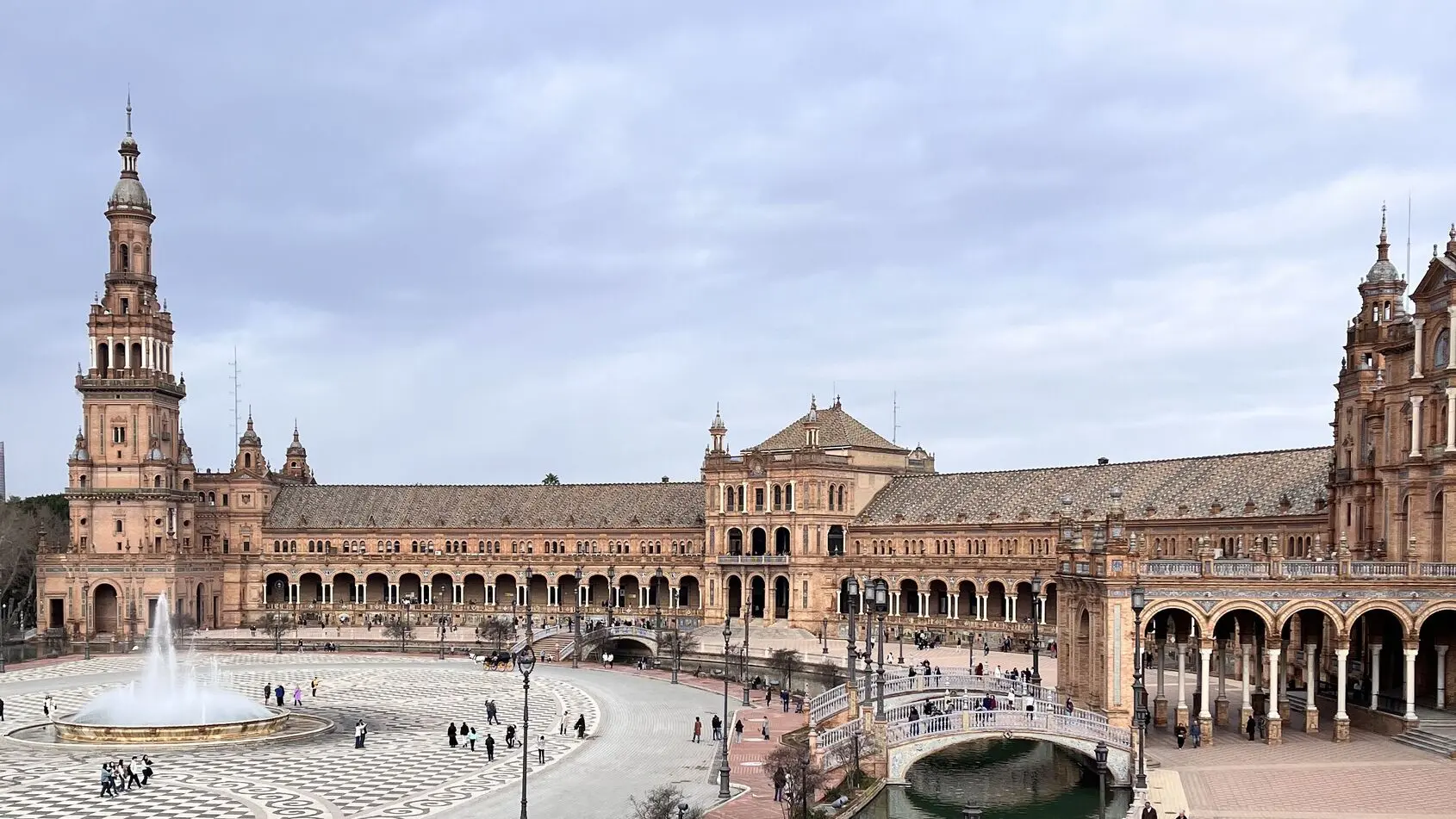
We arrived early enough that the square wasn’t too crowded yet. With its enormous semicircular building, canal and bridges stretching across the front, Plaza de España feels even bigger in person than it looks in photos.

We walked around the square, crossed the bridges and stopped to look at the tiled panels representing different parts of Spain. Then we simply sat down for a while and took it all in. This isn’t really a place you want to rush through, and starting our day here while the morning was still cool turned out to be a very good choice.
→ Plaza de España Travel Guide — Read our separate guide for the story behind the square, its architecture, bridges and tiled panels, along with the details worth looking out for during your visit.
🕛 Towards Midday: Walking into the Centre & Visiting the Alcázar
After leaving Plaza de España, we turned towards the city centre. On the way, we walked alongside the massive walls of the University of Seville until we reached Puerta de Jerez. With its fountain and palm trees, it’s a modest but lively square where the tram line, metro and several main streets come together.
Seville’s architecture has a character of its own. Yellow, orange and mustard-coloured façades line the narrow streets, almost like a carefully arranged backdrop. White-framed windows, wrought-iron balconies, flower pots by the doorways… Put it all together and you get a look that could hardly belong anywhere but Seville. It’s hard to find quite the same combination anywhere else in Europe.

From Puerta de Jerez, we continued into the narrow streets of the historic centre. The crowds gradually grew, and after a few more minutes on foot, we reached the second major stop of our day: the Real Alcázar.
🏰 The Main Stop of the Day: Real Alcázar
There’s a small but useful detail to know before entering: the ticket office isn’t directly in front of the main gate. You need to head towards Patio de Banderas, so if it’s your first visit, finding the right entrance can take a few extra minutes.
As soon as you step inside, the busy streets of Seville seem to disappear behind you. Suddenly, you’re surrounded by courtyards, arches, geometric patterns and intricate decoration in a much quieter setting.
If you’ve already visited the Alhambra, some of the details may feel familiar. But the Alcázar has an atmosphere of its own; to us, it felt a little darker and more intense. There were rooms where we genuinely felt that the craftsmanship and grandeur could easily hold their own against the Alhambra.

The gardens deserve just as much time as the palace itself. We wandered among orange trees, pools, fountains and paths leading from one section to another. More than once, we found ourselves returning to places we had already seen for another look, and in the end, we stayed much longer than we had planned.
→ Real Alcázar Travel Guide — See how we explored the palace rooms, courtyards and gardens, along with the details that stood out to us and practical information for planning your visit.
⛪ Seville Cathedral & La Giralda: Climbing Above the City
By the time we left the Real Alcázar, it was around 3:00 pm. The quiet streets of the morning had long since filled with people, so we didn’t linger and headed straight to Seville Cathedral, just across the way.
We already knew how enormous the cathedral was, but seeing it up close was still surprising. As you approach the entrance, the building seems to take over your entire field of view. From the square, its sheer scale makes you feel very small.
Once inside, we headed to La Giralda first. Instead of a conventional staircase, the tower is climbed via a series of wide ramps, which made the ascent much easier than we had expected. At the top, the rooftops, narrow streets and courtyards of Seville stretched out around us in almost every direction.

After coming back down, we continued exploring the cathedral. The vast interior, the golden Retablo Mayor and the tomb of Christopher Columbus were among the things that caught our attention most. Like the Alcázar, this isn’t somewhere you can simply walk through in a few minutes; we ended up spending more time inside than we had expected.
→ Seville Cathedral & La Giralda Travel Guide — Read our separate guide to the cathedral’s main sights, the climb up La Giralda, ticket information and the details worth knowing before your visit.
🌇 Late Afternoon: As the City Changes Colour
After leaving Seville Cathedral, we took a short break and walked back to the car park. We picked up the luggage we had left there that morning and headed to our hotel on foot.

We stayed at Hotel Simon, just a short walk from the cathedral, so the location puts you right in the heart of the city. Rather than a modern chain hotel, it feels more like an old Andalusian house, with plenty of character. The tiled rooms and central courtyard give the place a warm, traditional atmosphere. The only downside was that they didn’t have a family room for four, so we booked two separate double rooms instead.

After settling in and resting for a while, we headed back out. As daylight began to fade, the colours of Seville started to change with it. The clear, bright city we had seen that morning gradually gave way to softer evening light falling across the warm-toned buildings.


This time, we headed towards Calle Sierpes. As the evening went on, the streets began to fill, shop lights came on and tables spilled out onto the pavements. Seville was slowly settling into its evening rhythm.

🍽️ Calle Sierpes: Into the Evening Crowds
Calle Sierpes is a narrow but fairly long pedestrian street lined with shops, small boutiques, cafés, tapas bars and other places to stop for a drink. Flamenco dresses and traditional accessories in the shop windows are little reminders that you’re very much in Seville.
What we liked here was that there was no real need to make a plan for dinner. You can stop at a tapas bar for something small, carry on walking, then try something else a few streets later. There are also plenty of small shops where you can pick up a drink or a snack along the way. It’s basically a case of eating as you wander.

As the evening went on, Calle Sierpes became busier, with illuminated shop windows, signs and the hum of people filling the street. We stopped for a while and simply watched everything going on around us.
🌃 Evening: Streets, Lights & Seville After Dark
After walking to the end of Calle Sierpes, we came out onto a wider street. We turned right and continued for a few more minutes until we came across a very different side of Seville.
🌇 Seville’s Modern Side: Metropol Parasol
In front of us was Metropol Parasol, a structure unlike anything else we had seen in the city. Locally, it’s known as “Las Setas” — the mushrooms — because of its unusual shape. Surrounded by Seville’s traditional architecture, it does look a little strange at first.

The site itself has an interesting story. In the early 2000s, an underground car park was planned here, but Roman remains were discovered during excavation and the project changed course. Today, the Antiquarium archaeological museum sits beneath the structure, while a walkway and viewing terrace run across the top.
We arrived in the evening, and once it got dark, the lighting kept changing across the huge wooden structure. I could imagine Metropol Parasol feeling slightly out of place among historic Seville during the day, but under the lights at night, it somehow made more sense to me.

You can buy a ticket to access the upper walkway and viewing terrace, which is particularly popular around sunset. We decided not to go up; walking around below and seeing it from street level was enough for us that evening.
A small note: My wife wasn’t particularly impressed by Metropol Parasol. 🙂 After spending the whole day surrounded by historic Seville, she thought it felt a little “out of place.” I can see her point — in the middle of the city’s traditional architecture, it really does look as though it belongs to another world. I found that contrast interesting, though.
🌃 Getting Lost in Seville’s Side Streets
After leaving Metropol Parasol, we stopped making plans altogether and simply wandered into the surrounding streets. We headed into Calle Cuna and the narrow streets around it. Tight lanes, busy bars spilling out onto the street, different sounds and movement around every corner… Tapas bars, small shops and places to grab a drink all seemed to blend into one another.

Here’s a small trick we often use when exploring an unfamiliar city. Open Google Maps and you’ll notice that some areas have a much denser concentration of places marked on the map. Those are often where you’ll find plenty of restaurants, bars and activity. We simply headed towards those areas and let the evening unfold from there.
Check the map, find where things are happening, and walk straight into it.
Without any particular destination in mind, we wandered from street to street and gradually found ourselves heading back towards La Giralda.
✨ Seeing La Giralda at Night
La Giralda looks completely different after dark. We had already seen it during the day, but illuminated against the night sky, the tower felt more dramatic.

We sat opposite it for a while and simply looked up at it. Then we walked around to the other side of the cathedral and continued along Avenida de la Constitución. This broad avenue, with the tram running through it, is busy during the day but felt calmer and more spacious in the evening.
In a nearby side street, we came across a small gelateria called Mito and treated ourselves to some Italian-style gelato. It was very good, and I’d happily recommend stopping by if you’re nearby.

From there, we headed towards the Guadalquivir River. Once we reached the riverbank, the atmosphere changed again. The daytime crowds were gone, the streets were quieter and the city lights reflected on the water. It was a calmer, more romantic side of Seville.
🏰 Torre del Oro: Seville’s Watchtower by the River
As you walk along the river, Torre del Oro is hard to miss. Built in the 13th century during the period of Muslim rule in Andalusia, it served as a defensive watchtower controlling access to the city from the Guadalquivir. Over time, it also took on other roles connected to the port and river traffic.

Its name means “Tower of Gold,” and there are different explanations for where it came from. Whatever the origin, the tower is especially striking at night, illuminated beside the river and reflected in the water. Standing there, it’s another reminder of just how closely Seville’s history is tied to the Guadalquivir.
🐟 Our Final Stop: Something Local to Eat
It was getting quite late by this point. As we walked back towards the hotel, a place nearby caught our attention: Freiduría La Isla.
It’s a traditional Andalusian fried-fish shop, but the way it works might feel a little different if you haven’t been to one before. At the counter, there’s a selection of fish and seafood ready to be fried. The idea reminded us a little of a British fish and chip shop: you choose what you want, they fry it there and serve it on paper.
Then you sit at one of the small tables and eat it while it’s still hot. It isn’t fancy, and it’s not the kind of restaurant where you sit for hours, but the food was genuinely delicious. It ended up being one of our favourite eating experiences in Andalusia.

After eating, we called it a day and walked back to the hotel. It had been a long one: starting at Plaza de España in the morning, continuing through the Alcázar and Cathedral, and ending with side streets and a walk along the river. We were tired, but by then we had already fallen for Seville.
❤️ It’s Hard Not to Love Seville
You can’t “finish” Seville in a single day — and trying to treat a city that way wouldn’t really do it justice anyway. We were tired, but we already loved Seville. From starting the morning at Plaza de España to wandering through the courtyards of the Alcázar, climbing above the city at the Cathedral and ending the evening among busy streets and along the Guadalquivir, Seville kept showing us a different side of itself.
I’ve been to Paris and Rome, Barcelona, Madrid, Vienna, Milan… They all have their own kind of magic, of course. But there’s something different about Seville. It’s affordable and easy to enjoy, its historic sights are incredible, and its parks — with those green parakeets flying around — bring another kind of energy to the city. The Guadalquivir runs right through it, and you can walk along the river for hours. The coast is about an hour and a half away, while the other cities of Andalusia are within easy reach. It doesn’t feel as overwhelmingly touristy as some of Spain’s other major cities, the crowds felt manageable to us, and there’s no shortage of good food. Once you’ve seen the Alcázar, the Cathedral and Plaza de España for yourself, you start to understand why.
Would I come back? Absolutely.
And if someone asked me to choose a city in Europe where I’d like to live, my answer would be simple: Seville.
Keep Exploring
→ Andalusia Road Trip & Travel Itinerary — Follow our full journey through Andalusia, including the route between cities, where we stayed and what we experienced along the way.

Yorumlar
Comments