



Plaza de España is one of Seville’s most impressive landmarks and a place that almost every visitor to the city ends up exploring. But what makes it special goes far beyond its popularity.
At first glance, it looks like a grand and monumental square. The more time you spend here, however, the more you realize that it is much more than that. Every corner reveals a new detail, and the experience becomes richer the longer you stay.
After visiting many cities across Spain, I can honestly say that, in my personal opinion, there is no square quite like Plaza de España in either Madrid or Barcelona. Its scale, architecture, and overall atmosphere make it a truly unique place.
Whether you’re interested in architecture, history, photography, or simply experiencing one of Seville’s most iconic sights, Plaza de España delivers. Those who enjoy it the most, however, are usually the visitors who take their time and explore it at a relaxed pace.
In this guide, we’ll take a closer look at Plaza de España, including its history, highlights, the best places to spend time, and how to make the most of your visit.
⏱️ How Much Time Do You Need for Plaza de España?
You can walk through Plaza de España fairly quickly, but if you want to truly appreciate the site, it’s worth setting aside at least 1 to 1.5 hours. Stopping on the bridges to admire the views, climbing to the upper level, and exploring the ceramic tile murals all take time—and that’s part of the experience.
If you enjoy discovering architectural details and taking your time, you could easily spend half a day here. For most visitors, however, I would say that 2 to 2.5 hours is the ideal balance. It’s enough time to see the highlights without feeling rushed, while still allowing you to appreciate the many details that make Plaza de España so special.
👉 Click here for our 1-Day Seville Itinerary
👉 Click here for our Complete Andalusia Travel Guide
🏛️ About Plaza de España
Plaza de España is one of Seville’s most iconic landmarks and has become a true symbol of the city. The complex was built for the Ibero-American Exposition of 1929, a major event designed to showcase Spain’s historical and cultural ties with Latin America. In other words, Plaza de España was conceived not only as an impressive architectural project but also as a political and cultural statement.
After the exposition ended, the building did not fall into disuse. Instead, various government institutions and public offices moved into the complex, and some sections are still occupied by official organizations today. Over time, however, Plaza de España evolved into one of Seville’s most important cultural and tourist attractions. Extensive restoration work carried out in the 2000s helped restore the site to the impressive condition visitors see today.

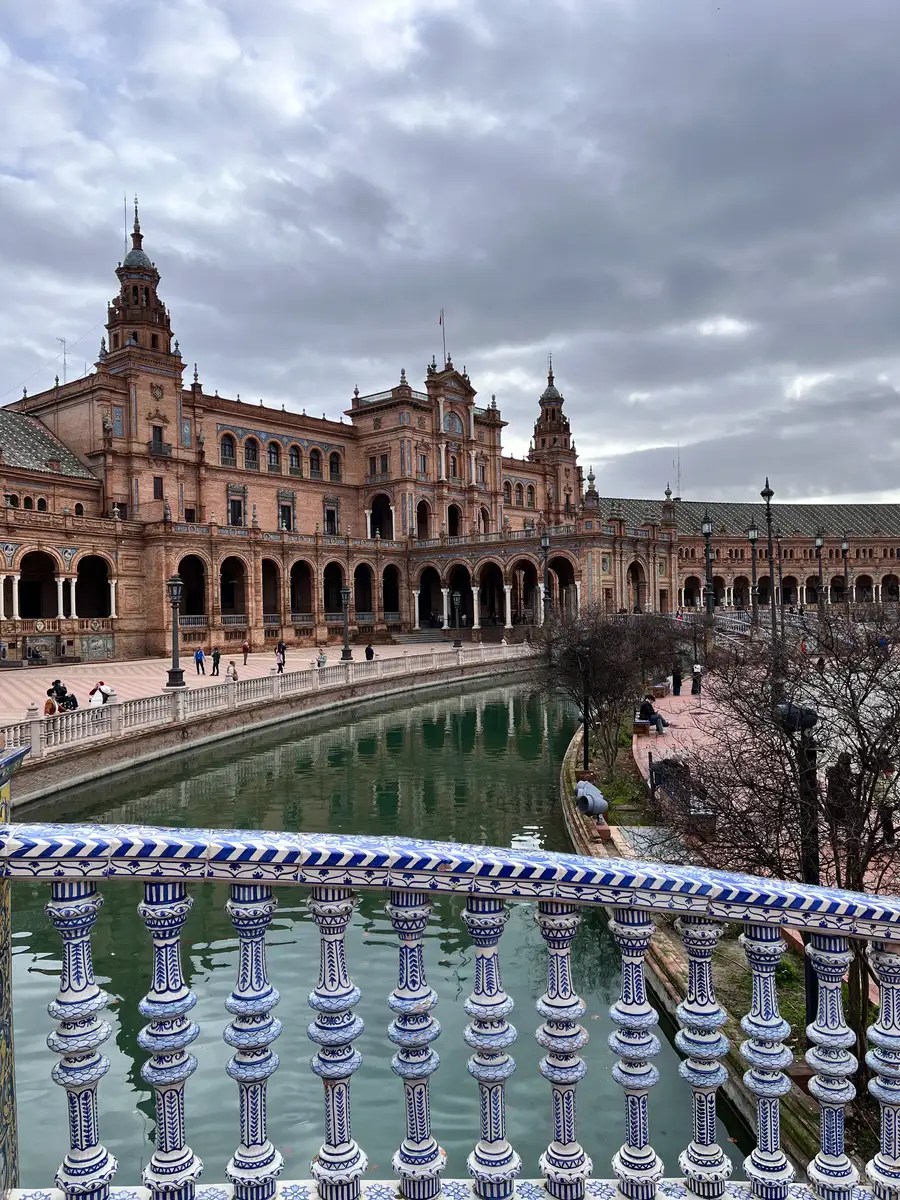
One of the most distinctive features of Plaza de España is its semi-circular design. The sweeping building that surrounds the square is decorated with ceramic tile panels representing different regions and cities of Spain. Each panel tells a small piece of the country’s history, giving visitors a cultural experience that goes far beyond the architecture itself.
As soon as you enter the square, one of the first things you’ll notice is the large canal running through the center. The waterway enhances the grandeur of the complex while adding movement and life to the space. Four decorative bridges cross the canal, each symbolizing one of Spain’s historic kingdoms, and together they create some of the most recognizable views in the entire plaza.
Today, Plaza de España is one of Seville’s busiest and most visited attractions, enjoyed by both tourists and locals alike. At first glance, it feels less like a traditional city square and more like the set of a grand historical film.
🗺️ How to Visit Plaza de España
Entry to Plaza de España is completely free, and no ticket is required. The square is open for most of the day, allowing visitors to come and go as they please. Even if you haven’t planned your itinerary in advance, it’s an easy place to add to your day in Seville.
Just behind the plaza lies Parque de María Luisa, one of the city’s most beautiful green spaces. Visiting the park after exploring Plaza de España feels like a natural continuation of the experience. If you’re looking for a relaxing walk or a break from the crowds, it’s well worth spending some time there.
Timing can make a big difference. From late morning onwards, Plaza de España becomes noticeably busier, especially during the peak tourist season. For a quieter experience, try to arrive early in the morning. The temperatures are more comfortable, the crowds are smaller, and you’ll have a better chance to appreciate the square at a slower pace.
For photography, the best times to visit are early morning and the hour before sunset. Morning light is softer and the plaza is less crowded, while sunset creates a more dramatic atmosphere with warmer colors. Both have their advantages, so the choice largely depends on your personal preference.

Exploring Plaza de España isn’t limited to walking around the square itself. Visitors can also access parts of the building and climb to the upper-level balconies. The views from above offer a completely different perspective and are among the best photo opportunities in the entire complex.

The staircases leading to the upper level are worth seeing in their own right. Their walls are covered with beautiful ceramic tiles, making them some of the most visually striking areas of the plaza. It’s also common to come across talented musicians performing here. The combination of live music, tiled architecture, and natural acoustics creates a memorable atmosphere.

There are also a few activities that can add to the experience. Visitors can rent a small rowing boat and explore the canal from the water, a classic but enjoyable option, especially for couples. Horse-drawn carriage rides are available around the square as well. While they may feel a bit touristy, they offer a different perspective of the area.
There’s also a quieter side to Plaza de España. Ducks, geese, and other birds are a common sight around the canal and open spaces. In the early morning, watching and photographing these animals can become a surprisingly enjoyable activity away from the busiest areas. If you have some extra time, grab a seat on one of the benches, enjoy a snack or breakfast, and simply take in the surroundings.

📐 How Big Is Plaza de España?
Plaza de España is impressive at first sight, but what truly stands out is its sheer size. Designed in a semi-circular shape with a diameter of roughly 200 meters, the complex immediately gives you a sense of its scale the moment you step inside. The canal that runs through the center stretches for nearly 500 meters, and walking from one end to the other takes longer than you might expect.
The space is so vast that capturing the entire structure in a single photograph is surprisingly difficult. At ground level, you often have to choose between framing the bridges, the canal, or the sweeping curve of the building. Fitting everything into one shot requires finding just the right angle.
At either end of the complex stand two impressive towers that further emphasize the monument’s grandeur. Depending on where you’re standing, they can appear remarkably imposing and serve as useful reference points for understanding the scale of the plaza.
One of the most interesting things about Plaza de España is that, despite being a 20th-century construction, it feels much older. At first glance, many visitors would probably assume it dates back to the 17th or 18th century. This impression comes from both its elaborate architectural style and the way the structure feels so established within the cityscape.
The most important thing to know is that the true scale of Plaza de España is difficult to appreciate through photos or videos alone. The real impact only becomes clear when you’re actually there, walking through the space and experiencing its dimensions firsthand.
🚶♂️ Exploring Plaza de España
As you approach Plaza de España from the outside, it’s surprisingly difficult to understand what awaits inside. The entrance is relatively understated, and at first glance it feels like you’re about to enter just another historic building.
The moment you climb the steps and reach the square itself, however, everything changes. The scale and shape of the complex suddenly unfold before you. Bridges, ceramic details, water, towers—your eyes are constantly drawn in different directions as you try to take it all in.
If you’re the kind of traveler who likes to get an overview before focusing on the details, Plaza de España can be a little overwhelming. There is simply so much to see that even when you’re trying to look at the bigger picture, your attention keeps drifting toward the smaller details. I found that the best approach was to start small and gradually work outward, beginning with the bridges before exploring the rest of the complex.
🌉 The Bridges
The bridges are far more than simple crossing points. They are among the most distinctive features of Plaza de España and play a major role in its character. The four main bridges were designed to represent Spain’s historic kingdoms and have become one of the plaza’s defining visual elements.

One of the things I liked most about the bridges is the variety of perspectives they offer. From the top, you can see both the canal and the sweeping semi-circular building at the same time, making them some of the best viewpoints for photography.
The decorative details are equally impressive. The railings and surfaces are covered with colorful ceramic tiles whose patterns and craftsmanship immediately stand out. These tiles are not merely decorative; they are an essential part of the plaza’s architectural identity. Meanwhile, the rowing boats passing beneath the bridges add a constant sense of movement to the scene.
🏛️ The Central Building
After exploring the bridges, your attention naturally shifts toward the large central section of the complex. This is the most dominant part of Plaza de España and the visual focal point of the entire square.

Positioned at the center of the semi-circular structure, it feels architecturally stronger and more prominent than the surrounding sections. Everything else seems to radiate outward from this central point.
🏰 The Towers
From the central building, your eyes are naturally drawn toward the towers at either end of the complex. These are the elements that define the outer limits of Plaza de España and contribute significantly to its grandeur.

From a distance, they frame the structure like architectural bookends. Up close, however, they feel much more imposing. Looking up from their base is one of the best ways to appreciate the vertical scale of the building.
💧 The Canal and Fountain
The canal and central fountain are among the most important features of Plaza de España. They help define the heart of the complex and bring a sense of balance to the space.
Their presence becomes even more noticeable during the summer months. Seville can be extremely hot, and being close to the water provides a welcome sense of relief. It’s also one of the best places to take a short break, sit for a while, and watch the activity around the square. Families with children will find it particularly enjoyable.
🪜 The Balcony Entrances and Upper Level
On both sides of the plaza, you can enter the building through balcony-style entrances and climb to the upper level. The staircases themselves are worth seeing, with walls covered entirely in ceramic tiles and a different pattern appearing around almost every corner.

Once you reach the balcony, the entire square opens up in front of you. Details that may have gone unnoticed from ground level suddenly become much easier to appreciate. The views from above are among the best in Plaza de España, showcasing both its impressive scale and remarkable symmetry.
If you visit Plaza de España, I highly recommend making the climb. Some of the most memorable photographs of the plaza are taken from this upper level.
🎨 Ceramic Tile Murals and City Benches
One of the most distinctive features of Plaza de España is the series of ceramic tile murals that line the lower part of the building along the entire semi-circular structure. At first glance, they may look like decorative ornaments, but they were created with a much deeper purpose in mind.

These murals were designed for the 1929 Ibero-American Exposition to showcase Spain’s cities and cultural diversity. As a result, Plaza de España is not only an architectural landmark but also a visual representation of the country’s different regions. In total, 48 Spanish cities are represented, each occupying its own dedicated space along the plaza. An interesting detail is that the displays are arranged alphabetically according to their Spanish names, making it surprisingly easy to locate a particular city.

Each mural tells a story from the history of the city it represents. Many depict important historical events, influential figures, military victories, or defining moments from the city’s past. Others focus on religious themes, particularly scenes related to Christianity. No two murals are exactly alike. Their colors, themes, and artistic styles vary considerably, which makes walking along the plaza feel like a continuous process of discovery.
One of the most impressive aspects is the quality of the craftsmanship. The colors remain remarkably vibrant and, in many places, the tiles look almost as if they were installed only recently. Despite the passage of time, the details remain sharp and beautifully preserved. Beside each mural, you’ll also find coats of arms and flags that help tell the story of the city being represented. These symbols are far from random—each carries historical and cultural significance.
Another detail worth noticing is the ceramic map included within each section. These maps show not only the featured city but also the surrounding towns and neighboring areas, providing a miniature geographical overview of the region alongside the historical scene.
The benches in front of the murals are perfect places to slow down and spend some time exploring. During our visit, we started searching for the Andalusian cities we had already visited—Seville, Granada, Córdoba, and others. Every time we found one, it felt like reconnecting with a familiar place. Later, my son and I turned it into a small game and started looking for the cities of different La Liga football clubs. Which team belongs to which city? What story is shown on its mural? Before we knew it, quite a bit of time had passed.

That’s part of what makes this area so enjoyable. Most visitors naturally begin searching for places they already know, and the experience quickly turns into a kind of interactive treasure hunt.
From a photography perspective, this is also one of the strongest areas of Plaza de España. The vibrant colors, intricate details, and symmetrical design create some of the most eye-catching images in the entire complex.
Even today, this part of the plaza remains one of its liveliest spaces. People sit on the benches, study the murals, take photographs, and often end up staying much longer than they originally planned.
🧭 Conclusion
Plaza de España is one of the places you simply shouldn’t miss when visiting Seville. What makes it special, however, is not just its architecture or impressive scale, but the countless details and experiences it offers once you begin exploring.
It’s undeniably striking at first sight, yet its real value reveals itself over time. Walking across the bridges, climbing to the upper level, taking in the views, and examining the ceramic tile murals one by one all add depth to the experience. Together, these elements transform Plaza de España from a beautiful landmark into something much more memorable.
If you only stop by for a quick look, you’ll probably leave thinking, “That was a beautiful square.” But Plaza de España deserves more than a brief visit. Without crossing the bridges, exploring the upper level, and spending time with the tile murals, you haven’t really experienced what makes this place unique.
Give it a little time, slow your pace, and allow yourself to explore the details. If you do, there’s a good chance Plaza de España will become one of the places you remember most from your time in Seville.
Continue Exploring
→ Seville Travel Guide — Discover how Plaza de España fits into our day in Seville, along with the city’s historic streets, landmarks, neighborhoods, and other places we visited.
→ Andalusia Itinerary — Follow our complete journey through Andalusia, including Seville, Córdoba, Granada, and the other stops along the way.
Yorumlar
Comments