



In the centre of Seville, behind high walls, lies a completely different world: the Real Alcázar. Once you step inside, you quickly realise that this isn’t a palace from a single period, but a vast complex that has been altered and expanded over centuries. Andalusian architecture sits alongside later additions made by Christian kings, with courtyards, tiles, water channels and extensive gardens connecting the different parts of the complex.
In this guide, I’ll take you through the palace in the same order we explored it, from the first courtyards to the Palacio del Rey Don Pedro, then out into the gardens and down to the underground Baños de Doña María de Padilla.
🎟️ Quick Information
- Average visit time: 2–2.5 hours, although you can easily spend longer if you explore in detail.
- Tickets: Buying in advance is a good idea, as queues can form at the entrance.
- Location: Just behind Seville Cathedral
- Upper Royal Apartments (Cuarto Real Alto): A separate ticket is required.
📌 What’s in This Guide?
🏛️ Real Alcázar: History and Significance
The Real Alcázar of Seville is a palace complex built in layers by different cultures over centuries. Its origins go back to the 10th century, during the period of Muslim rule in Al-Andalus, when the site was used as both a palace and a centre of government.
After Christian forces captured Seville in 1248, the complex was not simply demolished and replaced. It was preserved, expanded and gradually transformed.
The most important change came in the 14th century under King Pedro I of Castile. When Pedro commissioned new sections of the palace, he employed Muslim craftsmen and deliberately continued many of the architectural traditions that had developed in Al-Andalus.
🕌 Andalusian Architecture and the Mudéjar Style
Some of the palace’s most elaborate rooms date from this period, particularly the Palacio del Rey Don Pedro.
The style is known as Mudéjar: broadly speaking, architecture created under Christian rule using Islamic artistic traditions and, often, the skills of Muslim craftsmen. This is why the palace combines the visual language of Islamic art with a building commissioned for a Christian king.
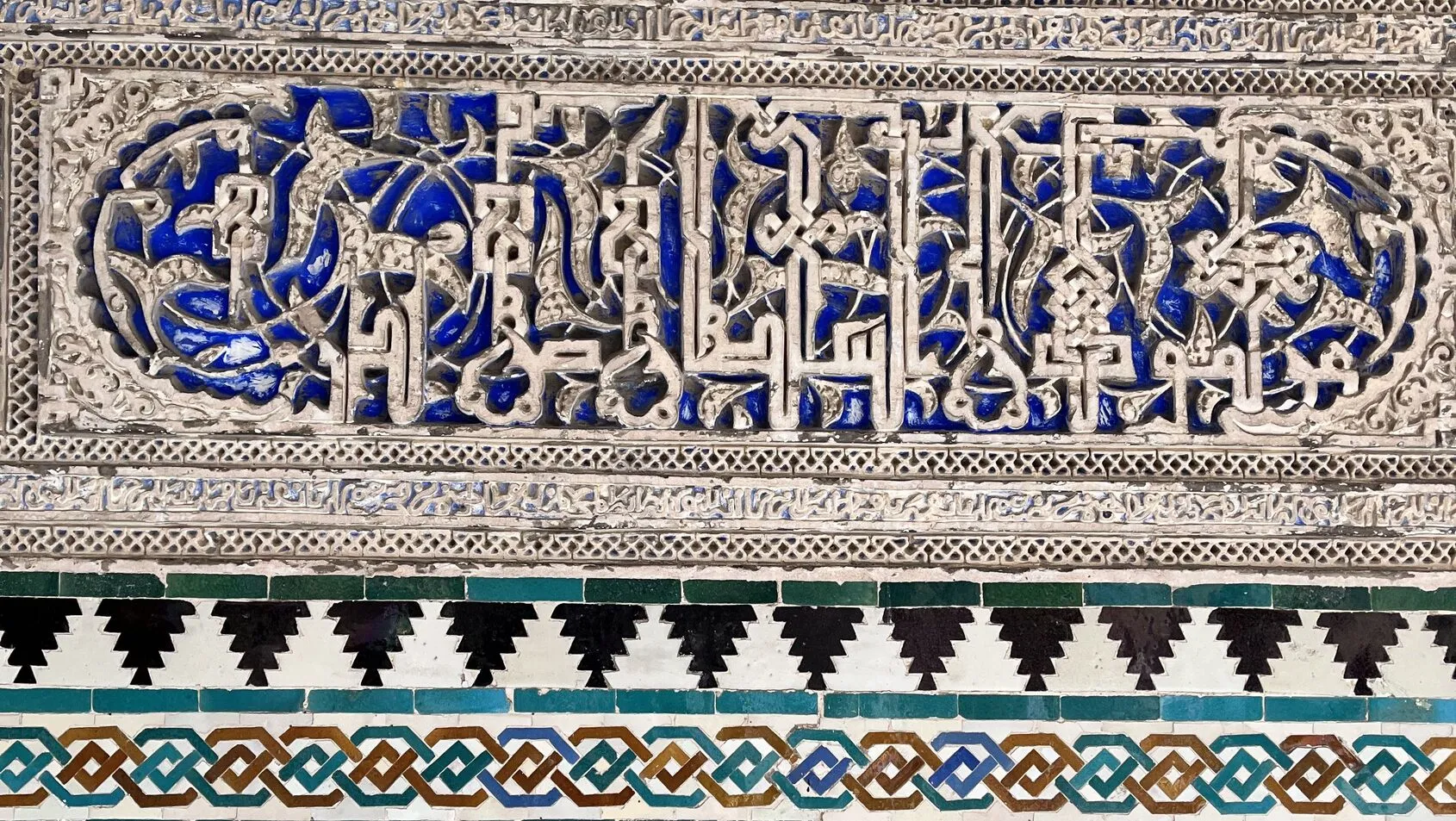
There is a fascinating contradiction in the details. On the walls of rooms built for Pedro I, you can still find Arabic calligraphy, religious phrases and inscriptions such as “There is no victor but God.”
The two cultures don’t simply sit next to each other here; they overlap.

Geometric patterns, carved plasterwork, colourful tiles and horseshoe arches appear throughout the palace and form much of the visual language you see as you move from room to room.
🏰 The Connection with the Alhambra
The easiest comparison is with the Alhambra in Granada. The Alhambra was built under Muslim rule, while the Alcázar shows how much of the same artistic language continued to be used under Christian kings.
The similarities are easy to spot in the tile patterns, bands of calligraphy, arches and the arrangement of the courtyards. Some of the craftsmen who worked on Pedro I’s palace were even brought to Seville from Granada.
👑 Still a Working Royal Palace
The Real Alcázar is not simply a historic monument. It is still an active royal palace, and the Spanish Royal Family uses it as an official residence when visiting Seville.
The complex is also continuously maintained and restored. Delicate features such as tilework, carved plaster and wooden ceilings require regular conservation, allowing the different historical layers of the palace to survive. The Alcázar has been a UNESCO World Heritage Site since 1987.
🎬 A Game of Thrones Filming Location
The Alcázar also appeared in Game of Thrones, where parts of the palace and gardens were used to represent the Water Gardens of Dorne.
The Patio de las Doncellas and several areas of the gardens appeared on screen with surprisingly few changes. Scenes involving Prince Doran Martell, the pools and the long arcaded walkways were filmed here.
If you watched the series, some of these places are instantly recognisable when you walk through them.
🏰 Entering the Palace: The First Courtyard
Once you pass through the ticket entrance, you find yourself in a quiet open space. It feels less like a traditional courtyard and more like a broad threshold in front of the palace — almost a small square.
This is essentially a crossroads. There are buildings on either side, while straight ahead an ornate façade immediately draws your attention.
That entrance leads to the main palace, and even from here it feels as though the real show is waiting behind those doors. We decided to save it for later and explore the surrounding sections first.

On the left side of the square, just beyond the entrance, there is a much more modest doorway. It isn’t particularly grand and would be easy to walk past without noticing.
That’s where we headed first.
🏛️ Palacio del Yeso
Compared with the main palace, the Palacio del Yeso is a quieter space and doesn’t take long to explore. A small pool sits in the middle, providing both a focal point and a way of cooling the space. The ceiling is also noticeably simpler than those in the more elaborate rooms elsewhere in the Alcázar. Historically, this area is thought to have been used for judicial purposes.
Continue through and you reach the Patio del Yeso, a small courtyard considered part of the oldest surviving sections of the palace.
The plaster decoration around its arches is particularly interesting — yeso means plaster in Spanish — and preserves an early example of the architectural style developed here during the Al-Andalus period.

After exploring this side of the complex, we returned to the square. The entrance to the main palace was still directly ahead, but we weren’t going in just yet.
This time, we turned right towards the two-storey building on the opposite side: the Casa de la Contratación.
🏛️ Casa de la Contratación
You could describe this building as a kind of “headquarters” where some of the foundations of the modern world were laid. Founded in 1503, the Casa de la Contratación was the main institution responsible for managing Spain’s connections with the New World. Calling it simply an “office” would hardly do it justice; it functioned almost like a ministry of trade, a maritime school and an intelligence centre all at once.
Records of ships leaving for the Americas were kept here, their cargoes were registered and sealed, and decisions about who could cross the Atlantic were made here. Likewise, gold, silver and exotic goods arriving from the Americas were registered and inspected here.
What makes walking through these rooms particularly interesting is knowing the history connected to them. Christopher Columbus met with the monarchs here after returning from America, while Magellan made preparations for his voyage around the world within the Casa de la Contratación.
Inside, the architecture feels orderly and functional. There is decoration, but nowhere near the intensity you find in other parts of the palace. Look more closely, though, and there are some beautiful details. The staircase in particular stands out, with extensive tilework covering the walls and the areas around the steps.
Another interesting part is the small chapel, where you can see religious paintings and decorative details. Areas connected with the maps and information gathered during the voyages of exploration were also located here.
Upstairs, there is an exhibition area displaying ceramic and tilework pieces.
🏰 The Magnificent Palace: Palacio del Rey Don Pedro
We return to the square and this time head towards the main entrance. We pass through the lace-like façade we had been admiring from a distance and finally step inside. The open, airy feeling of the square disappears almost instantly, replaced by a dense, almost dizzying world of detail where practically every surface seems to have been worked by hand.
👑 Salón de los Embajadores (Hall of Ambassadors)
Once inside, you reach the room where the palace really seems to show off: the Salón de los Embajadores. Built during the reign of King Pedro I in the 14th century, this was the palace’s formal reception hall. For centuries, kings received foreign ambassadors here, using the room as a setting for displaying power and splendour.

The wooden dome, dominated by golden tones, immediately draws your eyes upwards. It looks almost like a single piece, but it is actually made from hundreds of smaller elements arranged into a geometric pattern. The pattern builds layer by layer, creating a remarkable sense of depth as it rises towards the centre.

The same approach continues across the walls. Tiles cover the lower sections up to a certain height, while delicate plasterwork takes over above them. The transition naturally draws your eyes upwards and makes the room feel even taller.
The Andalusian forms used in the arched passages and the columns supporting them are just as carefully worked. Even the structural elements become part of the decoration. There is a very clear sense of symmetry throughout the room. No single detail dominates, but together they create a powerful overall effect.
⛲ The Heart of the Palace: Patio de las Doncellas
Just a few steps from the Hall of Ambassadors, you enter the view that many people immediately associate with the Alcázar: the Patio de las Doncellas, the palace’s main courtyard.

The first thing you notice is the long, narrow pool running through its centre. The surface of the water is often almost completely still, reflecting the arches, columns and upper level with remarkable clarity. Standing in the middle, the real architecture and its reflection almost seem to merge.
The effect makes the balance and symmetry of Andalusian architecture much easier to appreciate. There is something slightly dreamlike about the whole scene, almost as if it had been deliberately arranged like a stage. It really does feel like a scene from the One Thousand and One Nights.
The architectural language of the courtyard comes directly from the Andalusian tradition. Its arches, decoration and treatment of surfaces follow a similar aesthetic to the Alhambra. Horseshoe arches, slender columns and their intricately carved capitals are some of the clearest examples.
The walls are decorated in layers. Tiles cover the lower sections in ordered, repeating patterns. Above them, the plasterwork takes over and the level of detail becomes noticeably more intense.

Another thing you notice in the courtyard is how cool it feels. In Seville’s hot climate, water features like this were not included purely for appearance; they also had a practical purpose. The pool and surrounding stone surfaces help moderate the heat and create a noticeable sense of coolness inside the courtyard.
Leaving this courtyard really isn’t easy — although, to be fair, you could say that about almost every part of the palace.
🏛️ Rooms Around the Courtyard: A Closer Look
The rooms surrounding the Patio de las Doncellas take you from the palace’s broad open spaces into a more private and detail-focused world. These areas were designed as semi-private royal living spaces and smaller reception rooms.

As you move through them, long corridors lead into a series of smaller rooms. At first, many seem to follow a similar layout, but look more closely and you realise that none are exactly alike. The tile patterns, wooden ceilings and plaster decoration keep changing in subtle ways.

The windows are particularly interesting. From outside, some look like simple openings, but inside they deepen into niches, giving the surrounding decoration much more space to develop.
There is an extraordinary amount of detail around the windows and balustrades. Geometric motifs, star patterns and decoration associated with Islamic art overlap across the surfaces. If you look carefully, you can also find different symbols worked into the designs, including the word “Allah” and the Star of David. The decoration is not purely aesthetic; there is a symbolic layer woven into it as well.

These may not be the largest rooms in the palace, but in terms of craftsmanship, they are among the areas that caught our attention the most.
🤍 Patio de las Muñecas (Courtyard of the Dolls)
Continue through one of the rooms opening from the main courtyard and you eventually reach a much smaller space: the Patio de las Muñecas.
Despite rising through three levels, the courtyard remains open to the sky, which gives the compact space a surprising sense of airiness.

The surrounding structure is almost entirely white and covered with incredibly fine decoration. Arches, columns and carved surfaces repeat across each level in an almost perfect rhythm. Because the courtyard is so small, all of this detail remains close to eye level. Instead of looking at it from a distance, you can examine the fine carving on the arches and columns from just a few steps away.
This is thought to have been a more private part of the palace, connected with the everyday life of the royal family. It is modest in size, but the craftsmanship makes it another memorable part of the Alcázar.
👑 Cuarto Real Alto (Upper Royal Apartments)
As you explore the palace, look up and you will notice windows and enclosed balconies on the upper floors. This is the Cuarto Real Alto.
These rooms are still used as the official residence of the Spanish Royal Family when they visit Seville. So while you are exploring a historic palace downstairs, there is still an active royal residence directly above you.
The upper apartments are reached by a narrow staircase beside the Patio de las Doncellas. They require a separate ticket in addition to general admission. Inside are rooms furnished largely in an 18th-century style, with velvet upholstery and large chandeliers.
We didn’t visit this section, but if you have enough time, it offers a chance to see a very different side of the palace.
🏛️ Palacio Gótico
Continuing through the main palace, a narrow passage eventually brings you to a very different building at the rear: the Palacio Gótico.
The detailed, geometric architecture with its strong Andalusian influence suddenly gives way to something simpler and much more distinctly Gothic in character.
This section was built in the 13th century under King Alfonso X of Castile and was later remodelled in the Gothic style. Compared with the rest of the palace, the rooms have higher ceilings, broader proportions and much simpler surfaces.

Large tapestries covering the walls immediately stand out. They generally depict historical events and military scenes, with Spain’s wars, victories and other important moments presented almost scene by scene. Human figures, armies, cities and battles are woven into the fabric in considerable detail.
In short, the Palacio Gótico is a relatively brief stop, but it shows just how varied the architecture of the Alcázar can be.
From here, we head back outside and into the gardens.
🌿 The Alcázar Gardens: Beyond the Palace
After leaving the rooms filled with stonework, tiles and carved plaster, you discover a completely different side of the Alcázar: its gardens.
This isn’t simply a small green space added behind the palace. The gardens form a large complex of different sections, expanded by successive rulers over the centuries.
The same sense of order you see inside the palace continues outdoors. Paths, pools, fountains and trees are all part of a clear design, but the strict symmetry of the interiors gives way to a much more relaxed atmosphere.
🌳 Walking Through the Gardens
You don’t immediately realise just how large the gardens are. New sections keep appearing as you walk, taking you from broad lawns into groves of orange trees and then along paths lined with tall palms. One moment you are standing in an open space; a few minutes later you are walking between high hedges or beneath the trees.
The scent of orange blossom is particularly noticeable in areas with orange trees. When we visited, you could smell it throughout much of the gardens.

Water appears almost everywhere as well. Small pools, channels and fountains are woven into the layout rather than simply added as decoration.
A good example is the Estanque de Mercurio, or Mercury Pond. From the higher level overlooking it, you get a much clearer sense of how the water, trees and paths have been planned together.

🦚 The Residents of the Gardens
You’re not alone in the gardens. After walking around for a while, you start coming across peacocks. They wander freely through the grounds and sometimes appear from a corner when you least expect them.
The peacocks aren’t simply a modern addition for visitors. Different animals were historically kept in the Alcázar gardens, and keeping exotic species in palace grounds was also a display of wealth and power. Today, the peacocks feel like a much more modest continuation of that tradition, wandering around as though they have always belonged here.
🌿 The Maze
For us, the maze was the most entertaining part of the gardens to explore with the kids.
From the outside, it doesn’t look particularly complicated. Once you step between the high hedges, though, things change quickly. After a few turns, the paths start looking remarkably similar and it becomes surprisingly easy to lose track of where you came from.
We took the wrong turn more than once and had to double back. The kids, meanwhile, had a much more important concern than the history or landscape design of the gardens: who could find the exit first?
We spent quite a bit of time here.
🧱 Looking Over the Gardens from the Walls
The old walls rising along the edge of the gardens may look like nothing more than a boundary at first. But at one point, a narrow staircase takes you up onto them, where you can walk along the top.
For me, this is where you really understand the scale of the gardens.

From ground level, the rows of trees, pools, paths and separate garden sections can seem almost independent from one another. From above, they suddenly become parts of a single plan.
Even the maze we had just struggled to find our way through looks tiny — and rather easy — from up here.
🕳️ Baños de Doña María de Padilla
After walking through the gardens, we started making our way back towards the palace when we noticed a section hidden beneath the winding paths and stairways. Head down the steps and you reach the Baños de Doña María de Padilla.
At first glance, the name might make you think these were “baths”, but they were actually underground pools used for water storage and cooling. The space is long and narrow, with a series of arches running alongside one another and water stretching beneath them.

The reflections are what make this place so striking. The arches above are mirrored almost perfectly in the still water below, and the low light makes the effect even stronger. Stone, arches and water come together to create a scene quite unlike anything else in the palace.
The reflections also made this a particularly good place to stop for a few photos.
🏁 Final Thoughts
After walking through the palace’s famous courtyards and finding our way through the maze in gardens scented with orange blossom, we eventually started heading towards the exit.
But leaving the Alcázar straight away wasn’t that easy.
We turned back towards the inner courtyards and walked through them once more. There was something about seeing the same details again, stopping at a few corners we had passed earlier and simply spending a little more time inside before leaving.
If you ever find yourself in Seville, do yourself a favour and take one more walk through these palace corridors for us too.
Keep Exploring
→ Seville Travel Guide — Explore our complete Seville itinerary, including the Alcázar, the city’s historic streets, landmarks and the other places we visited.
→ Andalusia Road Trip & Travel Itinerary — Follow our complete journey through Andalusia, including Seville, with all our stops and the route we took along the way.
Yorumlar
Comments