

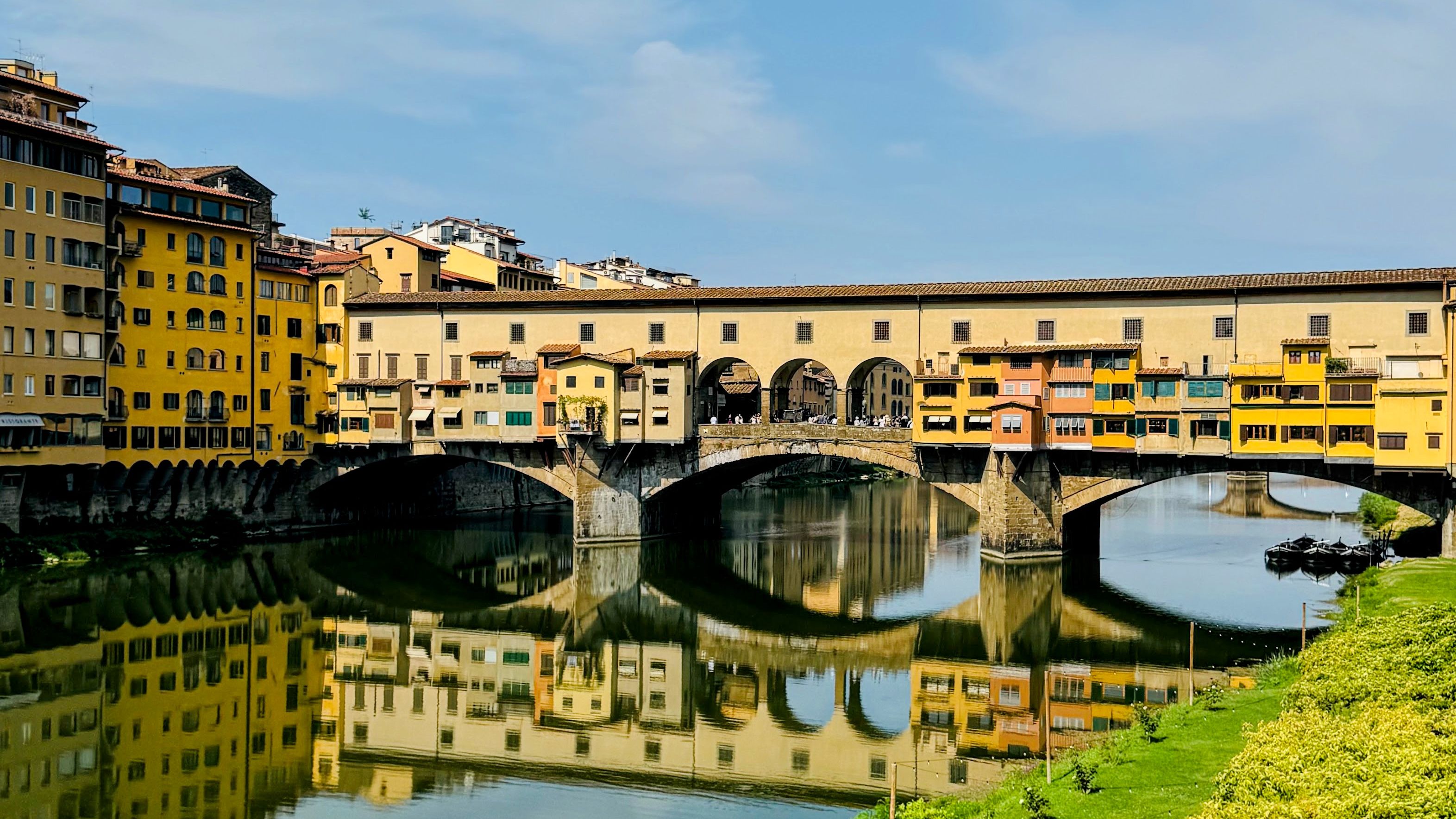


Córdoba is one of the first cities that comes to mind when people think of Andalusia. While most travelers come to Córdoba because of the Mezquita, one of the city’s most famous landmarks, the city has much more to offer. With its orange-tree-lined streets, a Roman bridge that has stood for centuries, the beautiful gardens of the Alcázar, and a rich heritage shaped by Islamic, Christian, and Jewish cultures, it is one of the best places to experience the true spirit of Andalusia.
During our Andalusia road trip, we spent a day exploring Córdoba. We wandered through the mesmerizing interior of the Mezquita, strolled around the fairy-tale gardens of the Alcázar, watched the sunset over the Guadalquivir River, and got lost in the historic streets that take on a completely different atmosphere after dark. Before arriving, our expectations were largely centered around the Mezquita. By the end of the day, however, Córdoba had given us far more than we had anticipated.
In this guide, I’ll walk you through our day in Córdoba step by step, sharing the historic landmarks, squares, viewpoints, restaurants, and practical travel tips that helped us make the most of our visit.
If you’re planning a trip to Andalusia and wondering what to see in Córdoba, join us as we explore this city through its orange-scented streets.
⚡ Córdoba at a Glance
🕒 Duration: 1 day
🚶♂️ Walking: 15+ km
💸 Total Cost (2 Adults + 2 Children): ~€276
👤 Per Person: ~€69
🎟️ Tickets: Mezquita + Alcázar (€47)
🚗 Parking: ~€12
🍽️ Food & Drinks: ~€54
🏨 Accommodation: ~€146
💶 Other Expenses: ~€18
🔥 Highlights: Mezquita · Alcázar de los Reyes Cristianos · Roman Bridge · Guadalquivir River · Plaza del Triunfo · Puerta del Puente · Plaza de la Corredera · Historic Center
* Prices are based on our expenses from January 2025.
🍊 First Impressions of Córdoba
After finishing our explorations in Toledo, the previous stop on our Andalusia road trip, we set off for Córdoba, the fourth destination of our journey. We left around 10:30 AM and spent roughly three hours driving through Spain’s characteristic plains before arriving in Córdoba at around 1:45 PM.

The first thing that caught our attention was that almost every street seemed to be lined with orange trees. Since we visited in early February, we happened to be there during the orange harvesting season. Throughout the city center, we frequently saw municipal workers and vehicles collecting oranges. Some streets were even temporarily closed to traffic because of the ongoing work. Seeing hundreds of oranges hanging from trees along the roads gave Córdoba a very distinctive character.
After the cooler weather in Madrid, it was also nice to feel spring-like temperatures again. The sunny streets and the scent of oranges immediately brought us back to the Andalusian atmosphere we had been enjoying throughout the trip.
Compared to other popular Andalusian cities such as Granada and Seville, Córdoba feels smaller, more compact, and noticeably quieter. The Mezquita is clearly the focal point of the city. As you approach the historic center, its centuries-old walls and massive stone structure gradually begin to dominate the skyline.
🏨 Where We Stayed: Eurostars Conquistador
For our stay in Córdoba, we chose the Eurostars Conquistador Hotel, located right next to the Mezquita. It would be difficult to find a better location. The moment you step outside the hotel, you find yourself standing in front of the city’s most important landmark.
🅿️ How We Solved the Parking Situation in Córdoba
If you’re visiting Córdoba by car, one of the most important things to know is that much of the historic center is restricted to vehicle traffic. The area surrounding the Mezquita cannot be accessed without special authorization. We entered the hotel address directly into our navigation system and quickly found ourselves driving through narrow streets and dead ends. While trying to figure out the correct route, we crossed the river several times and spent nearly half an hour circling around the city center. 🙂
Once we finally understood what was happening, we decided to forget about the hotel for the moment and focus on finding a parking garage first. Shortly afterward, we arrived at Parking La Ribera, located just outside the historic center. The location was excellent, and the prices were reasonable. Our car remained parked there for the rest of our stay in Córdoba. Since all of the city’s major attractions were within walking distance, we never needed to use it again.
After walking to the hotel and completing check-in, we took a quick look around. The hotel’s courtyard was particularly beautiful, resembling the traditional patio architecture found in classic Andalusian homes. The rooms also featured authentic details that matched the city’s historic atmosphere.

As soon as we dropped off our luggage, we headed straight back outside. Just a few steps away stood the Mezquita, a place we had admired for years through photos and videos. Excited to finally see it in person, we set our course directly toward Córdoba’s iconic landmark.
🕌 The Heart of Córdoba: The Mezquita
Today officially known as the Mezquita-Cathedral of Córdoba, this monument is considered one of the most important landmarks not only in Córdoba and Andalusia but also in the history of world architecture. Construction began in the 8th century during the Umayyad period of Al-Andalus, and the structure was expanded over the centuries by successive rulers, eventually becoming one of the largest mosques of its time. Today, it welcomes visitors as a truly unique monument that combines both a mosque and a cathedral under one roof—something rarely found anywhere else in the world.

From the outside, its high walls, imposing gates, and relatively simple appearance make it feel almost like a fortress. Beyond those walls lies the peaceful Patio de los Naranjos, filled with its famous orange trees. Once inside, visitors are greeted by the seemingly endless rows of red-and-white arches and an interior that resembles a vast forest of columns.

Naturally, the Mezquita was the first place we headed after arriving in Córdoba. Having read about it in history books and watched countless documentaries over the years, our expectations were naturally very high. While the architecture was undoubtedly impressive, we also experienced a slight sense of disappointment when we saw some of the later modifications made to the original structure. The transformations the monument has undergone throughout its history, along with many other details, deserve a much more in-depth explanation than we could fit into this article.
I’ve prepared a separate, comprehensive guide covering the Mezquita in detail. In it, you’ll find everything from its history during the Al-Andalus period to the stunning mihrab, the cathedral section built within the mosque, practical ticket information, and the parts of the monument that impressed us the most during our visit.
→ Mezquita-Cathedral of Córdoba Visitor Guide — Explore the monument’s history, architecture, ticket information, and our practical tips for planning your visit.
🏰 Alcázar de los Reyes Cristianos
When we arrived at the Alcázar de los Reyes Cristianos (Palace of the Christian Monarchs), we never expected it to be this impressive or this beautiful. Naturally, all of our excitement and attention in Córdoba was focused on the Mezquita. In our minds, the Alcázar was simply another attraction worth visiting since it was nearby.
Our first impressions actually reinforced that assumption. We were greeted by thick stone walls, small courtyards, and relatively modest exhibition spaces. But as we continued exploring the palace and eventually stepped through the doors leading to the gardens, our opinion changed completely.
🌿 One of the Finest Examples of Andalusian Garden Design
Long, perfectly symmetrical water channels, enormous reflecting pools mirroring the sky, orange and lemon trees heavy with fruit, towering palm trees, colorful plants, decorative fountains, and beautifully maintained landscaping… Rather than feeling like a palace garden, the entire place looked like a scene from an Arabian Nights fairy tale.

The gardens of the Alcázar are considered one of the finest surviving examples of Andalusian and Moorish garden design. What impressed us most was the way water is used throughout the complex. The long pools, narrow channels, and gently flowing fountains do more than create visual beauty—they also provide a sense of coolness and tranquility in Córdoba’s famously hot climate.

One area that particularly caught our attention was the Paseo de los Reyes (Walk of the Kings). Large stone statues representing rulers who shaped Córdoba’s history stand among the greenery and reflecting pools. Combined with the palm trees rising behind them, the result is a truly impressive sight.

During our visit, the afternoon sun was beginning to cast its golden light across the gardens. The immaculate condition of the grounds played a major role in creating this almost magical atmosphere. Carefully shaped pine trees and palms meant that every direction seemed to offer another perfect photo opportunity. Walking through all this greenery with the kids was a lot of fun. We may also have helped ourselves to a few mandarins along the way. 🙂
🏛️ From Roman Foundations to the Spanish Inquisition
The Alcázar is not a monument tied to a single period of history. The site originally contained Roman and Visigoth structures before being expanded during the Umayyad period of Al-Andalus into a grand caliphal palace known as Al-Cázar.
After Córdoba was captured during the Reconquista, the fortress became one of the principal residences of the Catholic Monarchs, Queen Isabella I and King Ferdinand II. It was within these very walls that Christopher Columbus received the royal approval and financial backing that would eventually lead to his voyage to the Americas.
The site also has a darker chapter in its history. For centuries, it served as a headquarters of the Spanish Inquisition, housing courtrooms, prison cells, and interrogation chambers.
🏛️ Exploring the Peaceful Courtyards
As you wander through the gardens accompanied by the sound of flowing water, you’ll come across several beautiful courtyards. One that particularly stood out to us was the Patio Morisco (Moorish Courtyard). The elegant Islamic design, featuring fountains, water channels, symmetry, and carefully shaped trees, blends beautifully with later additions made by the Christian rulers.

Courtyards, or patios, were an ingenious feature of Andalusian architecture, designed to cool living spaces naturally during the intense summer heat. Even though we visited in February, we could still feel a noticeable drop in temperature whenever we stepped into these shaded spaces. They have a calm and peaceful atmosphere that invites you to slow down and simply enjoy the surroundings.
🏛️ Views of Córdoba from the Alcázar Walls
After spending plenty of time exploring the gardens and courtyards, we climbed up to the fortress walls and watchtowers.

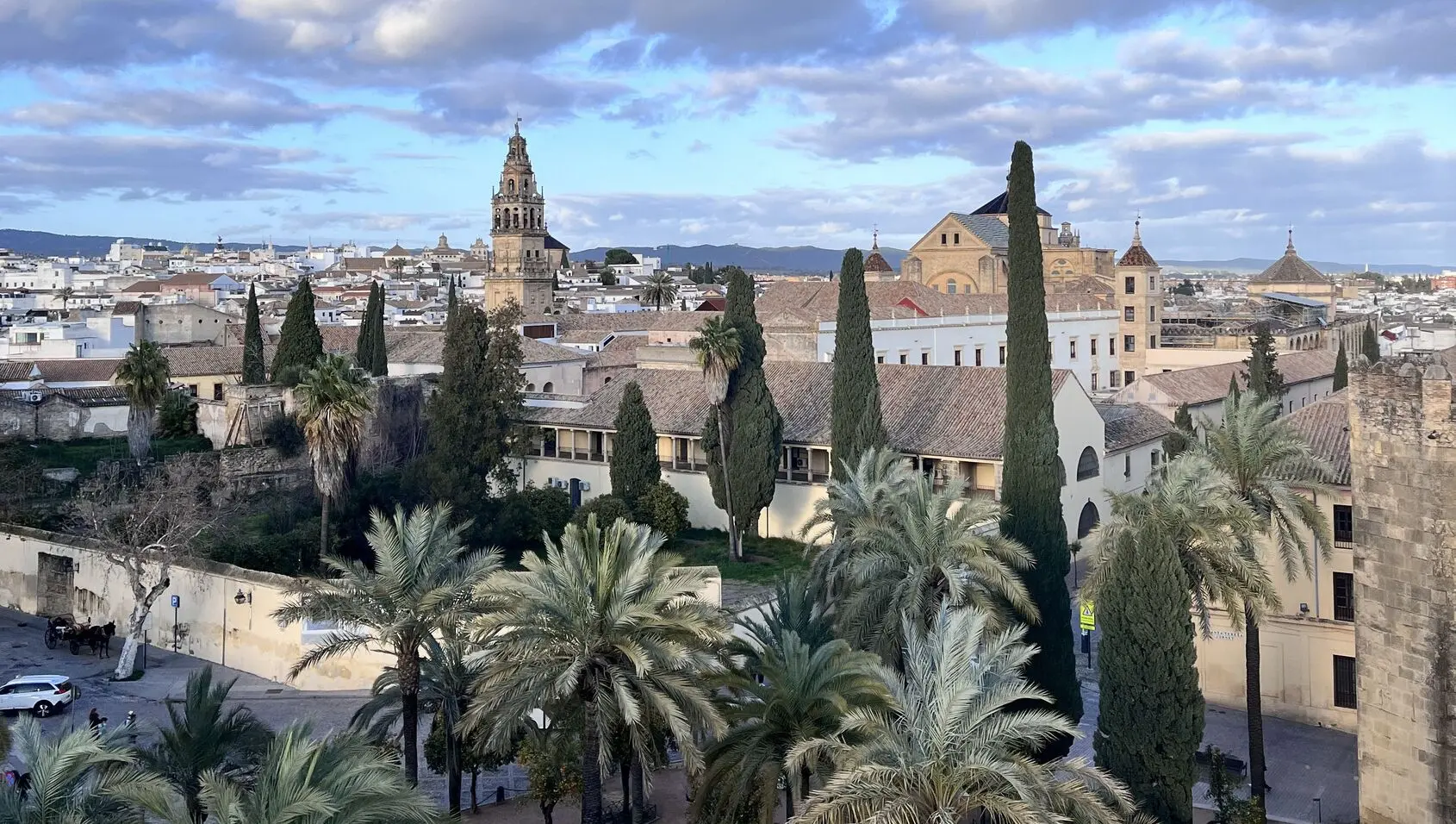
The climb was absolutely worth it. From the top, we had a fantastic view over Córdoba. Below us stretched the symmetrical gardens we had just wandered through, filled with palm trees, orange trees, and reflecting pools. Turning slightly, we could also see the bell tower of the Mezquita rising prominently above the city.
As we stood on the ancient walls taking in the view, it was easy to imagine ourselves in the prosperous days of Al-Andalus. Red-tiled rooftops, palm trees, centuries-old stone walls, and a historic cityscape extending toward the horizon created a scene unlike anywhere else we visited in Spain. There is a distinctly Moorish character to Córdoba’s skyline, and from up here it becomes impossible to miss.
🌉 The Guadalquivir River and the Historic Roman Bridge
After spending a wonderful afternoon exploring the gardens and walls of the Alcázar, we followed the riverside promenade toward one of the best viewpoints in Córdoba. Before long, we found ourselves in the Plaza del Triunfo area.
🏛️ Plaza del Triunfo and Puerta del Puente
Plaza del Triunfo is located at the intersection of several of Córdoba’s important historic landmarks. Turn one way and you’ll see the imposing walls of the Mezquita rising above the city. Turn the other, and the ancient Roman Bridge stretches across the Guadalquivir River. Thanks to its strategic location, this area has served as one of the city’s busiest and most important hubs for centuries.

Striking monuments in the square is the Puerta del Puente (Bridge Gate). At first glance, it resembles a classic Roman triumphal arch. In reality, it was built as the ceremonial gateway for travelers entering the city from across the river via the Roman Bridge. Although the structure we see today was redesigned during the 16th century, the site itself has served as one of Córdoba’s prestigious entrances since Roman times.
🌊 The Guadalquivir River: The Lifeline of Andalusia
Leaving Puerta del Puente behind, we began walking toward the bridge and were greeted by the Guadalquivir River. Before arriving in Córdoba, we had no idea the river would be so wide. On a map, it looks like an ordinary waterway, but standing on its banks tells a very different story.
The Guadalquivir is one of Spain’s largest and most important rivers. It originates in the Sierra de Cazorla mountains in eastern Andalusia and travels roughly 650 kilometers before eventually reaching the Atlantic Ocean near Seville, one of the next destinations on our trip. Throughout history, this river played a vital role in the development of Córdoba, the growth of trade routes, and the rise of Al-Andalus as a major cultural center.
Even today, you can clearly see the impact it has on the region. The fertile farmland surrounding the city, the endless olive groves, and even the orange trees that welcomed us throughout Córdoba all owe their existence to the water supplied by this river.
🌅 Sunset on the Roman Bridge
Our route eventually led us onto Córdoba’s most famous landmark, the Roman Bridge (Puente Romano). Stretching approximately 330 meters and supported by 16 massive arches, this pedestrian bridge connects both sides of the Guadalquivir River.
Originally built during the Roman era, traditionally associated with the time of Julius Caesar, the bridge has stood for nearly two thousand years. Although it has undergone numerous restorations throughout its long history, it still retains the spirit of Roman engineering. Its impressive length alone is enough to demonstrate the scale of the river beneath it.

By the time we reached the bridge, the sun was slowly approaching the horizon. Golden light reflected across the river’s surface, while the ancient stonework glowed with warm colors. A gentle breeze drifted along the water, and the combination of the historic skyline, the river, and the deep orange hues of the evening sky created what was probably the most memorable moment of our entire visit to Córdoba.
Even now, I can still remember the colors of that evening and the sense of peace we felt standing there. If you’re visiting Córdoba, I highly recommend making sure you’re on the Roman Bridge at sunset.
🌙 An Evening Walk Through Córdoba’s Illuminated Streets
After watching that sunset from the Roman Bridge, we made our way back toward the historic center. However, the Córdoba we encountered under the glow of streetlights felt noticeably different from the city we had explored during the day.
The streets that had charmed us with their whitewashed walls, flower-filled balconies, and peaceful atmosphere now felt much livelier thanks to illuminated shopfronts, busy restaurants, and evening crowds. As we wandered through the narrow stone alleys, we would suddenly emerge into small plazas before disappearing once again into another side street. Córdoba is one of those cities where it’s often better to stop following a map and simply allow yourself to get lost. Some of our favorite discoveries came when we did exactly that. After meandering through countless alleys and hidden corners, we eventually found ourselves in Plaza de la Corredera.
🏛️ Plaza de la Corredera
Plaza de la Corredera is one of Córdoba’s most unusual squares. At first glance, it feels more like a grand square in Madrid or even Italy than something you would expect to find in Andalusia. Unlike the irregular and intimate plazas commonly seen throughout the region, this one features a perfectly rectangular layout surrounded by uniform arcaded buildings.

Built during the 17th century, the square has served many purposes throughout its history, including markets, celebrations, bullfights, and public events. Today, the ground floors are lined with restaurants and cafés, making it one of the city’s favorite gathering places in the evening. We spent some time sitting there, relaxing and watching local life unfold around us.
🌊 An Evening Stroll Along the River
After leaving Plaza de la Corredera, we once again allowed ourselves to drift through the maze of side streets. Before long, we found ourselves back on the banks of the Guadalquivir River.
The river was almost entirely hidden in darkness, with only a few dim lights reflecting on the water. More than anything, you could hear it rather than see it. As we slowly made our way toward the hotel, we spotted a restaurant called Taberna La Manuela and decided it looked like the perfect place to stop for dinner.
🍽️ Dinner at Taberna La Manuela
We immediately liked the traditional atmosphere inside. Andalusian-style ceramic tiles, wooden details, and local decorative touches gave the restaurant a warm and welcoming feel. From the outside, it looked somewhat touristy, but once inside, it felt surprisingly authentic.

This was where we decided to try one of Spain’s signature dishes: seafood paella. It turned out to be an excellent choice. The paella was flavorful and well prepared, while the kids happily ordered pizza from the menu. The food quality and service were both very good, and the prices felt reasonable as well. It’s a place we would happily recommend.
☕ The Quiet Streets Around the Mezquita at Night
After dinner, we returned to the hotel and put the kids to bed. Later that evening, my wife and I decided to head back out for one last walk before ending the day.

Our destination was the area surrounding the Mezquita, located just steps from our hotel. During the day, the area is packed with visitors from around the world. At night, however, it transforms completely. The crowds disappear, leaving behind a peaceful silence that feels almost magical.
The centuries-old exterior walls of the Mezquita are beautifully illuminated with warm golden lighting. As we walked around, we also noticed decorative details on the walls that had escaped our attention earlier in the day. We grabbed coffees from a café that was just about to close and spent some time enjoying the quiet atmosphere before finally returning to the hotel.
👋 Farewell Córdoba, Onward to New Adventures
After a packed and memorable day in Córdoba, we woke up early the following morning. Despite the busy schedule, we had managed to see a remarkable amount in a relatively short time and gained a much deeper appreciation for one of Andalusia’s most historic cities.
Before hitting the road, we enjoyed breakfast at our hotel. I should mention that the breakfast at Eurostars Conquistador exceeded our expectations. The buffet offered both excellent variety and quality. One of our favorite discoveries was pan con tomate, a traditional Spanish breakfast consisting of toasted bread topped with olive oil and fresh tomato. It suited our tastes perfectly. Combined with fresh fruit, cheeses, and plenty of other options, it made for a fantastic start to the day. If you’re planning to stay at this hotel, I would definitely recommend including breakfast with your reservation.

After breakfast, we checked out, picked up our car from Parking La Ribera, and continued our Andalusian road trip.
The endless columns of the Mezquita, the fairy-tale gardens of the Alcázar, the sunset over the Guadalquivir River, and our evening walk through the softly illuminated streets all made Córdoba one of the highlights of our Andalusia itinerary. Shaped by centuries of Islamic, Christian, and Jewish influence, the city offers one of the richest and most atmospheric glimpses into Andalusia’s past.
We came to Córdoba for the Mezquita. By the time we left, it was only one of many things we would remember about the city.
Now it was time to turn our attention toward Seville, often considered the heart and capital of Andalusia. A pleasant drive of about an hour and a half lay ahead, leading us to another exciting chapter of our journey through southern Spain.
Continue Exploring
→ Seville Travel Guide — Discover the places we visited, what we experienced, and our practical tips for exploring the city.
→ Andalusia Itinerary — Follow our complete route through southern Spain, including Córdoba, Seville, Granada, and every stop along the way.
Yorumlar
Comments