



The Royal Palace of Madrid draws huge numbers of visitors, but it’s only once you step inside that you realise just how impressive it really is. Grand staircases, rooms covered in gold detailing, frescoes stretching across entire ceilings, spaces decorated with porcelain, the Royal Chapel, the magnificent Banquet Hall used for state ceremonies, and the Crown Room displaying symbols of the Spanish monarchy — every part of the palace has a completely different atmosphere.
Built to represent the power of the Spanish monarchy, the enormous palace constantly changes character as you move from one room to the next. Some are dominated by elaborate gold decoration, while others draw your attention to tapestries, huge chandeliers, historic paintings or intricate porcelain work.
We’ll start with a short look at the palace’s history, then follow the same route we took through the building — from the inner courtyard and Grand Staircase to the Gasparini Room, Banquet Hall, Royal Chapel and Throne Room.
ℹ️ Practical Information & Tips
I definitely recommend buying your tickets online in advance. It saves you from having to wait in an additional ticket queue when you arrive, which can get quite long during peak season and around midday.
Going at the first entry time in the morning is a big advantage. Some of the rooms are fairly small, and once the crowds build up, it becomes much harder to stop and take in the details. If you want to explore the inner rooms, the Throne Room and the Banquet Hall more comfortably, an early start makes a real difference.
How long you need depends on how interested you are in the details, but around two hours is a good amount of time for most visitors. If you prefer not to rush through the rooms, you could easily spend longer.
If you’re visiting with children, don’t worry too much. The grand halls, enormous chandeliers, thrones and lion figures give them plenty to look at as well.
The Royal Palace is also a good option for a rainy or extremely hot day in Madrid. Most of the visit takes place indoors, so the weather won’t have much effect on your plans.
🏰 A Short History of the Royal Palace of Madrid
Long before the present-day Royal Palace was built, the site was home to a fortress dating back to the Muslim period of Al-Andalus, the site was home to a fortress dating back to the Muslim period of Al-Andalus. Built in the 9th century, it occupied it occupied a strategically important position in the city for many years.
After the area came under Christian rule, the fortress was gradually transformed into a royal residence. The old Alcázar, used by Spanish monarchs for centuries, was eventually destroyed by a major fire on Christmas Eve in 1734.
At the time of the fire, Philip V — the first Spanish king from the Bourbon dynasty — wanted to replace it with a new royal palace that could rival the great palaces of Europe. He was the grandson of Louis XIV of France and had grown up surrounded by the grandeur of Versailles. His new palace was intended to be more than just a royal residence; it was also meant to represent the power and splendour of the Spanish monarchy.
The result certainly lived up to that ambition. With around 3,400 rooms, the Royal Palace of Madrid remains one of the largest royal palaces in Europe today.
🚶♂️ Entering the Palace & First Impressions
Once you pass the ticket checkpoint, the first thing you come across is the palace’s vast inner courtyard. Located at the centre of the complex, this large open space was once used for official ceremonies, military events and royal receptions. It gives you an immediate sense of the palace’s monumental scale and also serves as one of the main connecting points between its different wings.
Today, the courtyard mainly serves as a passageway for visitors. People stop here briefly to take photos before heading off in groups towards different parts of the palace. It’s also a good spot to stop and take in the palace from the outside. From the middle of the courtyard, the symmetry of the façades and the sheer scale of the building become much easier to appreciate.
🖼️ The Grand Staircase and State Rooms
From the courtyard, the visitor route leads directly into the palace’s Grand Staircase. This is your first real introduction to the palace interiors, with the staircase leading up towards the formal rooms on the upper floor.

Directly opposite the staircase stands a statue of King Charles III of Spain. His depiction in a classical style reminiscent of a Roman emperor is no coincidence: the Bourbon dynasty placed great importance on presenting itself as part of Europe’s long imperial tradition. Statues like this were deliberately used to symbolise the authority of the monarchy, as well as order and state power.
What really draws your attention here, though, are the ceiling frescoes and the vast, high-ceilinged space surrounding the staircase. Despite the elaborate decoration and marble detailing, natural light pouring in from above gives the hall a surprisingly bright and open feel.

At the top of the main staircase, the route opens into the larger and more elaborate state rooms. The first of these is the Hall of Halberdiers, which was once used by palace guards and officials waiting to take part in formal ceremonies. Royal guests would pass through rooms like this before entering the more private areas of the palace.
Large embroidered tapestries cover the walls, while statues, bronze decorations and chandeliers add to the formal feel of the room.
🛋️ Inside the Palace Rooms
After the state rooms, the route continues into the palace’s private rooms. This is where the palace really starts to surprise you: every room has a completely different style. The colours, wall decorations, furniture, ceiling details and overall design change dramatically from one room to the next. After a while, the visit starts to feel like a long journey of discovery, with something new constantly catching your eye. You find yourself genuinely curious about what the next room will look like. Some rooms are covered almost entirely in gold detailing and elaborate decoration, while others use darker colours and a much heavier style.
The Gasparini Room
One of the palace’s most elegant spaces, the Gasparini Room takes its name from the painter Matías Gasparini, who designed it. Decorated in the Rococo style, the room was used as a royal bedroom during the reign of Charles III. Its interior has been preserved unchanged to this day, with marble floors, silver-embroidered tapestries, gold leaf and ornate mirrors creating a completely different atmosphere. While many of the palace rooms have a sense of imposing grandeur, the Gasparini Room feels more delicate, with intricate decoration that almost resembles fine jewellery.

The Porcelain Room
The Porcelain Room is one of the more unusual spaces in the palace. It looks completely different from the rooms around it, with walls and decorative surfaces covered from top to bottom in real porcelain pieces. With its floral motifs, relief work and intricate craftsmanship, the entire room almost feels like a single work of art. Created purely for decorative purposes in the 18th century, it has become one of the rooms that leaves the strongest impression on visitors.
Large textile decorations and tapestries frequently cover the walls throughout the palace. These woven pieces weren’t used purely for decoration; they also helped insulate the rooms. The palace is also home to works by world-famous artists including Velázquez, Goya and Caravaggio. You might come across one of these paintings tucked into the corner of a room or hanging along a corridor.

What stayed with me most was how difficult it was to take everything in. In one room you’re looking up at the ceiling frescoes; in the next, it’s the furniture, chandeliers or wall decorations that catch your eye. Some rooms are so detailed that a few minutes later you almost want to go back and look at them again. Believe me, it’s difficult to take everything in. And amid all that grandeur, I kept thinking about the fact that people once actually lived their everyday lives in these rooms.
🍽️ The Banquet Hall
As we moved through the rooms, still taking everything in, we eventually found ourselves in an incredible space: the Banquet Hall. Why incredible? Because neither words nor photos can really capture the scale and richness of this room. Wherever you look, there’s something else competing for your attention.
The hall actually took on its present form in the 19th century, when King Alfonso XII combined three separate rooms to create this enormous space. Its original purpose hasn’t changed: the hall is still used today for official visits and state banquets.

The extremely long mahogany table in the centre is hard to believe when you first see it. It can seat 144 people. Standing at one end, the other almost seems to disappear into the distance. The table was also designed with practicality in mind: after a banquet, it could be removed to clear the floor for dancing. So the hall wasn’t used only for formal dinners; it also served as an important ballroom for royal dances and celebrations.

The huge chandeliers, gold detailing and sheer amount of craftsmanship are incredible. You can take photos, but believe me, nothing you see on a screen quite captures what it feels like to stand in that room. Standing there, the history of the room feels much more immediate. Large candelabras, silver jugs, ornate tableware and countless decorative details mean there’s always something else to notice.
I’ve only encountered an interior this rich and elaborate once before: the Grand Foyer inside the Palais Garnier in Paris. I wrote about its atmosphere in more detail in another post.
🎻 Exhibition Areas and the Royal Chapel
After the state rooms and private chambers, the route continues into the exhibition areas. This part of the visit shows that the palace isn’t just about lavish ceremonial spaces; it also preserves plenty of details from everyday life at the royal court.
The first section displays objects from the old palace kitchens. The kitchens of the Royal Palace of Madrid are considered among the best-preserved royal kitchens in Europe. Large copper cooking utensils, serving equipment, ornate cutlery and various objects related to the dining culture of the period are all on display here.

The collection of musical instruments is also interesting. Guitars, violins, cellos, organs, pianos and gramophones from different periods are displayed as part of the collection, some of them with remarkably detailed decoration.

From here, the route leads to the Royal Chapel, where the lavish decoration seen throughout the palace continues without missing a beat. High domes, extensive gold detailing, large marble columns, an enormous organ and intricate frescoes covering the ceiling immediately draw your attention. The scale and height of the chapel give the space a distinctly grand atmosphere. In the past, it was used by the royal family for religious ceremonies and private services.
👑 The Crown Room – Royal Treasury
At the end of the exhibition areas, you come to the Crown Room, where some of the Spanish monarchy’s most important symbols are displayed.
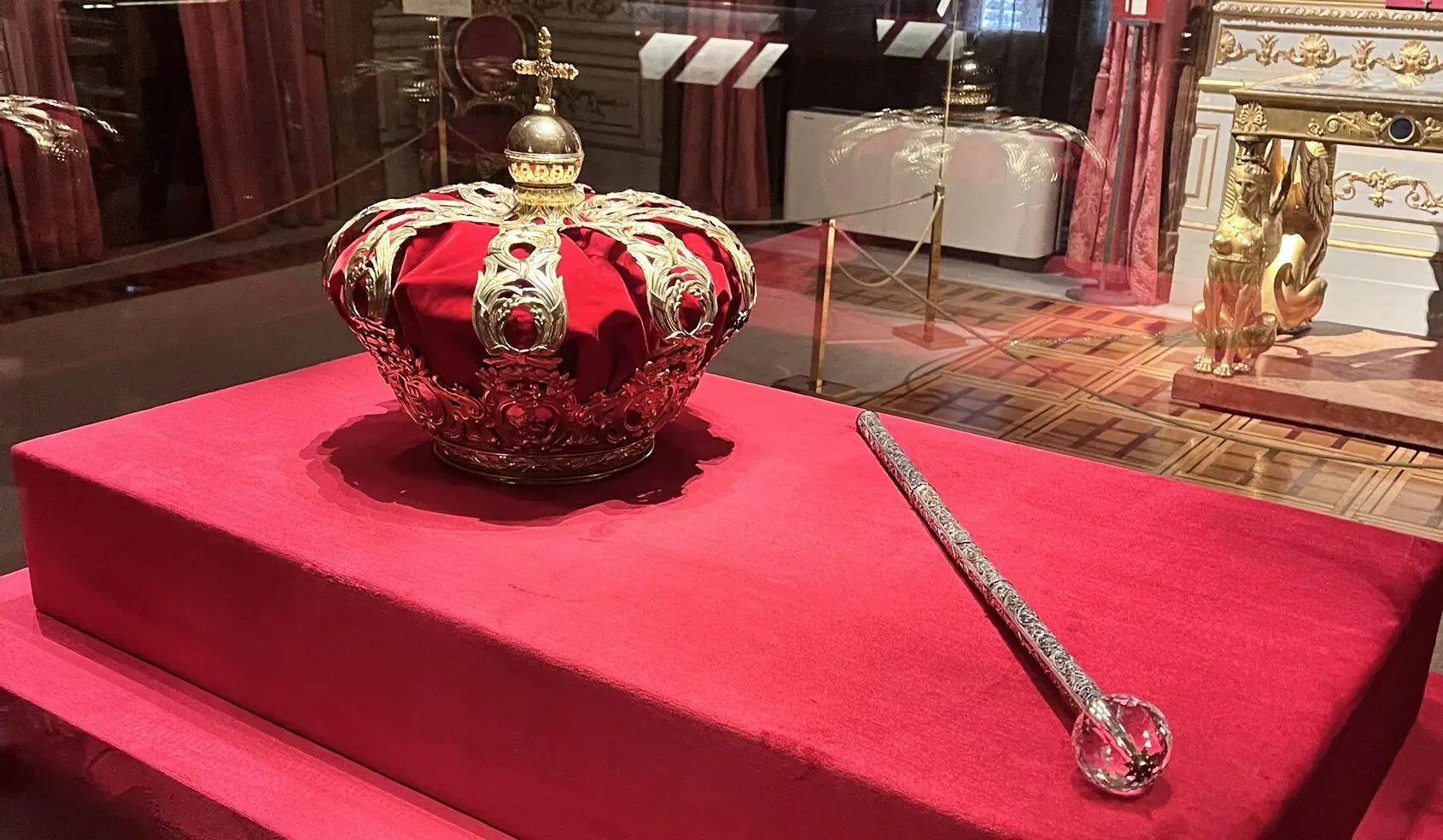
The room houses the royal crown, the throne of Charles III, royal jewels, and a silver-gilt sceptre decorated with rock crystal and enamel. These aren’t simply decorative objects; they are symbols of state that were used in official ceremonies of the Spanish monarchy for centuries.

The crown and sceptre are particularly striking. Made from gilded silver, the crown features the heraldic symbols of Castile and León: castles and lions. It was made in Madrid on the orders of Charles III. The sceptre, meanwhile, was made in Vienna in the 16th century and presented to King Philip II of Spain by Holy Roman Emperor Rudolf II.
The room itself is decorated to match the significance of the objects on display. The wall decorations depict the four seasons, while the combination of gold detailing, deep red tones and elaborate ornamentation gives the room the feel of a true royal treasury. In the other rooms, architecture and decoration tend to take centre stage; here, it’s the historical significance of the objects that makes the strongest impression.
🦁 The Throne Room
Towards the end of the visit, you reach the Throne Room. By this point you’ve already seen plenty of richly decorated halls, yet this room still manages to feel different. This is a space designed specifically to project the power of the monarchy.
The thrones form the centrepiece of the room. Upholstered in red velvet, they stand on a large raised platform surrounded by gold detailing. Nearby are some of the room’s most distinctive symbols: the bronze lions. They aren’t there purely for decoration; they represent power, authority and royalty. The fact that lion motifs appear repeatedly throughout the room is no coincidence.

The large carpet also plays an important part in bringing the room together. The ceiling decoration, wall colours, chandeliers and patterns in the carpet were designed to complement one another. So despite the sheer amount of ornamentation, the room doesn’t feel chaotic. Instead, all the details seem to form part of a single composition.
The Throne Room was once used for official ceremonies, diplomatic receptions and state events. Today you see it empty, but standing in the middle of the room and imagining the ceremonies that once took place here is actually quite fun.
✨ Leaving the Palace
The Royal Palace of Madrid turned out to be far more impressive than I had expected. Having previously visited the Palace of Versailles, Schönbrunn Palace in Vienna and the grand halls of the Vatican, I can comfortably say that, in terms of interior decoration and sheer level of detail, this is among the most impressive palaces I’ve seen — perhaps even the most impressive.
The amount of detail in the rooms is genuinely surprising. While you’re looking up at the ceiling of one hall, you miss the decoration on the walls; focus on the furniture, and suddenly you realise you haven’t even noticed the chandeliers. Every room feels like a world of its own.
If you’re visiting Madrid, this definitely isn’t a palace to admire only from the outside. If you’re interested in history, architecture, art and European palace culture, the Royal Palace is likely to be one of the strongest experiences of your time in the city.
Keep Exploring
→ 2 Days in Madrid: Itinerary & Travel Guide — Follow our two-day route through Madrid, including the places we visited, what we ate and our experience exploring the city.
→ Andalusia Road Trip & Travel Itinerary — Follow our full journey through Andalusia, including the route between cities, where we stayed and what we experienced along the way.
Yorumlar
Comments