

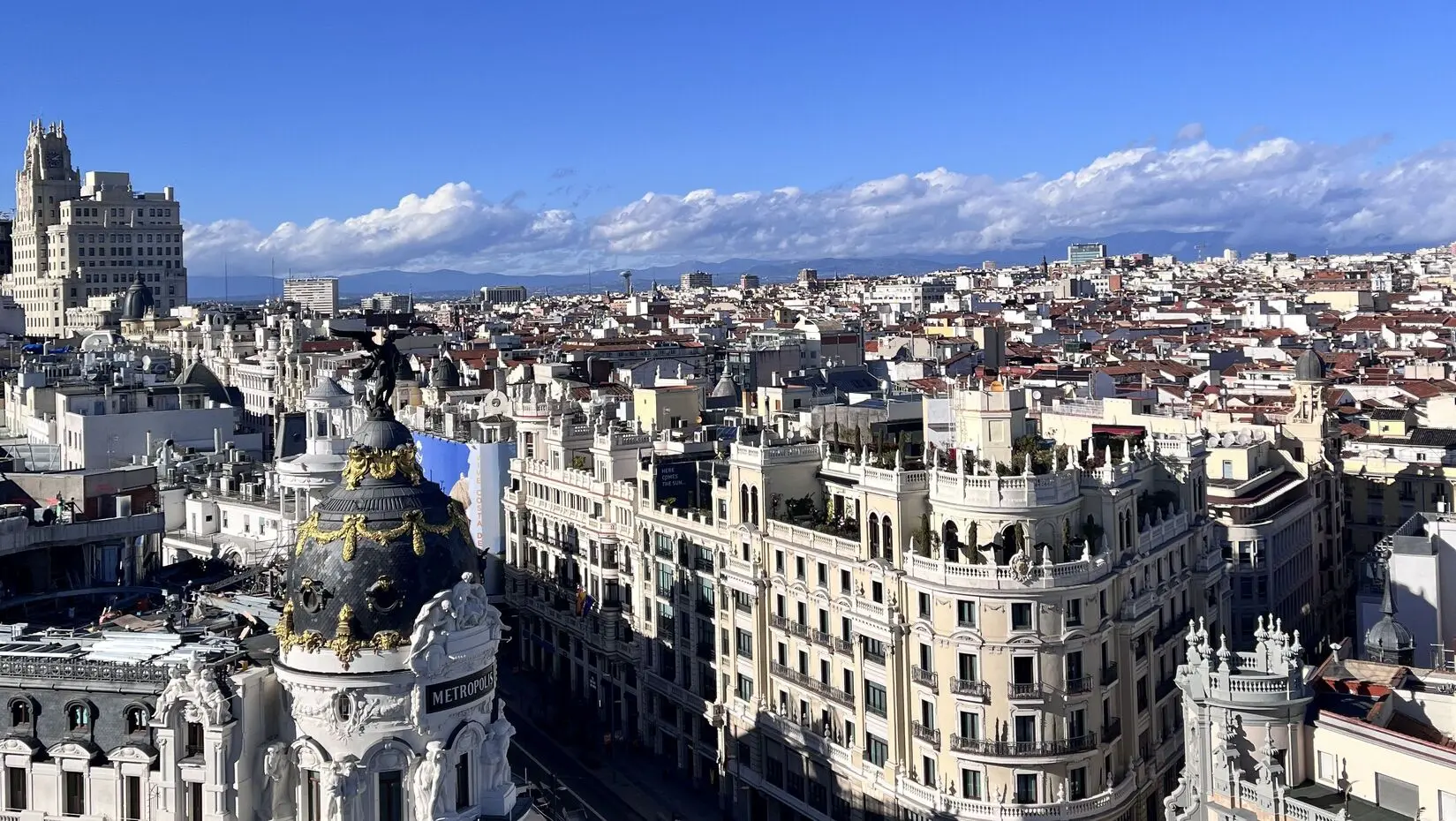


From the first few hours in Madrid, it immediately felt like a major European capital. With its wide boulevards, grand squares, monumental buildings and streets that stay busy well into the night, the city felt on a completely different scale from the Spanish cities we had visited before.
Part of that character comes from Madrid’s centuries-long role as the centre of the Spanish monarchy. You feel it most clearly around the Royal Palace, but Madrid is far more than palaces and historic buildings. Within a few hours, you can go from major art museums and parks to busy shopping streets and neighbourhoods with a much more local feel.
We had two days in Madrid. During that time, we visited Retiro Park, the Royal Palace, the Prado and Reina Sofía museums, saw Gran Vía at night, wandered through different neighbourhoods and, of course, spent some time figuring out what to eat in Madrid. Two days isn’t long, but with a good plan, it was enough to experience several very different sides of the city.
Ready? Let’s start with our first day in Madrid.
🗺️ 2 Days in Madrid – Quick Overview
🚶♂️ Walking: 20+ km
💸 Total (2 adults + 2 children): ~€626
👤 Per person: ~€157
🎟️ Tickets: Royal Palace (€45) · Prado Museum (€30) · Rooftop Café (€16)
🚗 Transport: Parking + Fuel (~€72)
🍽️ Food & Drinks: ~€61
🏨 Accommodation: ~€180
🛍️ Shopping: ~€72
💶 Other Expenses: ~€150
🔥 Highlights: Royal Palace of Madrid · Prado Museum · Gran Vía · Plaza Mayor · Puerta del Sol · Rooftop Views · Retiro Park
* Prices are based on what we spent in January 2025.
🗺️ Our Walking Route Through Madrid
You can see the walking route we followed on the map below. It takes in Madrid’s historic centre, the Royal Palace, Plaza Mayor where we stopped for coffee, the rooftop views from Círculo de Bellas Artes, the busy streets of Gran Vía and the Reina Sofía Museum, home to Picasso’s Guernica. For a first visit to Madrid, it’s a good route for seeing both the historic and more modern sides of the city.
🚗 Arriving in Madrid: First Impressions
Madrid was our next stop after Granada on our Andalusia trip. We drove there in the rental car we had for the trip and chose to stay a little outside the city centre, at the Holiday Inn Express Madrid Leganés by IHG.
📍 Where We Stayed: Holiday Inn Express Madrid Leganés by IHG
We were very happy with the hotel for the price. It was clean and reliable, and the breakfast in particular was much better than we expected. Being close to the ring road also worked really well for us. Since we were heading towards Toledo after Madrid, we didn’t want to deal with city-centre traffic the following morning.
We arrived in Madrid in the late afternoon. After checking in, we dropped off our bags and headed straight back out. We drove into the city centre and parked in one of the underground car parks.
🚗 Is Parking in Central Madrid Difficult?
There are plenty of underground car parks in central Madrid, so driving into the city turned out to be easier than we expected. We didn’t have to drive around looking for a space, and the prices seemed fairly reasonable for a major European capital.
As soon as we came out of the car park, we found ourselves in front of Puerta de Alcalá. Built in the 18th century during the reign of King Charles III, this historic gate has become one of Madrid’s best-known landmarks. Standing in the middle of those wide boulevards, it gave us our first real sense of Madrid as a capital city.

🌳 Retiro Park
Our first stop was El Retiro Park, just across from Puerta de Alcalá. Once used as a private retreat by the Spanish royal family, Retiro is now one of Madrid’s main green spaces.

It was nice to find such a large park right in the middle of a busy city like Madrid. As we walked around, we saw people running, exercising, cycling and performing, while others were simply sitting on the grass or on benches enjoying the day.
One of the busiest parts of Retiro is the lake, where you can rent small rowing boats. If you’re planning to go out on the water, it’s worth getting there early as the boat rentals close fairly early. Just behind the lake stands the Monument to Alfonso XII, with its large semicircular colonnade overlooking the water.
Retiro is a huge park, but around an hour was enough for us to walk around its main areas. There are also a few small kiosks and places to grab a snack along the way.
We left the park before it got completely dark and started walking along Calle de Alcalá. We left the park before it got completely dark and continued along Calle de Alcalá towards Salamanca.
✨ Salamanca
We decided to spend our first evening in Madrid exploring Salamanca. Located east of the city centre, the neighbourhood shows a more modern and affluent side of Madrid, with wide streets, elegant apartment buildings, high-end shops and restaurants. Our plan was to have dinner here and then spend some time walking around the area.
🍕 NAP Goya
We stopped for dinner at NAP Goya, a pizzeria along our route. After the long drive, it was exactly what we needed, and the pizzas were very good. I especially recommend the Margherita.

After dinner, we walked around the streets of Salamanca for a while. The neighbourhood was fairly quiet and orderly in the evening, with a very different feel from Madrid’s historic centre. The elegant apartment buildings, shops and restaurants made its more upscale character immediately noticeable.

At the end of the evening, we headed back towards Puerta de Alcalá to pick up our car. Before returning to the hotel, we made one more stop at Santiago Bernabéu Stadium. We parked nearby and went to have a look from the outside. With its metallic façade, it looks very different from a traditional football stadium. Modern and futuristic.
Then we headed back to our hotel. We’d spent much of the day on the road, so we didn’t stay out too late. We left the main part of our Madrid sightseeing for the next day.
☀️ A New Day in Madrid
We started the morning with breakfast at the hotel. We’re used to fairly standard breakfasts at city hotels in Europe, but this one was much better than we expected, both in terms of variety and quality. In fact, I can’t remember another hotel we’ve stayed at in Europe that served a breakfast this good.
After breakfast, we drove back into central Madrid. Our first stop of the day was the Royal Palace of Madrid. We’d bought our tickets online in advance and deliberately booked a time close to opening, as the palace can get seriously crowded later in the day. After leaving the car in a nearby car park, we walked over to the entrance. We arrived about 15 minutes before opening, so we waited outside for a short while.
Directly opposite the palace stands Almudena Cathedral. Madrid’s main cathedral is surprisingly recent compared with the historic cathedrals we’re used to seeing around Europe. Construction began in the late 19th century, and the cathedral opened for worship in 1993. Standing directly across from the Royal Palace, the two buildings make quite an impressive sight together.
👑 Royal Palace of Madrid
After a short wait, we entered the Royal Palace of Madrid. Considered one of the largest royal palaces in Europe, it is the official palace of the Spanish Royal Family. Although the royal family no longer lives here, the palace is still used for state ceremonies and official events.
Once inside, the palace exceeded our expectations. With its lavish halls, enormous chandeliers, ceiling frescoes and décor that changes from room to room, it became one of the places that impressed us most in Madrid. We spent around 2–2.5 hours inside, and because we’d arrived early, we were able to explore the first sections before the crowds started building up.

→ Royal Palace of Madrid Guide — Read our separate guide for the history of the palace, its rooms, the Throne Room, Banquet Hall and everything you need to know before visiting.
After finishing our visit to the palace, we started walking towards Madrid’s historic centre.
☕ Walking Through Madrid’s Historic Centre
We started by walking along Calle Mayor, a historic street lined with old apartment buildings, small cafés and tourist shops.
After a while, we reached Mercado de San Miguel. This covered food market is known for tapas, seafood and small bites, and it was busy and very touristy when we visited. Most of the food on display consisted of small canapé-style snacks. There was also a strong smell of jamón throughout the market, which can be a bit much if you’re not used to it. It certainly was for us, so we had a quick look around and didn’t stay for long.

From there, we continued to Plaza Mayor. Surrounded on all four sides by symmetrical buildings, this historic square has been used over the centuries for markets, ceremonies and various public events. Today, it’s a busy place filled with cafés, street performers and visitors. We stopped here for a short break and had a coffee.

After leaving the square, we walked along Calle de Bolsa and then towards Huertas. This part of Madrid felt more traditional, with narrow streets lined with old restaurants, small tapas bars and shops selling local products.
By the end of our walk, we had reached the Prado Museum.
🎨 Prado Museum
The Prado Museum (Museo del Prado) is a major stop in Madrid, especially if you’re interested in classical European art.
We had booked timed tickets online in advance, and when we arrived, we realised just how good a decision that had been. The queue at the entrance stretched for hundreds of metres. Having our tickets already booked saved us a serious amount of time.

The collection is enormous. As you move through the galleries, you’ll come across major works of Spanish, Italian and Flemish art, including paintings by Diego Velázquez, El Greco and Francisco Goya.
Goya’s works were the ones that impressed us most. The dark atmosphere and intensity of his Black Paintings were particularly striking. Velázquez’s famous Las Meninas, unsurprisingly, was one of the paintings that drew the biggest crowds.
📸 Can You Take Photos in the Prado Museum?
No. Photography and video recording aren’t allowed inside, and the staff are quite strict about it. After a while, you stop reaching for your phone and simply focus on the art — which, to be fair, I don’t think is a bad thing.
The Prado isn’t somewhere you can rush through. If you’re interested in art, you could easily spend several hours inside. We ended up staying longer than we’d planned. One thing worth knowing, though: looking at that many works of art one after another does get pretty tiring after a while.
The museum itself has the feel of a traditional art gallery, with high ceilings and classically arranged rooms. If classical European art interests you, the Prado is well worth making time for while you’re in Madrid.
🌆 Círculo de Bellas Artes
After leaving the Prado Museum, we walked towards a place that ended up being one of our favourite stops in Madrid: Círculo de Bellas Artes. It may not be as immediately recognisable as some of the city’s major sights, but we really enjoyed our time here.
The entrance to Círculo de Bellas Artes was a little surprising at first. Rather than walking into a grand entrance from the main avenue, we entered through a narrower doorway that almost felt like the entrance to an old hotel. This is also where we bought our tickets.
From there, a narrow, rather old-fashioned lift takes you up to the rooftop. For a moment, we genuinely wondered, “Are we in the right place?” The lift really does look that old. But as soon as we reached the top, the view completely changed our first impression.
From the rooftop, you get a 360-degree view across Madrid. You can see Gran Vía and a large part of the city stretching into the distance. We were there close to sunset, which made the view even better.

There’s also a small café on the rooftop where you can sit and have something to eat or drink while enjoying the view. We ordered hot chocolate and churros, and both were delicious.
We stayed for a while, enjoying the view with hot chocolate and churros. Looking back, this was easily one of our favourite moments in Madrid.
🏙️ Gran Vía
After coming down from Círculo de Bellas Artes, we turned towards Gran Vía, Madrid’s best-known avenue.
At first, Gran Vía reminded us a little of New York or Paris. With its wide avenue, tall buildings and constant flow of people, this was where we felt Madrid’s big-city character most strongly.

The street is lined with shops, restaurants, theatres and historic buildings. The architecture is worth paying attention to as you walk, especially the domes, sculptural details and elaborate façades that give Gran Vía its distinctive look.

Alongside luxury shops, you’ll also find more affordable brands, so it’s naturally a busy shopping area. For us, though, the best part of Gran Vía wasn’t the shopping but simply walking along the avenue.
As we continued along Gran Vía, we eventually reached Hotel Riu Plaza España, next to Plaza de España. The hotel occupies Edificio España, a historic skyscraper that has long been part of Madrid’s skyline. It also looks particularly striking when lit up in the evening.

Just across from the building is Plaza de España, a large open square with walking paths, seating areas, palm trees and plenty of space to stop and take a break.

The main feature of the square is the monument to Miguel de Cervantes, with statues of Don Quixote and Sancho Panza in front of it. The section showing the two famous characters on horseback naturally attracts plenty of people taking photos. Even if literature isn’t particularly your thing, the monument and the square around it are still worth stopping to see.
Without really realising it, we’d made almost a full loop through central Madrid and ended up back near the Royal Palace. Our car was parked nearby, so we picked it up and drove towards our next stop of the day, the Reina Sofía Museum.
🚉 Atocha and a More Local Side of Madrid
We parked near the museum and, since we’d arrived a little early, had some time to walk around the area before our entry slot.
The streets around the Reina Sofía Museum felt quite different from the parts of Madrid we’d explored earlier in the day. With Atocha railway station nearby, the area was busy and had a more cosmopolitan feel, with a noticeably diverse mix of people.

We came across plenty of small, affordable restaurants serving food from different parts of the world. Within just a few streets, we saw places offering African, Middle Eastern, Latin American and Asian food. Compared with Salamanca or Gran Vía, this part of the city felt more residential and centred around everyday life.
Many of the buildings still had the cream-coloured façades and tiled details we’d seen elsewhere in Madrid. Along the way, we also noticed small barbershops, tailors, independent shops and other neighbourhood businesses. It was nice to see a side of Madrid that felt a little removed from the main tourist areas.
🎨 Reina Sofía Museum
One of the nice things about visiting the Reina Sofía Museum was its free-entry period. When we visited, admission was free after 7:00 pm, although you still needed to book a free ticket online. It’s worth checking the current times before you go, as the free-entry hours can change.

Free admission also means crowds. From around 6:30 pm, long queues start forming outside, so arriving a little early can save you some time.
Once it was our turn, we headed inside. From the moment you enter, the Reina Sofía feels completely different from the Prado. The modern architecture, spacious courtyards and use of glass and metal give the museum a very different character. The glass lifts on the exterior and the high stairways are particularly striking.
The way we found easiest to explore the museum was to take the lift to the top floor and then work our way down, floor by floor. It made the route much easier to follow.
The collection includes works by major Spanish artists such as Pablo Picasso, Salvador Dalí and Joan Miró. If the Prado feels traditional and classical, the Reina Sofía is almost the opposite. We actually preferred this museum. Modern art appealed to us more, and the children enjoyed themselves much more here than they had at the Prado.
We also found it less tiring than the Prado. It’s still a large museum, but the visit felt easier and more relaxed. Here are a few of the works that particularly caught our attention.
Guernica

The museum’s most famous work is Picasso’s Guernica. Inspired by the bombing of the town of Guernica during the Spanish Civil War, this enormous painting draws some of the biggest crowds in the museum. Its sheer size, dark atmosphere and chaotic details are incredibly powerful when you see it in person.
The Weeping Woman

Another work that caught our attention was The Weeping Woman. Often translated into Turkish as “Mendilli Ağlayan Kadın,” the fragmented facial features and intense use of colour give the painting a very strong expression.
Woman at the Window

Another painting we really liked was Dalí’s Woman at the Window. Painted before he fully moved into his Surrealist period, it feels quite different from many of the modern works around it.
The figure in the painting is Dalí’s sister, Ana María, standing in front of an open window overlooking the Bay of Cadaqués. The way the light enters the room, the stillness of the sea and the realism of the figure really stood out to us. It looks so lifelike that it almost feels as though you’re looking at an old photograph taken beside a window rather than a painting.
Un Mundo

Another work that caught our attention was Un Mundo. This huge painting was created by Spanish artist Ángeles Santos when she was just 17 and caused quite a stir in the art world at the time.
Instead of depicting the world as a sphere, Santos imagined it as a strange, cube-shaped world. Figures move through the sky, women light the stars, and people inhabit different layers of this surreal landscape. There’s so much going on that you keep noticing new details the longer you look at it.
Dance of the Poppies

Dance of the Poppies is a work by Joan Miró, and this one entertained the children more than anything else. They had a good laugh saying that modern and abstract art apparently meant “drawing three dots and two lines.”
By the time we left the museum, it was already getting late. We picked up the car and decided to take one last drive through central Madrid before heading back to the hotel. Once again, we ended up on Gran Vía.
This time, instead of walking, we drove slowly along the avenue under the evening lights. Gran Vía looked completely different at night, with its historic buildings illuminated and the streets still full of people. Seeing the same avenue again just a few hours later, but in a completely different setting, was a nice way to end the day.

After our short night drive, we headed back to the hotel to get some rest before leaving for Toledo the following morning.
🏁 Final Thoughts
Madrid more than lived up to our expectations. Over two days, we followed a fairly packed route that took us from the Royal Palace to the Prado and Reina Sofía museums, along Gran Vía and through several different parts of the city. Círculo de Bellas Artes was one of the places that stayed with us most. We hadn’t gone there with particularly high expectations, but watching Madrid from above around sunset ended up being one of our favourite moments of the trip.
Driving around Madrid also turned out to be much easier than we’d expected. We had no real trouble finding parking in the centre, and staying outside the city made both getting in and out of Madrid and continuing our road trip much easier.
Two days obviously isn’t enough to see all of Madrid. We managed to visit most of the places we’d planned, but by the time we left, we were already thinking that we’d happily come back and spend a few more days here. The next morning, we got back in the car and headed for the next stop on our journey: Toledo.
Keep Exploring
→ Toledo Travel Guide — Follow our next stop after Madrid, including the places we visited, the route we followed and our experience exploring Toledo.
→ Andalusia Road Trip & Travel Itinerary — Follow our full journey through Spain, including Madrid, the route between our stops and what we experienced along the way.

Yorumlar
Comments