



Granada is one of the first places that comes to mind when people think of Andalusia. While many travelers visit for the famous Alhambra, the city has much more to offer. With its narrow streets, the whitewashed houses of the historic Albaicín district, the blend of Moorish and Spanish heritage, lively squares, and its unique setting at the foot of the Sierra Nevada, Granada is one of the best places to experience the spirit of Andalusia.
We began our Andalusia trip in Granada. We wandered through the old center, got pleasantly lost in the maze-like streets of Albaicín, admired one of the best views of the Alhambra from Mirador de San Nicolás, and found traces of Andalusia’s rich history around almost every corner. More than anything, it was Granada’s atmosphere that stayed with us long after we left.
In this guide, I’ll walk you through our day in Granada step by step, sharing the squares, landmarks, viewpoints, food stops, and practical tips that helped us during our visit.
If you’re planning a trip to Andalusia and wondering what to see in Granada, let’s explore the city together, one street at a time.
⚡ One Day in Granada – Quick Summary
🚶♂️ Walking: 20+ km
💸 Total (2 adults + 2 children): ~€339
👤 Per person: ~€85
🎟️ Tickets: Alhambra (€39)
🚗 Parking: ~€9
🍽️ Food & Drinks: ~€56
🏨 Accommodation: ~€135
💶 Other Expenses: ~€100
🔥 Highlights: Alhambra · Albaicín · Mirador de San Nicolás · Granada Mosque · Plaza Nueva · Darro River · Granada Cathedral · Plaza Bib-Rambla
* Prices are based on our expenses in January 2025.
🗺️ Our Walking Route in Granada
You can see the walking route we followed during our visit on the map below. Covering Granada’s old center, Plaza Bib-Rambla, the Darro River, the Albaicín district, Mirador de San Nicolás, and the Granada Mosque, this route is a great option for anyone visiting the city for the first time.
🚗 Arriving in Granada and Our First Impressions
Granada, the first stop of our Andalusia trip, was about a two-hour drive from Málaga, where our flight had landed. We picked up our rental car at the airport and set off around noon, passing through the Andalusian countryside with its endless olive groves and postcard-like scenery before arriving in Granada.
🏨 Where We Stayed: Hotel Arabeluj
For our stay in Granada, we chose Hotel Arabeluj, located close to the hills where the Alhambra stands. Watching Granada from the hotel’s terrace and balconies was one of the highlights of staying here. The interior is stylish and reflects the local character of Andalusia.
For travelers arriving by car, like we did, the free parking was a big advantage. We didn’t have to pay anything to park, and considering the overall experience, it was one of the best value-for-money hotels we stayed at during our Andalusia trip.
After checking in, we rested until around 4:00 p.m. to recover from the early start to the day. From the terrace, we could see the Sierra Nevada in the distance along with Granada’s distinctive skyline, which gave us a great first impression of the city.
Feeling refreshed, we headed down to Granada’s city center to start exploring. There are plenty of public parking garages around the center, and compared with many other major cities in Spain, the parking fees are quite reasonable.
🏛️ Exploring Granada’s Old Center
After leaving our car in the parking garage, we headed straight into the narrow streets of Granada’s old center. This is where Granada’s long history really comes to life. As we wandered through its stone-paved streets, we passed traditional tapas bars, small boutique shops, and old buildings at almost every turn.
Granada’s old center has long been home to Muslim, Christian, and Jewish communities. That blend of cultures is still reflected in the city’s architecture and atmosphere, making it easy to spot both Andalusian and Moorish influences as you explore.
⛪ Granada Cathedral
As we continued walking, one of Granada’s most iconic landmarks suddenly came into view: Granada Cathedral.
Construction of this impressive Renaissance cathedral began in the 16th century, and today it is considered one of Spain’s finest Renaissance buildings. Its history is just as significant. After Granada was conquered by the Catholic Monarchs in 1492, the cathedral was built on the site of a former mosque as a symbol of the city’s new era.
We didn’t go inside during this visit. Instead, we spent some time in the square outside, watching everyday life unfold around us. It had the relaxed atmosphere of a classic Spanish city square.
⛲ A Short Break at Plaza Bib-Rambla
A few minutes’ walk from the cathedral brought us to Plaza Bib-Rambla, one of Granada’s liveliest squares.
For centuries, this has been one of the city’s main gathering places. During the Andalusian period, it hosted markets and public events, while today it’s a pleasant square surrounded by cafés and restaurants where both locals and visitors come to relax.
One of the first things that caught our attention was the historic Fuente de los Gigantones fountain at the center of the square. Surrounded by palm trees, colorful flower beds, and historic buildings, it’s one of the most photogenic corners of Granada.
☕ Food Stop: Alhambra Churrería
While exploring Plaza Bib-Rambla, we came across Alhambra Churrería, one of the city’s best-known traditional churro cafés.
Popular with both locals and visitors for many years, it seemed like the perfect place to try one of Spain’s classic treats.

We ordered freshly made churros with thick hot chocolate, along with coffee, and took the opportunity to sit down and relax for a while. The churros were lightly crisp on the outside, soft on the inside, and easily one of our favorite snacks in Granada.
🚶 Walking Through Granada’s Historic Streets Toward Albaicín
After our relaxing churros break at Plaza Bib-Rambla, we continued exploring Granada. Our next destination was Albaicín, one of the city’s oldest and most historic neighborhoods. To get there, we followed Reyes Católicos, one of Granada’s main streets.
🏛️ Corral del Carbón: A Caravanserai from Andalusia
Not far along the street, we came across Corral del Carbón, a fascinating building that’s easy to miss if you’re walking by too quickly. Built in the 14th century, it is one of the best-preserved examples of civilian architecture from the Moorish period.

Originally, it served as a caravanserai where merchants could stay and store their goods after arriving in the city. As one of the few surviving non-religious buildings from Granada’s Muslim period, it holds an important place in the city’s history. Stepping into its courtyard, you immediately notice the elegant details of Moorish architecture. The arched entrance and the courtyard even reminded us of some of the architectural features we would see the following day at the Alhambra. Best of all, it only takes a few minutes to visit, making it an easy stop while exploring the city center.
👑 Plaza Isabel la Católica
Continuing our walk, we reached Plaza Isabel la Católica, one of Granada’s busiest squares.
The large bronze monument in the center immediately catches your eye. It depicts the famous moment when Christopher Columbus presented his plan to sail west to Queen Isabella I, a meeting that would ultimately change the course of history. Today, the monument is one of Granada’s best-known landmarks.

The square was full of cafés, old buildings, and visitors. After wandering through Granada’s quieter backstreets, this felt like the city’s more lively and tourist-friendly side.
🌉 Plaza Nueva and a Walk Along the Darro River
From Plaza Isabel la Católica, we continued to Plaza Nueva. Despite its name, which means “New Square,” it is actually one of the oldest squares in Granada. It forms a natural gateway between the old center, Albaicín, and the Alhambra. With street performers, cafés, restaurants, and the city hall nearby, it’s a lively place throughout the day.
Just beyond the square, we followed the historic street that runs alongside the Darro River, one of the most picturesque walks in Granada. On one side stood centuries-old stone buildings, while on the other, traditional houses overlooked the river, their balconies and windows decorated with colorful flowers. It turned out to be one of our favorite walks in Granada.
⛲ Don’t Miss the Pilar del Toro Fountain
As we continued along the Darro River, we stopped at the Pilar del Toro Fountain, located beside the Church of San Gil and Santa Ana. Dating back to the 16th century, this Renaissance fountain is named after the large stone bull that crowns it. While many visitors simply walk past it, it’s well worth taking a closer look at the craftsmanship and details.
A small travel tip: If you’re following this route, this is a good place to take a short break, refill your water bottle, and get ready for the uphill walk that’s about to begin.
After leaving the river behind, we turned uphill toward Mirador de San Nicolás, Granada’s most famous viewpoint. The climb is fairly steep, but with sunset approaching and one of the city’s best views waiting at the top, it was well worth the effort.
🏘️ Walking Through the Streets of Albaicín
A UNESCO World Heritage Site, Albaicín is Granada’s historic Muslim quarter. With its narrow streets, whitewashed houses, and maze-like layout, this neighborhood has preserved its character since the days of Al-Andalus and remains one of the city’s most distinctive areas.
As we climbed higher, the streets became even narrower. Around almost every corner, we found small courtyards, hidden squares, and quiet passageways. White houses decorated with colorful flowers, traditional windows, and cobbled streets gave the neighborhood a postcard-like feel.
Its maze-like layout made the walk even more enjoyable. It was fun for the kids as well. You might separate from another group of walkers at one corner, only to find yourselves crossing paths again several streets later. Exploring Albaicín felt a bit like wandering through a living labyrinth.
After a steady uphill walk of about 15–20 minutes, we finally reached Mirador de San Nicolás, Granada’s most famous viewpoint, just before sunset.
🌅 Mirador de San Nicolás: Granada’s Best View
Perched on the hillside above Albaicín, Mirador de San Nicolás offers what is probably Granada’s most iconic view. Directly in front of you stands the Alhambra, while the snow-capped peaks of the Sierra Nevada rise in the background. Below, the Darro Valley and Granada’s historic center complete the panorama.

After spending just a few minutes here, it’s easy to see why this viewpoint attracts visitors from all over the world. Close to sunset, the changing light gives the Alhambra’s stone walls a warm glow, making the view even more memorable.
We spent some time enjoying the scenery before noticing another place just beside the viewpoint that caught our attention.
🕌 Granada Mosque (Mezquita Mayor de Granada)
Right next to Mirador de San Nicolás stands the Granada Mosque (Mezquita Mayor de Granada), a place we discovered while exploring the area.
Opened in 2003, it was the first major mosque built in Granada after the end of Muslim rule more than 500 years earlier. Today, it stands as one of the city’s most meaningful symbols of Granada’s Islamic heritage.
The mosque’s architecture is elegant and understated, with clear influences from traditional Moorish design. The real highlight, though, is the peaceful garden. From here, you can enjoy one of the finest views of the Alhambra, and many visitors come just to sit quietly and take in the scenery.
During prayer times, the mosque is reserved for worship, creating a calm and peaceful atmosphere inside.

As we sat in the garden overlooking the Alhambra, the evening call to prayer began.
Hearing the adhan in Granada, a city that was once one of the great centers of Islamic civilization and learning in Al-Andalus, was a deeply moving experience for us. Reading about this history is one thing, but hearing the call to prayer here made it feel much more real, but hearing that familiar call echo across the city made the past feel unexpectedly close.
After the call to prayer, we went inside and performed the evening prayer alongside Muslims from many different countries. Looking back on our entire Andalusia trip, this remains one of the moments we remember most vividly.
✨ The Alhambra After Dark
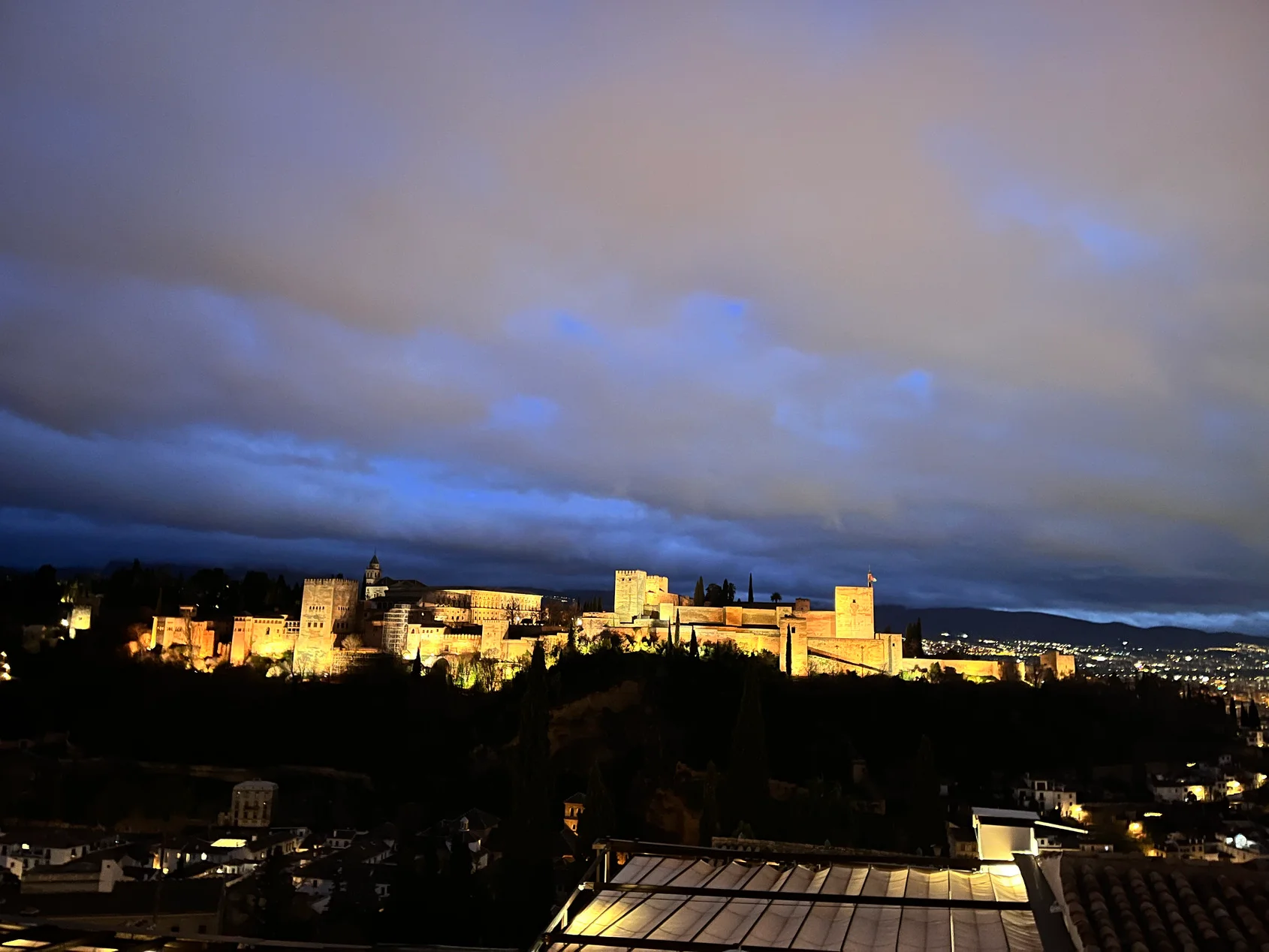
By the time we left the mosque, night had fallen over Granada. Returning to Mirador de San Nicolás, we found the city transformed.
The Alhambra, which had looked majestic in the daylight, now glowed under carefully placed lights, standing above Granada like a golden crown against the night sky.
The square was much livelier than it had been earlier. Street musicians filled the air with music, people sat along the stone walls enjoying the view, and photographers searched for the perfect angle as the evening continued.
🌙 An Evening Walk Back Through Albaicín
After spending some unforgettable time at Mirador de San Nicolás, we slowly began making our way back down. Instead of retracing our steps, we chose a different route to explore more of Albaicín’s narrow streets.
The streets that had been bright and colorful during the day felt completely different after sunset. Soft streetlights illuminated the whitewashed houses and flower-filled balconies, giving the neighborhood a quieter and more peaceful atmosphere. Seeing Albaicín both in daylight and at night turned out to be one of our favorite parts of the day.
As we continued downhill, the tourist crowds gradually gave way to everyday local life. Passing through a few small squares, we eventually reached the area around the Calisthenics Park. It seemed to be a popular gathering place for local residents, with people chatting on benches, relaxing, and enjoying the evening.
🌉 A Night Walk Along the Darro River
From there, we joined the riverside path once again and followed the Darro River back toward Plaza Nueva.

The atmosphere was completely different from what we had seen earlier in the day. Historic buildings were beautifully illuminated, shop windows glowed under the evening lights, and the streets were full of people enjoying Granada after dark. Along the way, we passed souvenir shops, small boutiques, tapas bars, and local restaurants that gave the area plenty of character.
🍔 Dinner and One Last Walk Through the Historic Center
Before long, we were back at Plaza Nueva, and from there we continued toward the city center.
This time, we approached Granada Cathedral from a different side. The busy daytime crowds had disappeared, replaced by the calmer atmosphere of the evening.
After such a long day of walking, we decided to keep dinner simple and stopped at the McDonald’s opposite the cathedral for a quick meal. Afterwards, rather than heading straight to the parking garage, we took a slightly longer route through Granada’s historic center to enjoy the city one last time at night.
During this walk, we passed the impressive Basílica de San Juan de Dios. With its grand entrance and richly decorated Baroque façade illuminated after dark, it was one of the most striking buildings we saw that evening.

🛏️ Wrapping Up Our First Day
By this point, it was getting late, and after walking throughout the day, we were definitely starting to feel tired. We returned to the parking garage, picked up our car, and drove back to our hotel.
The next day, we would finally visit Granada’s most famous landmark—the Alhambra. With another full day ahead of us, it was time to get some rest.
🏰 The Crown of Granada: The Alhambra
After our first day in Granada, it was finally time for one of the places we had been looking forward to most during our Andalusia trip: the Alhambra.
Construction of the Alhambra began in the 13th century under the Nasrid Dynasty, and today it is regarded as one of the finest surviving examples of Islamic architecture in Al-Andalus. For centuries, it served as the political and royal center of the Emirate of Granada. The vast complex includes the Nasrid Palaces, the Alcazaba, the Generalife Gardens, along with numerous courtyards, towers, and pavilions.
Recognized as a UNESCO World Heritage Site, the Alhambra is not only Spain’s most visited historic monument but also one of the most popular cultural attractions in the world. It’s impossible to think of Granada without thinking of the Alhambra.

🎟️ Book Your Tickets Well in Advance
The Nasrid Palaces, the most popular part of the complex, have a limited number of visitors each day. During peak travel seasons, tickets often sell out weeks—or even months—ahead, so it’s best to book as soon as your travel dates are confirmed.
⏰ Don’t Miss Your Entry Time
Your ticket for the Nasrid Palaces includes a specific entry time, and it is strictly enforced.
From the main entrance, it takes around 15–20 minutes to walk to the entrance of the Nasrid Palaces, depending on your pace. To avoid missing your time slot, we recommend arriving inside the Alhambra complex at least 30 minutes before your scheduled entry.
We left our hotel early that morning and drove to the Alhambra. If you’re arriving by car, there’s good news—the complex has a large, well-organized parking area right next to the entrance.
Rather than covering every detail here, we’ve put together a separate, in-depth guide dedicated entirely to the Alhambra.
→ Alhambra Travel Guide — Find everything you need to plan your visit, including the history of the palace, the highlights of the complex, ticket booking tips, and the walking route we followed during our visit
👋 Saying Goodbye to Granada
With our visit to the Alhambra complete, our time in Granada had come to an end.
We spent nearly half a day exploring the palace’s courtyards, gardens, and remarkable historic buildings. As we left behind one of the highlights of our Andalusia trip, it became even clearer why Granada is often considered one of the region’s most special cities.
From wandering through its historic squares and getting pleasantly lost in the winding streets of Albaicín, to watching the Alhambra from Mirador de San Nicolás and the peaceful gardens of the Granada Mosque, our time here was filled with memorable moments. Saying goodbye wasn’t easy, but new destinations were waiting for us.
We got back in the car and set our course for Madrid, Spain’s capital. A few hours of driving lay ahead, taking us from the historic atmosphere of Andalusia toward a completely different side of Spain.
Granada was the first stop of our Andalusia journey, but its atmosphere stayed with us long after we left. If you’re planning a trip to Andalusia, don’t visit Granada just for the Alhambra. Take the time to explore its neighborhoods, scenic viewpoints, and unique atmosphere as well.
See you in the next city and on the next adventure!
Continue Exploring
→ Madrid Travel Guide — Discover the places we visited and our experiences in Spain’s capital.
→ Andalusia Itinerary — Follow our complete road trip through southern Spain, including Granada and every stop along the way.

Yorumlar
Comments