Southern Spain One Day Road Trip: Cádiz, Tarifa & Ronda
We left Seville early in the morning for what would be one of the longest days of our Andalusia trip. Our route would first take us to Cádiz on the Atlantic coast, then to Tarifa, one of the southernmost points of mainland Europe. From there, we would continue along the Strait of Gibraltar before leaving…
We left Seville early in the morning for what would be one of the longest days of our Andalusia trip. Our route would first take us to Cádiz on the Atlantic coast, then to Tarifa, one of the southernmost points of mainland Europe. From there, we would continue along the Strait of Gibraltar before leaving the coast behind, heading into the mountains and ending the day in Ronda.
Along the way, the scenery would change constantly: from historic cities and the Atlantic coast to views across the Strait of Gibraltar toward Africa, and finally the winding mountain roads leading up to Ronda. With a long drive and plenty of stops ahead, this was going to be one of the busiest days of our Andalusia trip.
After leaving Seville, we headed toward Cádiz, our first stop of the day. As we approached the city, we crossed the enormous Puente de la Constitución de 1812, rising above the Bay of Cádiz. Opened in 2015, this modern bridge caught our attention before we had even reached the city, with its tall pylons and cables stretching across the bay.
Once across the bridge, we arrived directly on the peninsula where Cádiz’s historic center is located. Look at Cádiz on a map and it almost appears to be an island: the old city is largely surrounded by the Atlantic Ocean and connected to the mainland by only a narrow strip of land. Even as you enter the city, you immediately notice just how closely Cádiz is tied to the sea.
When we arrived, the underground car parks along Campo del Sur seemed like the most practical places to leave the car. This puts you within easy walking distance of both the oceanfront and the historic center. The waterfront was still quiet in the morning, and the city was slowly waking up to the sound of the waves.
With a history traditionally traced back to around 1100 BC, Cádiz is considered one of the oldest continuously inhabited cities in Europe. Its strategic position on the Atlantic made it an important port for centuries. Today, traces of that long history can still be seen throughout the narrow streets and squares of the historic center, as well as along the old walls facing the ocean.
After parking the car, we made our way toward the defensive walls running along the coast. For centuries, these fortifications protected the city from attacks from the sea, while also forming a barrier between Cádiz and the powerful waves of the Atlantic. We followed the waterfront past the huge concrete blocks in front of the walls and began walking toward the tip of the peninsula.
🏰 San Sebastián Castle
As we continued along the coast, the path led us to San Sebastián Castle. Located at the far end of Cádiz’s historic center, the castle sits just offshore and is connected to the city by a narrow causeway stretching out into the sea. From this point on, the route is pedestrian-only, so the castle can only be reached on foot.
The small island where San Sebastián Castle stands was used for centuries as part of Cádiz’s defenses. Much of the fortress we see today, however, took shape in the 18th century. As part of the defensive system protecting the entrance to the Port of Cádiz, it also served various military purposes over the years.
For me, the best part of this place wasn’t actually the castle, but the walk leading to it. As we made our way along the narrow causeway, Cádiz gradually disappeared behind us and the ocean opened up on both sides. It was also incredibly windy, which gave the walk a very different atmosphere.
At the end of the causeway, we reached the outermost point of the castle. In front of us was the Atlantic Ocean, with small rocky outcrops offshore and powerful waves crashing against them. The wind had picked up even more by then, so we sat for a while and simply watched the ocean. If you visit San Sebastián Castle, don’t turn back too soon; walk all the way to the end of the causeway and spend some time here.
🏘️ Cádiz Streets: Colors and Details
After returning from San Sebastián Castle, we left the waterfront behind and headed into the streets of Cádiz. Colorful façades, wrought-iron balconies, and small squares appeared one after another along the narrow streets. The historic center is compact enough that you don’t really need to follow a set route; wander for a few streets and you can easily find yourself back by the sea.
As we walked, we stopped at a small bakery/shop to pick up some fresh croissants and orange cake before continuing through the city.
By the time we made our way back to the waterfront through the side streets, the sun was much higher and the city, which had been so quiet when we arrived that morning, was beginning to come to life. We sat for a little longer on the walls overlooking the ocean, enjoying the view before heading back to the car.
Our few hours in Cádiz had come to an end. Next up was Tarifa, continuing south along the coast.
🌬️ Tarifa
After leaving Cádiz, we continued south along the N-340 toward Tarifa. This stretch of road was one of the most enjoyable drives of the day. With the sea on one side and the hills of Andalusia on the other, the road sometimes runs close to the coast and sometimes climbs higher, opening up wider views of the surrounding landscape. There are several viewpoints along the way where you can pull over and take some time to enjoy the scenery.
After around 1 hour and 15 minutes on the road, we reached Tarifa. It is one of the southernmost towns in Spain and mainland Europe. Its location at one of the narrowest points of the Strait of Gibraltar also means that, on a clear day, you can see Africa across the water.
The first thing we noticed when we arrived in Tarifa, however, was the wind. The strong winds that blow through this area almost constantly have made Tarifa one of the world’s major destinations for kitesurfing and windsurfing. After leaving our car near the center, we walked toward the coast.
Within walking distance of the center, Isla de Tarifa is one of the best places to appreciate Tarifa’s unique geographical position. As you walk along the narrow causeway, the Atlantic Ocean lies on one side and the Mediterranean Sea on the other. There’s something quite strange about walking along the causeway knowing that the Atlantic is on one side and the Mediterranean on the other.
And that’s not the only thing to see. When the weather is clear, you can make out the African coastline across the Strait of Gibraltar with the naked eye.
🌍 Mirador del Estrecho
After leaving Tarifa, we got back on the N-340 and continued east. As the road began to climb, the Strait of Gibraltar gradually dropped away below us. After about 15–20 minutes of driving, we reached Mirador del Estrecho, one of the best viewpoints along this stretch of road.
From here, you get a wide view across the Strait of Gibraltar. Cargo ships pass through the waters below, while the African coastline stretches across the horizon. On clear days, you can even make out settlements on the Moroccan side.
Mirador del Estrecho has a small parking area, a kiosk, and a few places where you can sit and enjoy the view. We stopped here for a while, had something to drink, and watched the ships passing through the strait. We even pulled up the map on our phones and tried to work out exactly where the places we could see across the water were on the Moroccan coast.
After seeing Africa from sea level in Tarifa, here you get a much higher vantage point with views across almost the entire Strait of Gibraltar. So if you’re driving east from Tarifa, I definitely recommend stopping at Mirador del Estrecho.
🚗 Towards Ronda: Into the Mountains
After our break at Mirador del Estrecho, we continued toward Ronda. Before long, the Rock of Gibraltar appeared on the horizon. The name “Gibraltar” comes from the Arabic Jabal Tariq, meaning “Tariq’s Mountain,” and the rock rises so prominently above the coast that it is impossible to miss.
A quick note about Gibraltar: it is a British Overseas Territory at the southern tip of the Iberian Peninsula. You can cross into Gibraltar by land from Spain, but border controls can take time, especially if you’re entering by car. Our schedule was already packed, so we decided not to visit Gibraltar and continued on our way. If you want to explore it properly, it makes much more sense to set aside extra time for it in your itinerary.
We continued along the Mediterranean coast until we reached Marbella. Without heading into the city center, we left the coast behind and took the A-397 up into the mountains toward Ronda. This part of the drive felt completely different from the roads we had been on earlier in the day. The bends became tighter, the road steeper, and the coastline quickly disappeared behind us. Some stretches even reminded us of the mountain roads around Antalya in Turkey.
By this point, we had been on the road for around eight hours since leaving Seville that morning. We had explored Cádiz and Tarifa, driven along the Strait of Gibraltar, and were finally approaching our last stop of the day. While the kids slept in the back seat, we continued along the winding mountain road from Marbella.
After another 1–1.5 hours of driving, signs for Ronda began to appear. Our long day, which had started near the Atlantic coast that morning, had finally brought us to our last stop.
🏔️ A Fairytale on the Edge of a Cliff: Ronda
We arrived in Ronda in the late afternoon, our final stop of the day. After checking into our hotel and parking the car, we headed straight out on foot toward the center. Ronda is a fairly compact city, and almost everything we wanted to see was within walking distance.
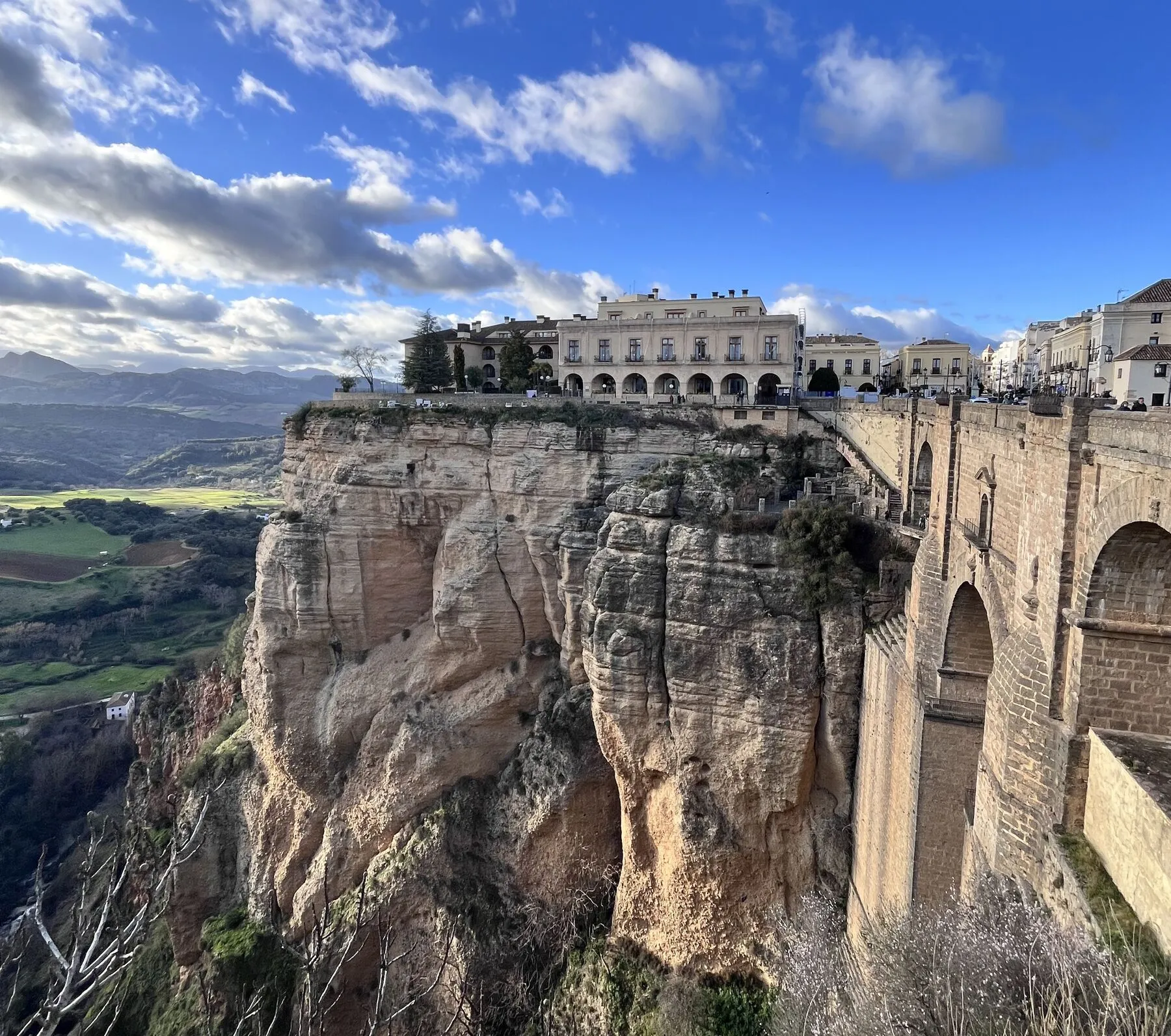
Our first stop, of course, was Puente Nuevo. We had seen the bridge countless times in photos, but standing there was something else entirely. On one side, the El Tajo Gorge plunged more than 100 meters below us; on the other, the Guadalevín Valley stretched for miles into the distance. Looking in one direction from the bridge, we saw a deep, narrow gorge. Turn the other way, and the view opened up across fields, forests, and small settlements. Within our first few minutes in Ronda, the long drive to get there already felt worth it.
After Puente Nuevo, we visited Plaza de Toros, one of the oldest bullrings in Spain, took in the valley views from Mirador de Ronda, and wandered through the narrow streets of La Ciudad on the other side of the bridge. Once it was dark, we returned to Puente Nuevo to see the bridge at night before ending the evening on Carrera Espinel.
Ronda isn’t a large city, and half a day is enough to see its main sights comfortably. But Puente Nuevo rising above the El Tajo Gorge, together with the landscape surrounding it, made Ronda one of the most memorable stops of our trip.
→ Ronda Travel Guide — Discover the route we followed from Puente Nuevo to Plaza de Toros and Mirador de Ronda, the streets of La Ciudad and Ronda after dark, along with our hotel experience and practical tips for visiting the city.
🛣️ At the End of the Day
When we left Seville that morning, we knew we had a long day ahead of us, but we hadn’t expected the scenery to change so dramatically from one stop to the next. We started the morning walking along the Atlantic in Cádiz, and just a few hours later we were in Tarifa looking across the water toward Africa. From there, we followed the Strait of Gibraltar to the Mediterranean coast before finally leaving the sea behind and heading into the mountains toward Ronda.
It wasn’t an easy day. We spent long hours driving, walked for miles, and tried to fit everything we wanted to see into each stop. But looking back, this was definitely one of the fullest and most memorable days of our Andalusia trip.
The Atlantic coast in Cádiz, walking between two seas in Tarifa, looking across the Strait of Gibraltar toward Africa, and ending the day on Puente Nuevo… Experiencing all of this in a single day was exhausting, but also incredibly enjoyable.
If you’re exploring Andalusia by rental car and don’t mind a packed travel schedule, we can easily recommend this route from Seville to Ronda via Cádiz and Tarifa. If we were planning the trip again, we’d take the same route.
🧭 Practical Tips for This Route
Fitting Cádiz, Tarifa, and Ronda into a single day from Seville makes for a packed itinerary, but it is doable with good planning. We completed the route with our children, although it’s worth keeping in mind that you’ll spend much of the day either driving or walking.
🎯 Who Is This Route For?
✅ Travelers with a rental car: Driving is by far the easiest way to connect places as different as Cádiz, Tarifa, Mirador del Estrecho, and Ronda in a single day.
✅ Travelers who enjoy a fast-paced itinerary: If you prefer seeing several different places rather than spending long hours in one city, this route is a great fit.
✅ Those who see the drive as part of the trip: If you enjoy road trips as much as the places you stop along the way, this route works particularly well. The coastal drive from Cádiz to Tarifa, the Strait of Gibraltar, and the mountain road from Marbella to Ronda are all memorable parts of the day.
⚠️ Who Might Find This Route Challenging?
❌ Those who struggle with winding roads: The A-397 between Marbella and Ronda is particularly twisty. If you’re prone to motion sickness, this is something worth keeping in mind.
❌ Travelers who prefer a slower pace: You’ll only have limited time in each of Cádiz, Tarifa, and Ronda. If you want to explore these places in more depth, splitting the route over two days would be a better option.
❌ Those who also want to visit Gibraltar: Entering and leaving Gibraltar takes extra time, so adding it to the same day could make an already busy itinerary unnecessarily rushed. If you want to explore Gibraltar as well, I recommend setting aside separate time for it.
📍 Interactive Route Map
You can see the full route we followed throughout the day, starting in Seville and continuing through Cádiz, Tarifa, Mirador del Estrecho, and Ronda, on the interactive map below.
Keep Exploring
→ Andalusia Road Trip Itinerary & Travel Plan — Explore our complete Andalusia journey, including this one-day route from Seville through Cádiz and Tarifa to Ronda, along with our route between cities, accommodation plan, and other stops along the way.




Yorumlar
Comments