



If you’re planning a trip to Andalusia, the Mosque-Cathedral of Córdoba is probably near the top of your list. And for good reason. Few places in Europe tell a story as complex as the Mosque-Cathedral of Córdoba. Once one of the most important mosques in the Islamic world and later transformed into a Catholic cathedral, it reflects centuries of religious, political, and cultural change within a single building.
It was also one of the places we were most excited to visit during our Andalusia trip. Walking through the streets of Córdoba, stepping into the courtyard filled with orange trees, wandering among hundreds of columns, and standing in front of the famous mihrab gave us a range of emotions. Some were exactly what we expected, while others were not.
In this guide, we explore the Mosque-Cathedral of Córdoba from beginning to end. We cover its history, exterior walls and gates, the orange tree courtyard, the famous forest of columns and arches, the Renaissance cathedral built in the middle of the former mosque, the chapels, the mihrab, and many architectural details that are easy to miss. Along the way, we share both historical information and our own impressions from the visit.
There is no real need to buy tickets in advance. We purchased ours at the ticket office within a few minutes without any issues. Admission is also reasonably priced. How long you spend here depends entirely on your interests. While it is not an enormous complex, you can easily spend several hours exploring the interior and courtyard if you take the time to appreciate the details.
🕌 History of the Mosque-Cathedral of Córdoba
Before visiting, we knew the Mosque-Cathedral of Córdoba had a complicated history. What we didn’t fully realize was just how many layers of history would be visible inside a single building.
Unlike many famous landmarks that belong to a specific period, this monument feels like several centuries stacked on top of each other. As you walk through it, you move between the legacy of Islamic Al-Andalus and the Christian additions that transformed the building after the Reconquista. Few places make that transition as visible as the Mosque-Cathedral of Córdoba.
The history of the site dates back to the Roman period. Later, the Visigothic Basilica of San Vicente stood here. After the Muslim conquest of Al-Andalus in 711, Córdoba began to grow rapidly. As the city’s population expanded, a larger place of worship became necessary. In 785, Abd al-Rahman I of the Umayyad dynasty purchased the site and began construction of what would become the Great Mosque of Córdoba.
Over the next two centuries, the mosque was repeatedly expanded. Major additions were made during the reigns of Abd al-Rahman II, Al-Hakam II, and Almanzor, gradually transforming it into one of the largest religious buildings in the Islamic world. By the 10th century, Córdoba had become one of the largest and most advanced cities in Europe. Historical accounts describe a city of hundreds of thousands of inhabitants, illuminated streets, and vast libraries. The mosque stood at the heart of this prosperity and cultural achievement.

The vast interior that visitors recognize today—with its forest of columns and iconic red-and-white arches—was largely created during these expansion phases. Many of the columns were reused from earlier Roman and Visigothic structures. As a result, their heights, colors, and capitals vary noticeably throughout the building.
In 1236, Córdoba was conquered by King Ferdinand III of Castile, bringing the Islamic period of the city to an end. The mosque was converted into a cathedral, and Christian additions continued to reshape the structure over the following centuries. The most significant transformation took place in the 16th century, when a large Renaissance cathedral was constructed directly in the center of the former mosque.
A famous quote is often attributed to Emperor Charles V after he saw the completed cathedral:
“You have destroyed something unique to build something that can be seen everywhere.”
Today, the Mosque-Cathedral of Córdoba is a UNESCO World Heritage Site and one of the few places where the legacy of Al-Andalus can still be experienced on such a scale.
🧱 Exterior Walls, Grand Gates, and First Impressions
One of the first things that catches your attention as you approach the Mosque-Cathedral of Córdoba is its massive outer walls. From the outside, it is surprisingly difficult to guess what awaits inside. The exterior has a restrained and almost fortress-like appearance, giving little indication of the architectural wonder hidden beyond it.
The building is surrounded by numerous gates of different sizes, some of them richly decorated. Even before entering, the horseshoe arches, intricate stone carvings, and geometric details offer a glimpse into the distinctive character of Andalusi architecture. In some places, Arabic inscriptions and traces of centuries-old decoration can still be seen. Although additions were made during different periods, the monument retains a remarkably cohesive architectural language.

The area surrounding the Mosque-Cathedral remains lively today. The nearby streets are lined with cafés, restaurants, souvenir shops, and small local businesses. Yet it is believed that this area was once even more vibrant. During the Islamic period, large markets and commercial districts surrounded the mosque, making it one of the busiest parts of the city. At a time when Córdoba was among the largest cities in Europe, the mosque served not only as a religious center but also as a social and cultural hub.
🍊 A Courtyard Filled with Orange Trees
As soon as we stepped through the gates and entered the courtyard, we were surprised by its size. We expected something closer to a traditional mosque courtyard, but instead found an expansive garden that felt almost as large and impressive as the building itself.

The atmosphere was incredibly peaceful. The noise of the city seemed to disappear the moment we entered. Walking beneath the orange trees, all we could hear was the sound of water, birdsong, and the distant murmur of other visitors. Fountains, small pools, and shaded walkways add to the calm and relaxing character of the space.

The most distinctive feature of the courtyard is, of course, its orange trees. Depending on the season, the experience can be very different. We visited in early February, right in the middle of orange season, and the courtyard looked spectacular. Nearly every tree was covered in bright orange fruit. Their arrangement is no coincidence either; the rows of trees were designed to mirror the rows of columns inside the mosque. As you walk through the courtyard, a subtle citrus scent lingers in the air.
Today, this area is known as the Patio de los Naranjos, or the Courtyard of the Orange Trees. During the Islamic period, it served as the mosque’s gathering and ablution area. Some historians believe that parts of the water channels date back to Roman times. The fountains and canals were not only decorative but also functional elements of the complex. One of the things we enjoyed most was simply slowing down, sitting for a while, and watching the birds among the trees before continuing our visit.
Minaret / Bell Tower
While exploring the courtyard, it is impossible to miss the tower rising above the surrounding walls. It tells one of the most fascinating stories of the entire complex.
The structure was originally built as a minaret and expanded during Córdoba’s golden age in the 10th century. After the Christian conquest of the city in 1236, it was converted into a bell tower. New layers were added around the original structure, and bells were installed inside. What visitors see today is the result of these two historical periods merging into a single monument.

If you look closely, traces of the original Islamic architecture can still be identified in the lower sections. Stonework, proportions, and remnants of arches reveal the character of the former minaret. The upper sections, however, belong to a later Christian reconstruction and display a noticeably different architectural style. In many ways, the tower perfectly summarizes the story of the Mosque-Cathedral itself.
🕌 Entering the Mosque-Cathedral: First Impressions
The moment we stepped inside from the courtyard, the atmosphere changed completely. The bright, open, and green surroundings outside suddenly gave way to a darker, cooler, and more solemn space. For the first few seconds, our eyes needed time to adjust to the dim light. There is a peculiar silence inside—not complete silence, but a constant blend of whispers, distant footsteps, and echoes drifting through the vast stone interior.

And then you see the famous columns.
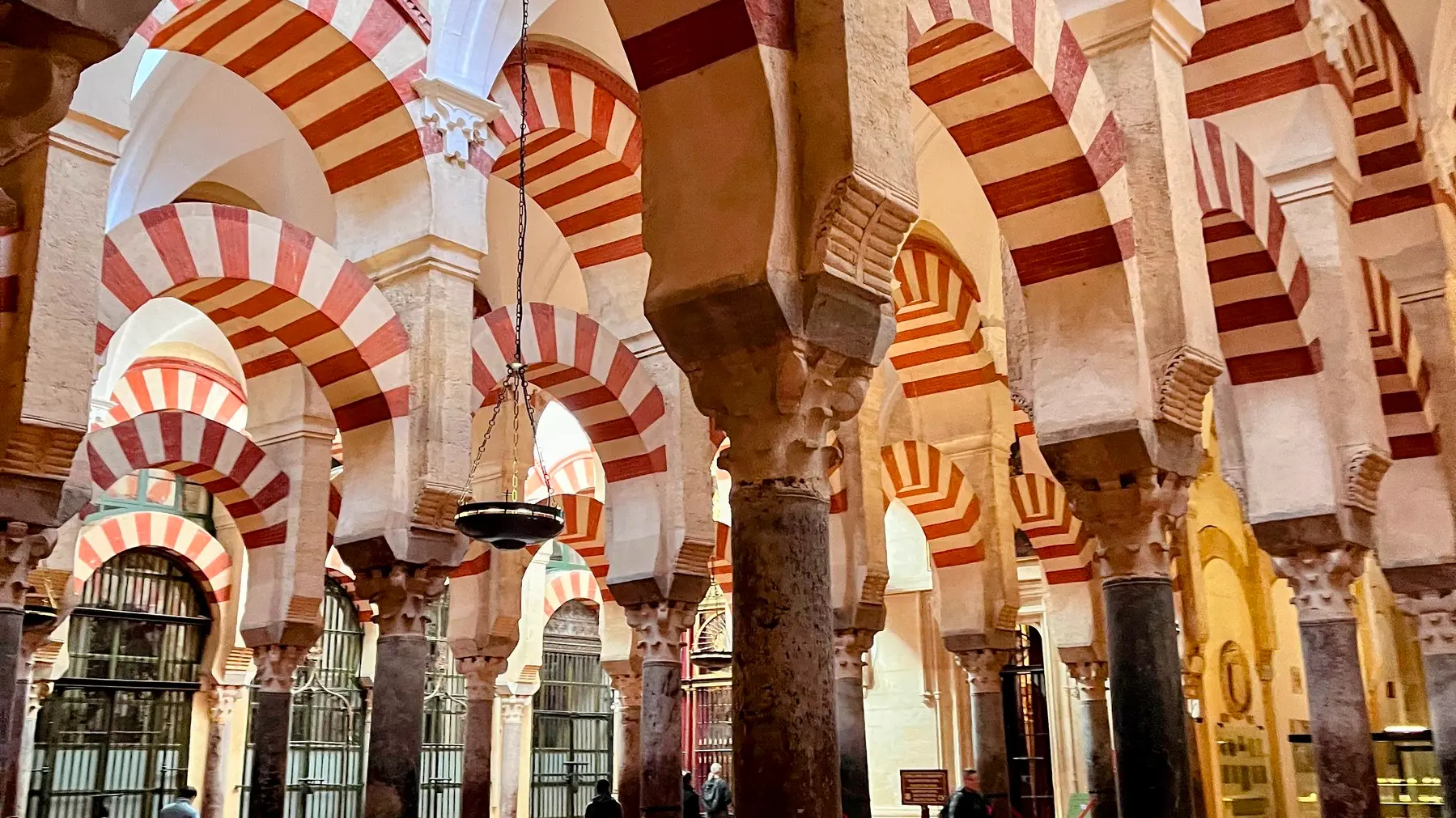
The seemingly endless rows of columns topped by red-and-white arches create one of the most recognizable interiors in the world. Even though we had seen countless photos and videos before visiting, the sight was still impressive in person. The columns do not stretch in just one direction. They extend to the left, to the right, and far into the distance, giving the impression of walking through an endless stone labyrinth.

Interestingly, these arches were not designed purely for aesthetic reasons. When the mosque was built, the architects wanted a much larger interior space, but many of the available columns had been taken from older Roman and Visigothic structures and were relatively short. To raise the ceiling, a two-tiered arch system was developed. Horseshoe arches form the lower level, while a second row of arches sits above them. The solution was both practical and visually striking, creating the distinctive red-and-white rhythm that has become the symbol of the monument. The red sections are made of brick, while the lighter sections are limestone.
As we began walking through the forest of columns, our first reaction was somewhat unexpected.
To be honest, we arrived with very high expectations. We’d seen countless photos, videos, and documentaries before the trip, so we expected to be impressed the moment we stepped inside.
But our initial impression was a little different.
It was certainly impressive, yet it also felt unfamiliar. Unlike a traditional mosque, the layout is unlike anything we had experienced before. And unlike places such as the Alhambra, where the atmosphere of Al-Andalus feels immediately present, the connection here was not as obvious at first.
In fact, our very first reaction was surprisingly simple.
We looked at each other and thought:
“This feels completely like a church now.”
That feeling would gradually change as we explored further, but it was an honest first impression. The cathedral built in the center of the former mosque is so dominant that it immediately shapes how many visitors experience the space.
✝️ Mezquita-Catedral de Córdoba
The building’s official name today is Mezquita-Catedral de Córdoba, and the name perfectly reflects what it has become. This is no longer simply a former mosque. It is also an active Catholic cathedral, with both identities occupying the same space.

Construction of the cathedral began in the 16th century, nearly 300 years after Córdoba was conquered by Christian forces. Church authorities wanted to build a grand Renaissance cathedral in the very heart of the former mosque. To make room for it, part of the original forest of columns was removed. The soaring nave, massive columns, elaborate altar, and impressive organ that visitors see today all belong to this later addition.
Viewed on its own, the cathedral would easily be one of the highlights of the city. Towering vaults, enormous stone pillars, gilded details, and richly decorated ceilings showcase the grandeur of Renaissance and Baroque religious architecture. Yet what makes the experience so unusual is its setting. Rather than standing on its own, the cathedral appears to have been inserted directly into the middle of the former mosque.
As a result, your attention constantly shifts between two very different architectural worlds. Islamic arches and columns stand beside Christian paintings, statues, and religious imagery. Some of the original columns were even incorporated into the cathedral itself. The contrast can feel striking, and at times a little surreal. Before visiting, we honestly did not expect such a strong Christian presence throughout the building.

Another feature that quickly catches your attention is the long series of chapels lining the sides of the monument. There are around forty of them, each commissioned by different noble families, religious orders, or guilds. Some served as private places of worship dedicated to particular saints, while others functioned as family burial chapels.
Many still display the coats of arms and names of the families associated with them. Historically, the keys to some of these chapels were passed down through generations, remaining in the possession of the families who funded them.

Looking inside the chapels reveals even more layers of history. Stone sarcophagi, old gravestones, and entrances leading down to crypts can be found throughout the complex. During the Middle Ages, being buried within a sacred building was considered a sign of prestige, and over time many of these chapels became family mausoleums as well as places of worship.

In the darker corners of the monument, the atmosphere becomes noticeably heavier. Weathered stone walls, iron gates protecting crypt entrances, and in some chapels even preserved burial chambers contribute to a sense of age and mystery. At times, the contrasts feel almost overwhelming.
One moment you are standing beneath the elegant arches of Al-Andalus. The next, you are looking at a Baroque altar or a centuries-old burial chapel.
🌙 The Famous Mihrab of the Mosque-Cathedral of Córdoba
After spending some time wandering among the columns, you’ll eventually notice a section where visitors begin to gather. As you move closer to the southern wall of the building, you arrive at one of its greatest treasures: the mihrab.
You cannot get very close, as the area is protected, but even from a distance it immediately stands out. Together with the surrounding domes and decorative arches, it feels like a direct connection to the Islamic history of Al-Andalus.

The mihrab of the Mosque-Cathedral of Córdoba is considered one of the finest surviving masterpieces of Andalusi architecture. It was commissioned in the 10th century during the reign of Caliph Al-Hakam II, a period often regarded as the height of Córdoba’s prosperity and cultural influence.
The first thing that catches your eye is the magnificent horseshoe arch framing the entrance. Every surface around it is covered with intricate mosaics. Gold, blue, and green patterns intertwine across the walls in a remarkable display of geometric and floral decoration. According to historical accounts, these mosaics were created by craftsmen sent by the Byzantine Emperor, making them one of the most extraordinary artistic collaborations of the medieval world.

What surprises many visitors is the size of the mihrab itself. From a distance it appears much larger, but in reality it is a relatively small chamber with a circular layout, large enough for only a few people. The ceiling was carved from a single block of marble and shaped like a seashell, creating one of the most distinctive architectural features within the monument.
The acoustics were also carefully designed. It is said that recitations of the Quran could be heard clearly throughout the prayer hall, allowing the voice to travel across the vast interior.
On either side of the mihrab lies the maqsurah, a protected area reserved for the caliph. Here, a series of interlacing horseshoe arches creates one of the most beautiful spaces in the entire complex. The arches seem to weave into one another, while the golden mosaics above them still retain much of their original brilliance despite being more than a thousand years old.
Standing in front of the mihrab, it becomes easier to imagine the wealth and influence of Córdoba during its golden age. Of all the places inside the monument, this was the spot that felt closest to the Córdoba of a thousand years ago.
🏛️ Getting Lost Among the Columns
After leaving the mihrab area, we found ourselves drawn back into the forest of columns. To be honest, one of the most impressive aspects of the Mosque-Cathedral of Córdoba is not a single room or architectural feature, but the overall atmosphere of the building itself. As you walk through the monument, your attention is constantly pulled toward new details.

Looking upward, you’ll notice beautifully crafted wooden ceilings in several sections of the complex. Some passageways are covered with dark geometric woodwork that has survived remarkably well over the centuries. Star-shaped patterns, repeating designs, and delicate carvings continue the sense of rhythm already established by the endless rows of columns and arches below. Because of the dim lighting, some of these details are easy to miss unless you take your time.

As you continue exploring, you begin to encounter arch designs that differ from the famous red-and-white horseshoe arches. Among the most striking are the layered arches found in certain parts of the monument. Unlike the traditional horseshoe shape, these arches form more complete semicircles and are arranged in overlapping tiers. The result is an intricate network of stone that almost appears woven together. Standing beneath them, it can be difficult to decide where to focus your attention. Every angle seems to reveal a new pattern.
In other sections, you’ll come across polylobed arches. Rather than being smooth or perfectly rounded, these arches feature multiple curved segments along their edges, creating a more decorative appearance. While they were primarily ornamental, their integration into the structure adds elegance without disrupting the overall harmony of the architecture.

What makes these details even more fascinating is that they reflect different phases of the monument’s development. The Mosque-Cathedral was expanded repeatedly over a period of nearly two centuries. Each generation of architects respected the work that came before while adding elements characteristic of their own time.

🌙 Leaving the Mosque-Cathedral of Córdoba
When we left the Mosque-Cathedral of Córdoba, the feeling we carried with us was quite different from what we had experienced at other Andalusian landmarks.
Places like the Alhambra immerse you almost immediately in the world of Al-Andalus. Walking through its palaces and courtyards, it feels as though that civilization has somehow survived intact. The Mosque-Cathedral offers a very different experience. What you see here is not simply an Andalusian monument, but a building that has been transformed, adapted, and given a new identity over the course of centuries.
Because of that, what you imagine before visiting and what you actually encounter do not always perfectly align. Many visitors arrive expecting a more “pure” example of Islamic architecture. Instead, they find themselves surrounded by a Renaissance cathedral, dozens of chapels, burial chambers, and Christian symbolism woven throughout the complex. At times, it can feel more like exploring a great European cathedral than a former mosque.
Even so, it never felt like the original mosque had completely disappeared.
As you walk among the columns, follow the rhythm of the red-and-white arches, and stand before the mihrab, traces of the Umayyad era remain unmistakable. Even today, it is possible to sense something of the spirit that once made Córdoba one of the most important cities in the Islamic world. The Mosque-Cathedral may no longer represent Al-Andalus in its original form, but it continues to preserve the memory of that civilization in a way few places can.
By the time we finished our visit, the sun was beginning to set. We decided to spend a little more time in the Courtyard of the Orange Trees before leaving. As the evening light filtered through the branches and painted the courtyard in warm colors, music suddenly began to drift through the air.
I’ll leave the video of that moment below.
For the first time that day, it became easier to imagine what this place might have looked like a thousand years ago.
We imagined the people of Al-Andalus gathering in this courtyard. We pictured merchants and travelers resting beside the water channels, families walking beneath the orange trees, and the original minaret rising where the bell tower now stands.
For a brief moment, history felt surprisingly close.
Continue Exploring
→ Córdoba Travel Guide — Discover our complete day in Córdoba, including the Alcázar, Roman Bridge, historic streets, viewpoints, and the other places we visited.
→ Andalusia Itinerary — Follow our complete route through southern Spain, including Córdoba, Granada, Seville, and the other stops along the way.


Yorumlar
Comments