



We arrived in Ronda after a long journey that had started in Seville that morning. Our route included several stops throughout the day, but Ronda was one of the places we were most excited to see. After leaving Marbella, it took us around 1–1.5 hours to reach the city, following a winding mountain road that climbed steadily through the hills.
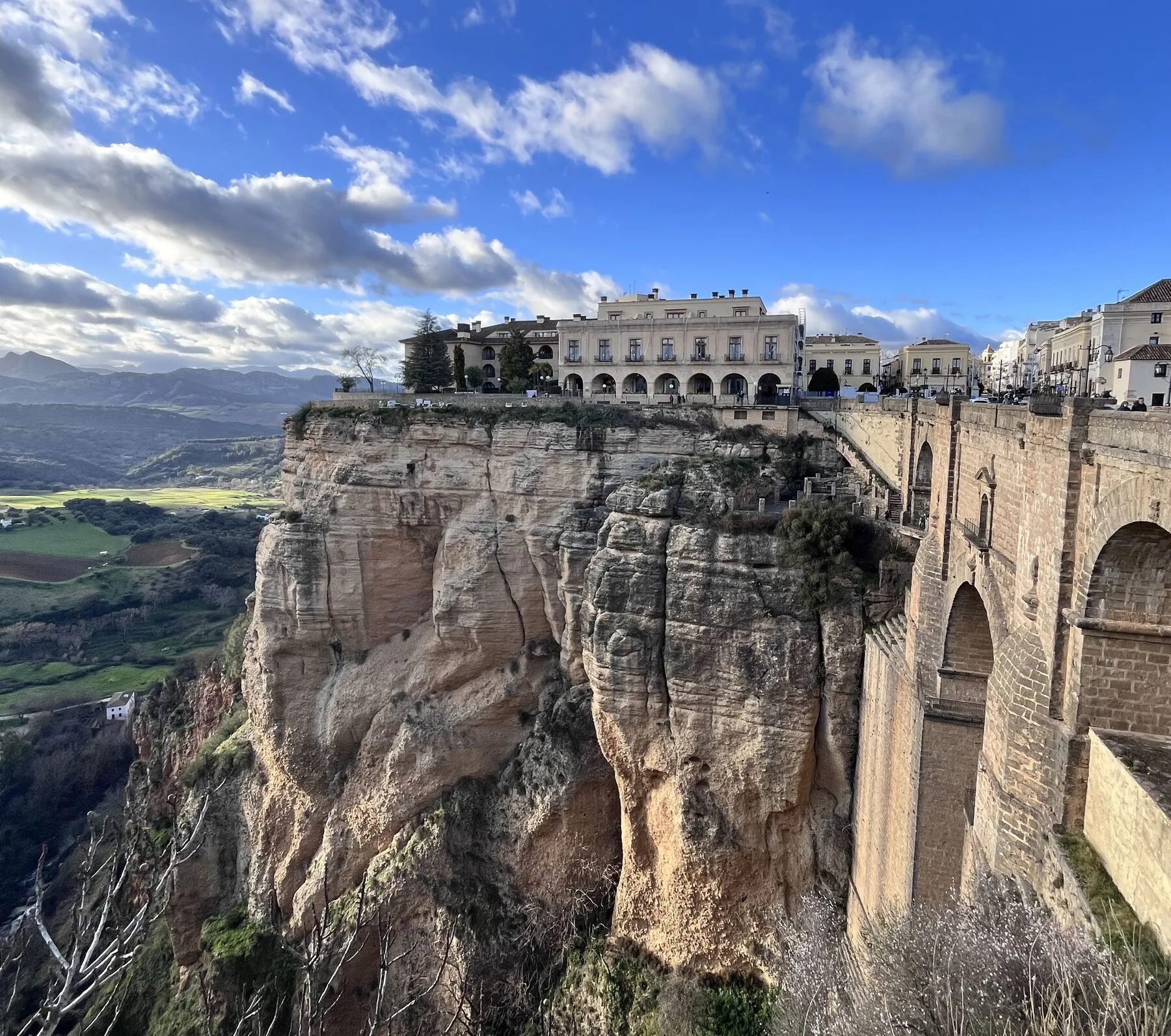
What makes Ronda, a town in the province of Málaga, so remarkable is its location. The city sits on both sides of El Tajo Gorge, carved by the Guadalevín River and reaching depths of more than 100 metres in places. Spanning the gorge is Puente Nuevo, the bridge that connects Ronda’s old and newer quarters and has become the city’s most recognisable landmark.
We had the rest of the afternoon and evening to explore Ronda on foot. Puente Nuevo was, of course, at the heart of our route, but there is much more to Ronda than its famous bridge. We’ll visit Plaza de Toros, one of the oldest bullrings in Spain, take in the views over the Guadalevín Valley, wander through the historic streets of La Ciudad on the other side of the bridge, and finally see how Ronda changes after dark.
Ready? Let’s start.
🏨 Where We Stayed in Ronda
Since we were staying in Ronda for just one night and planned to leave for Málaga early the next morning, our priorities were simple: we wanted somewhere reasonably priced and a safe place to park our car. Hotel Arunda II ticked both boxes.

The hotel has double rooms, so we booked two rooms for our stay. It’s about a 10-minute walk from the centre of Ronda, and there’s a large car park right in front of it. The parking fee was also quite reasonable, which was a definite plus since we were travelling by rental car.
When we arrived in Ronda, we parked the car there and checked in. We weren’t planning to spend much time at the hotel anyway, so as soon as we dropped off our bags, we headed straight back out and walked towards the centre of Ronda.
🌉 Puente Nuevo
After leaving our hotel, we started walking towards the centre of Ronda. We made our way through the narrow streets and eventually reached Puente Nuevo. We had seen the bridge countless times in photos, but standing there with the bridge and El Tajo Gorge right in front of us was far more impressive. Photos really don’t capture the sheer depth of the gorge or the scale of the bridge. We stood there staring at the view for quite a while.

Construction of Puente Nuevo, Ronda’s most famous landmark, began in 1759 and was completed in 1793. The bridge spans El Tajo Gorge, which is around 100 metres deep, and connects La Ciudad, Ronda’s old town, with the newer district of El Mercadillo. The name “New Bridge” might sound a little strange for a structure that is more than two centuries old, but Ronda also has two much older bridges known as Puente Viejo and Puente Árabe.
Once we stepped onto the bridge, we found two completely different views opening up on either side. In one direction, a vast valley stretched as far as we could see, with fields, forests and small villages scattered across the landscape, while the Guadalevín River wound its way through it all. Low clouds hung over the valley, making the view even more dramatic.

Turn in the opposite direction and the landscape changes completely. Here, El Tajo Gorge cuts deep and narrow into the heart of Ronda. On one side, an open valley stretching towards the horizon; on the other, a dramatic chasm squeezed between steep cliffs. Standing right in the middle of Puente Nuevo, you begin to understand just how extraordinary the landscape beneath Ronda really is.

Birds glide through the gorge while the sound of the Guadalevín River rises from somewhere far below. You may have seen Ronda countless times in photographs, but it’s only when you stand on Puente Nuevo that you can really take in the height, the depth of the gorge and the vast landscape surrounding you all at once.
🏛️ Plaza de Toros de Ronda
After leaving Puente Nuevo, it was only a few minutes’ walk to Plaza de Toros de Ronda. Opened in 1785, it is one of the oldest bullrings in Spain and played an important role in the development of modern Spanish bullfighting.
By the time we arrived, the bullring was about to close. Before letting us in, the staff told us we would have only 20 minutes to look around. It wasn’t much time, but we decided to go in anyway — and we were glad we did.
Once inside, the first thing we saw was the large sandy arena surrounded by stone stands. After walking through the passageways beneath the stands and seeing the gates through which the bulls once entered the ring, we stepped onto the sand and walked all the way to the centre of the arena.
Bullfighting is a highly controversial tradition today, but Plaza de Toros remains part of the history of both Ronda and Spain. With only 20 minutes, we had to make our visit fairly quick, but given how close the bullring is to Puente Nuevo, it’s an easy stop to include while exploring Ronda.
🌄 Mirador de Ronda
After leaving Plaza de Toros, we walked just a few minutes to Mirador de Ronda. Unlike the deep, narrow El Tajo Gorge we had seen from Puente Nuevo, the landscape here opens up completely, with the Guadalevín Valley stretching out in front of us.
From the viewpoint, we could see small settlements below, along with olive groves, fields and roads winding their way through the valley. It was essentially the same vast landscape we had seen from Puente Nuevo, but now from a slightly different angle.
What makes Mirador de Ronda particularly impressive is that, despite being right next to the town centre, there is almost nothing obstructing the view. Walk right up to the railings at the edge of the cliff and you’re reminded once again just how high above the surrounding landscape Ronda was built.
🏘️ La Ciudad: Ronda’s Old Town
After leaving Mirador de Ronda, we returned to Puente Nuevo and crossed the bridge into La Ciudad. This is the oldest part of Ronda, and it feels noticeably different from the livelier El Mercadillo district on the other side.
The traces of Ronda’s long history are still visible in the streets of La Ciudad. The period when the city was under Muslim rule, in particular, played an important role in shaping this part of Ronda. As we wandered through narrow streets lined with whitewashed houses, wooden doors and wrought-iron details, it became clear that there is much more to Ronda than Puente Nuevo.
Following the streets through the old town, we eventually reached Plaza Duquesa de Parcent. At the centre of this tree-lined square is a small fountain, with historic buildings and benches surrounding it.

The most prominent building on the square is Iglesia de Santa María la Mayor. Built on the site of a former mosque, the church is one of the buildings that reflects Ronda’s transition from Muslim to Christian rule. We didn’t go inside, choosing instead to explore the square and the surrounding streets.
In La Ciudad, we found it much more enjoyable to simply wander through the streets rather than trying to get from one sight to the next. The area isn’t particularly large either, so before long you’ll find yourself back at Puente Nuevo.
🌙 Evening and Night in Ronda
As we wandered through La Ciudad, the sun slowly began to set. By the time we returned to Puente Nuevo after dark, the view we had seen only a few hours earlier had completely changed. El Tajo Gorge, whose full depth had been visible during the day, had disappeared into the darkness, while the illuminated Puente Nuevo stood out more dramatically than ever.

So, if you’re spending a night in Ronda, I definitely recommend returning to Puente Nuevo after dark. You get two remarkably different views from exactly the same spot, just a few hours apart.
After leaving the bridge, we continued our evening walk along Carrera Espinel in the centre of Ronda. This long pedestrian street is lined with shops, souvenir stores, cafés and restaurants. One quick note: the shops here close fairly early, so keep that in mind when planning where and when to have dinner.
We browsed a few shops, picked up some small souvenirs for the kids and then had dinner. And that was how we brought our long day, which had begun that morning in Seville, to an end on the streets of Ronda. Since we were heading to Málaga early the next morning, we returned to our hotel after dinner and called it a night.
🏔️ Saying Goodbye to Ronda
Ronda isn’t a particularly large town. Its main sights, including Puente Nuevo, Plaza de Toros, Mirador de Ronda and La Ciudad, are all within walking distance of one another. So, if you arrive in the afternoon as we did, half a day is enough to see the city’s main highlights and explore at a comfortable pace.
If you’re driving to Ronda from the Marbella direction, be prepared to spend some time on winding mountain roads. But once you’re standing on Puente Nuevo, looking down into El Tajo Gorge on one side and across a valley stretching for kilometres on the other, the journey feels well worth it.
Spain is full of beautiful cities, grand squares and historic buildings, but Ronda’s geography is something else entirely. Having such a deep gorge running straight through the middle of a city, crossed by a massive stone bridge, makes Ronda a difficult place to forget.
For us, Ronda was one of the stops we had been most curious about on this journey, and once we finally saw it, we understood why it had become so famous. If your travels take you through southern Andalusia, add Ronda to your route even if it means making a bit of a detour. I think the view here is one everyone should see at least once in their lifetime.
Explore More
→ Andalusia Road Trip & Travel Itinerary — Discover our complete journey through Andalusia, including Ronda, with our route between cities, where we stayed and everything we experienced along the way.
Yorumlar
Comments